Elijah Clarence Santos '26
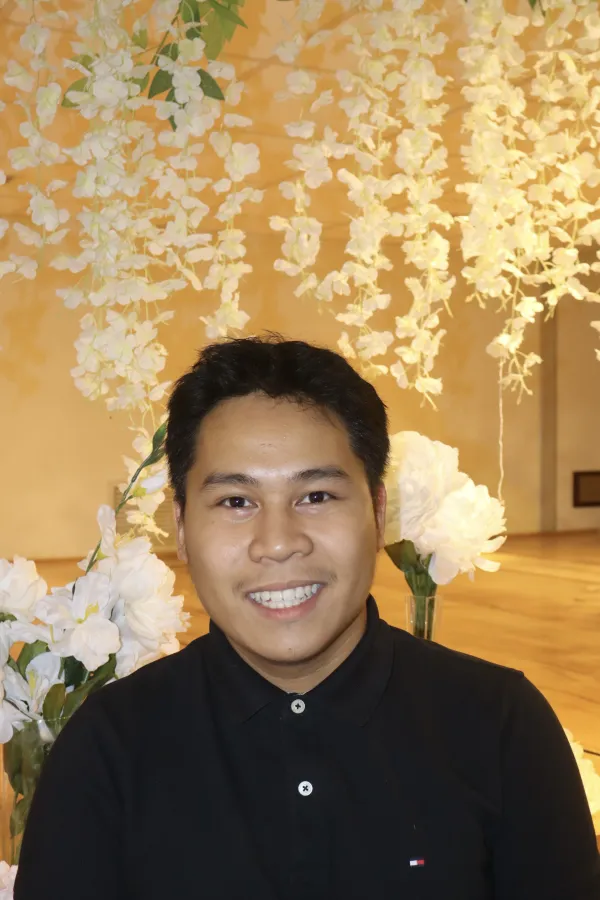
Elijah Clarence Santos ’25 began his journey with music before birth, when his mother played classical music in headphones pressed to her pregnant belly. His interest grew as he did through elementary and middle school, playing on an electric keyboard by ear. Growing up in Guam after moving from the Phillipines, Santos participated in middle school song contests in Chamorro – Guam’s national language – and English. In high school, he was a choral tenor leader and president of the band club.
In his sophomore year of high school, Santos discovered he has perfect pitch: the ability to identify and re-create any pitch without reference. "It’s sort of a cheat code,” Santos said, explaining that the ability helped him develop before he had access to classical training. “I guess it’s why I'm able to pick things up by ear.” Despite this prior experience, it wasn’t until arriving at Swarthmore that he began taking formal vocal lessons.
Santos, an aspiring civil or structural engineer, chose Swarthmore to be able to study both engineering and music; he is now an engineering major and a music minor. In the beginning, it was difficult to switch between classes like mechanics and music theory, especially since both engineering and music courses involve lab components. However, the experience has been rewarding. “I feel like I wouldn't be fulfilled if a day goes by without music.”
At Swarthmore, Santos began with Music 002, a course covering the elements of music notation, theory, and sight-reading, which laid a solid foundation for his later studies. Not quite ready for Music 048—private lessons subsidized by the Music Department—Santos took advantage of the Stott Beginners Program. The program helps students who’ve not received formal training prepare for the rigors of private lessons. There he met and received tremendous support from his vocal coach, Clara Rottsolk. Rottsolk recently left Swarthmore to become an assistant professor of the practice of music in voice at Duke University.
“[Rottsolk] was the one who introduced me to Bel Canto type of singing, more operatic,” Santos said. “My first classical piece was an Italian art song. Since then, I fell in love with that style of singing, and I wanted to keep going and hone my instrument.”
Preparing songs in languages other than English can be challenging, but Santos strives to understand the meaning of the songs and work through subtext. “I feel like once all the pieces fit together, the most important part for me is just enjoying the performance and telling the story,” he said. “Regardless if you understand the language or not, as long as I convey the feeling or the message, then I feel accomplished.”
Santos has performed with the Garnet Singers and Critical Mass while at Swarthmore, and is now focusing on preparations for his senior recital in February. He’ll be performing three sets: all five Italian art songs learned from Rottsolk (three accompanied by Nico Johnson); a set of five Shakespeare songs by composer Roger Quilter; and some Filipino music as well.
“I'm really excited about that. I don't think I've sung in public in my mother tongue [since] some cultural or music contest back in second grade,” Santos said.
Santos will perform his senior recital on February 28, at 8 p.m. in Lang Concert Hall.
--
Favorite music class? I think it might be the one I'm taking right now, which is called Music, Race, and Class. It's with Professor Lei Ouyang. It's a very thought-provoking class. I think it really made me think more about the faces and the people behind music genres and really enabled me to draw connections to the world. We looked at several case studies already about music from apartheid South Africa, or taiko music back in Japan in Osaka. Now we're looking at these Hawaiian song contests in the Kamehameha Schools where they try to provide a holistic education [and preserve the Hawaiian culture and language]. More than anything, the class has shown me that music is more than just sound, there's feeling to it, there's culture, it definitely has links to social identities and systems of discrimination or systems of oppression.
Favorite music making experience? Music 48 has been my favorite music-making experience, almost four years of doing that was just like the highlight of it all. I've never gotten classical vocal training, and this was like the perfect opportunity to finally do it.
What you'll miss most about Swarthmore? Now I'm getting emotional. The people, the scenery, I'm going to miss Underhill library. I already miss my vocal coach Clara, but I also miss my current vocal coach, Dr [Liangjun] Shi, who has truly helped me realize my abilities as a tenor, and Debra Scurto-Davis, my long-time collaborator.
What sound or noise do you love? I think the sound of Tagalog and Ilonggo, which are two Filipino languages. I like the sound of both, especially when I hear my aunt or parents talking. Not to be cheesy or anything.
What sound or noise do you hate? I hate silence. Unless I really need to focus then I'll sit with it.
What's the last song you played on your phone? "La Perla" by Rosalía