American Martyr Cantata
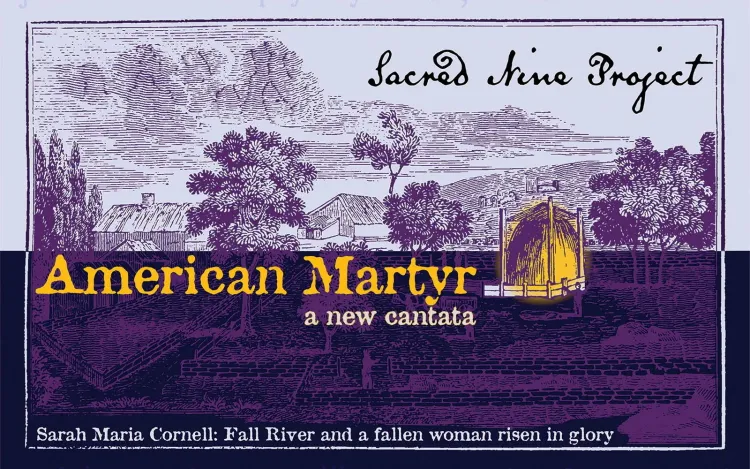
The Swarthmore College Music and History Departments, with the William J. Cooper Foundation, are pleased to announce the performance of Tulane University professor C. Leonard Raybon’s musical work, American Martyr: A New Cantata, on Friday, March 27th, at 8 pm in the Lang Concert Hall. The world premiere will be accompanied by interactive programming in the History Department, inviting audiences to reflect on the relationship between sound and word, story and history, and performance and representation.
Inspired by Swarthmore history professor Bruce Dorsey’s recent book, Murder in a Mill Town: Sex, Faith, and the Crime that Captivated a Nation, Professor Raybon’s multifaceted composition chronicles the life of Sarah Maria Cornell, a 19th-century New Englander whose violent death and the subsequent murder trial of a Methodist preacher captivated the nation. Her case unfolded with a sensationalism typical of today’s true crime documentaries.
Like Professor Dorsey’s book, Raybon’s piece seeks to move beyond the spectacle of Cornell’s life, reclaiming her story with greater care and complexity. According to Raybon, American Martyr aims to “beatify her, to try to right all the ills against her retroactively, to temper the sensationalism of her story with heart and understanding.”
Professor Dorsey was thrilled to have his work adapted in this way. Having originally taught Murder in a Mill Town as a class at Swarthmore, he values the intellectual opportunities and thematic depth that the narrative has to offer, especially in our current moment. “It's an honor,” he says, “... because I always thought this was a story that connected to the present day. It speaks to things we're concerned [about], such as who's to be listened to and trusted and whose word matters in cases of sexual crimes that happen.”
In five sections, American Martyr: A New Cantata recounts the life and times of Sarah Maria Cornell. Arranged for a quartet of singers, a keyboardist, and a chorus, Raybon’s music engages the traditions of Christian worship hymns and the Broadside.
“You will see the word ‘Broadside’ a lot,” adds Raybon. “Sometimes called Broadside Ballads, Broadsheets, [or] penny ballads, they evolved out of minstrelsy in the Renaissance. By the 17th century in England and then America, these terms denoted a single sheet of cheap paper on which was written a narrative poem that would often suggest a tune to which to sing the poem. These verses would often tell a story, hence the word ballad, and would often reflect current events. They were available on the streets, by vendors. Maria’s story spawned a lot of these.”
To Dorsey, music is an animating force. The “social drama” of Maria Cornell’s case lends itself to musical storytelling. “It makes people tell tales and think about ways they relate to their lives,” he says. “One of the best ways they did that was through music … they could think about how a song might trigger our connections to certain emotions.” Equally powerful are music’s narrative capacities, especially in historical contexts, where it creates space for overlooked subjectivities to emerge. “People are making up their own history as it's happening,” says Professor Dorsey. “That's partly what songs do, too. They allow you to interpret the world in an artistic way.”
Audience members at the premiere of American Martyr may recognize some old, familiar faces on stage at Lang Concert Hall. “The quartet of soloists,” says Swarthmore College Chorus Director Nathan Reiff, “are all Swarthmore alums … who are returning to campus to premiere the piece with us.” Former students Olivia Scarozza ‘25, Ava Pressman ‘25, Yixin Cui ‘25, and Greg Boatman ‘23 will sing alongside Hsiao-Han Yang, on piano and organ, and the Swarthmore College Chorus.
“It’s been very rewarding,” Reiff says in reference to working with the Chorus in preparation for the performance. “[The Chorus was] really open to new music and to [trying] new things, to encountering things that were, in some cases, very different from … music that they had done before.”
Remarking on the fact that the work will be a world premiere, Reiff adds, “It's always really exciting to be in the room for the first time a piece of music is ever performed. This is a large work that's a series of smaller pieces that all fit together. It's going to be something really special as it all comes together. And especially also to have the composer, to be part of the process in person on campus, and not only here working with us …, but also to actually be part of the performance too [will be] really special.”
When listening to the performance, Professor Dorsey recommends that audiences consider the voices of the historian and the composer as distinct and unique, but to avoid discrediting their own. “Murder in a Mill Town is my story of this case,” he says. “[The] musical composition American Martyr is Professor Raybon’s … listen to it; it’s our tale, but maybe it's your tale too.”
The performance will take place on Friday, March 27th, at 8 pm in the Lang Concert Hall. Admission is free and open to the public.