Jody Joyner: By the Book
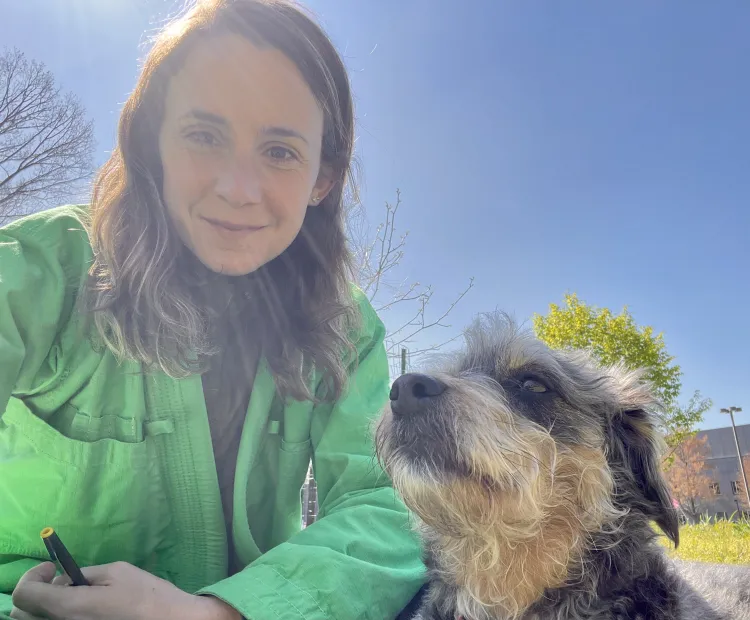
Assistant Professor of Art Jody Joyner teaches courses in sculpture, environmental sculpture, installation, wood, metal, and casting. Jody and her dog Judy love being outside, seeing art, reading, listening to music, and watching films.
What are you reading these days? I’m quickly reading On the Calculation of Volume IV by Solvej Balle and very slowly reading a biography of James Baldwin published last year called Baldwin: A Love Story. The recent Moby-Dick read-a-thon on campus inspired me to listen to the audiobook in my studio. I have two hours (about eight chapters) to go!
Describe your favorite place to read on campus: I mostly read at home in the morning. When I do read on campus, my favorite nook is behind Whittier, not the meadow, but a little lawn adjacent to it.
Is there a book you've read multiple times? As a little kid I reread my favorite book, Where the Red Fern Grows. Today, I don’t often reread books because there's always something else I want to read for the first time. Sometimes I’ll read a book on the page after listening to the audiobook.
Is there a book you pretend to have read? I once pretended to have read Susan Sontag’s On Photography. It’s classic art theory. This interview is reminding me to consider it (once again) for my summer reading.
Who is your favorite author? Changes often, but at the moment Annie Ernaux, Jon Fosse, Olga Tokarczuk, and Proust are favorites.
What's the latest book you could not finish even though you thought you should? Seeing is Forgetting the Name of the Thing One Sees by Lawrence Weschler is a very interesting book about the artist Robert Irwin. It’s mysterious to me as to why I keep losing the thread of this one.
What literary character would you most like to be friends with? Asle, the mystical narrator in Jon Fosse's Septology. He's an abstract painter with a doppelganger (a true shadow self in this case) also named Asle. We'd brood over topics like art, love, death, God, and memory. Septology is set in Norway, so obviously we're hanging out there in this budding friendship!
Do you have a literary nemesis? Not so much a nemesis, but sometimes I intensely dislike how artists and writers are portrayed in novels. I loved the form of Catherine Lacey’s Biography of X, but could not stand how the character X was written. Same with Irena Rey in Jennifer Croft’s The Extinction of Irena Ray. These characters felt like trite representations of the self-absorbed artist or writer, despite each inhabiting unusual worlds.
What is your favorite reading genre? Right now, literature in translation and some art-adjacent fiction. Small Rain by Garth Greenwell is a profound art-adjacent read.
What book do you recommend most often? I’ve somewhat recently become the person who recommends you read Proust's In Search of Lost Time. After hearing it referenced by many artists over many years, I finally took the plunge when I was on sabbatical last year. This is the book I most want to be forever reading and re-reading as an adult. In Search of Lost Time is a true work of art.
What's the best movie adaptation of a book you've read? Cheat answer: I loved the 2022 film Women Talking and have been meaning to read the book ever since. Another one I can thank you for reminding me to add to my summer list!
What author would you like to meet and what would you ask them? I recently read The Hearing Trumpet by Leonora Carrington (surrealist painter and novelist). I’d love to meet her and ask her about the relationship between her painting and writing. She and Max Ernst were lovers before he fled the Nazis, emigrated to New York, and married Peggy Guggenheim. Leonora Carrington later lived in Mexico City and was a part of the women’s rights movement there, all of which I’d be curious to hear more about.
What book made an early impact on you and why? As a child, a book series that made an early impact on me was The Boxcar Children. I wanted to live in their world and turned the closet of my bedroom into a boxcar for months? Maybe years? Would have to fact check with my mom…. Later on, Eudora Welty’s One Writer’s Beginnings. The way she wrote about curiosity and attention made me want to become an artist.
What is one lesson you learned from a book that you think everyone should know? In Search of Lost Time taught me more about perception and the ways art can transform everyday life than any other book. I felt a lot of this most profoundly at the end of the novel (don’t give up halfway through!).