- Tips
Jury members prioritize collections that express a well-defined focus and a unique approach. Children’s literature could be a fine collection, but illustrated children’s literature featuring friendships between humans and animals could be a prize-winner. Judges reward specificity and genuine enthusiasm. Pro tip: use winter break to gather books to bring back to campus!
- Collection
Your collection must consist of no less than 20 and no more than 30 books.
- These numbers may include up to 5 “wish list” titles that would fit in your collection.
- Textbooks may be included if appropriate but should not constitute a majority of the collection.
- All books should be physical, print editions, rather than e-books.
- Essay
Write a one-page personal essay that defines the theme, framework, and scope of your collection.
Questions to guide your writing may include:
- How did you become interested in the subject of your collection?
- How do you position yourself as a collector?
- Where and under what circumstances did you acquire these books?
- How does this collection fit in with your interests as a student and your role as a member of intersecting communities?
- Annotated Bibliography
Your bibliography must be consistently formatted according to a citation style, such as MLA or Chicago (consult our research guide on citation to select and apply the style you will use).
Your formal citations should be accompanied by descriptive annotations, addressing how each book relates to the rest of the collection, and, if not explained in the essay, how, where, when, and why each book was acquired.
- Deadlines & Prizes
Prizes
1st Prize: $1,500
2nd Prize: $1,200
3rd Prize: $1,000Please submit a PDF, Word doc, or Google doc. via email to Outreach Librarian Abbie Weil, aweil1@swarthmore.edu by 11:59 pm on Sunday, February 1.
2026 Prize Winners
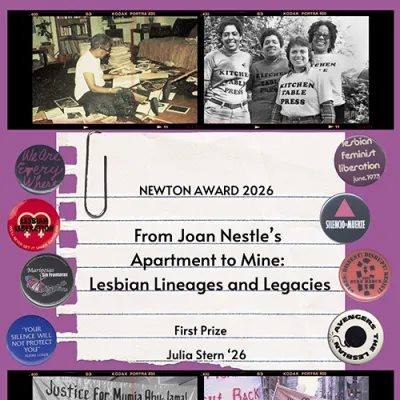
From Joan Nestle's Apartment to Mine:
Lesbian Lineages and Legacies. "Lesbian archiving asserts a sense of home and rootedness for lesbians across time, while also protecting materials by providing them with a physical home."
Read Julia's essay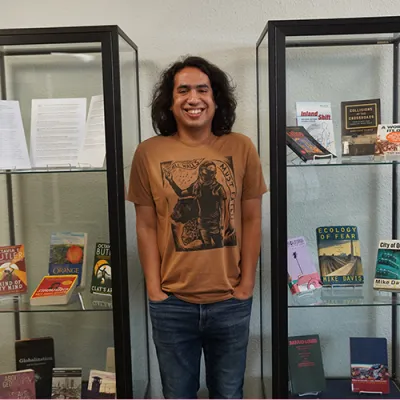
The Books that Brought Me Back Home:
Books about geography, urbanization, race, and space in greater Los Angeles. "These are the books that brought me back home. Not in a physical sense, but in an intellectual and emotional one."
Read Anthony's essay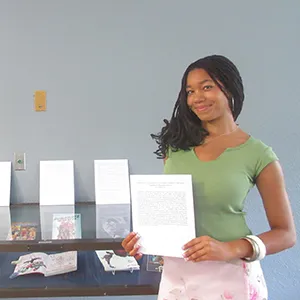
Who Gets to be a Hero?
A collection of BIPOC, Feminist, Superhero representations. "White supremacy wants you to believe there is one type of hero... And I kick myself for it, but I am super obsessed with superheroes."
Read Zuri's essay