John Alston H'15 is feeling the weight of retirement. After 32 years of leading the Chester Children’s Chorus, the melancholy of stepping away has settled in. But those emotions are secondary for now: There’s still work to be done.
Sitting in the familiar rehearsal space on the second floor of 715 Harvard Avenue on a recent spring day, Alston was focused less on endings than on the three spring performances that remain, before his final concert Saturday afternoon of Alumni Weekend.
What matters most to him now is the music itself — making these last performances worthy of the children’s efforts, and of the program he built.
“I want these shows to be the best shows ever,” he says, “and for me to be the best musician I’ve ever been at my last show.”
That focus on craft over ceremony feels characteristic of Alston, whose career has been defined less by sentimentality than by steady, relentless work. Even as retirement approaches for him this summer, he speaks less about legacy than momentum.
“I just want to keep it going,” Alston says. “I don’t want to have that Michael Jordan moment where I stayed too long. I want people to be grateful that I did the work and thankful that the new team is taking over.”
That transition, he emphasized, has been deliberate. Planned over several years, it reflects a program that has grown beyond any one person.
“This whole moment… it feels about as good as we all could imagine it would,” Alston says. “It hasn’t been too messy. We love each other. The team… they’re incredible.”
Today, the Chorus depends on a robust staff, including Sean Tripline, who served as assistant music director for the last 13 years and will become artistic director this summer; and Dana Semos, managing and education director since 2018, who becomes executive director. With continuity between them and the rest of the “super team,” says Alston, optimism abounds.
“Ten years from now, we’ll be twice as good as we are now,” he adds. “More than I ever could have imagined.”
“We Saw One Another Immediately”
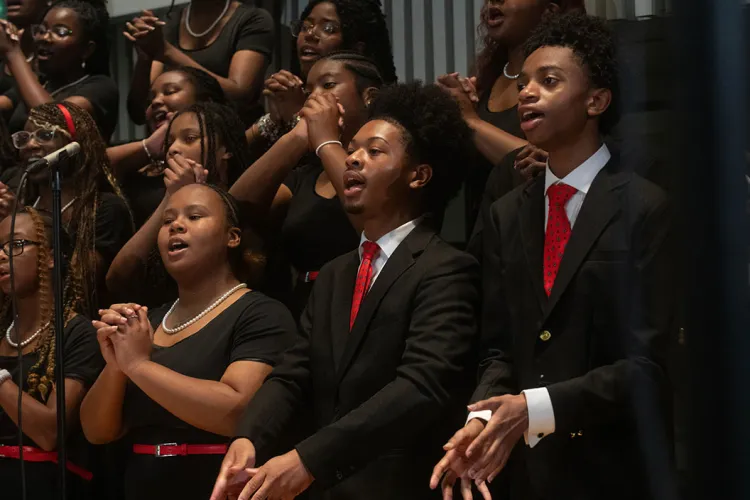
The story of the Chester Children’s Chorus is by now well known, but it still carries a kind of improbable energy. In 1994, Alston started what was then the Chester Boys Choir with seven children and little formal preparation.
“When I first started, I didn’t know anything about children,” he recalls. “We couldn’t sing a lick, but we saw one another immediately. We recognized each other’s sorrows. We recognized each other’s joys, and loved each other so quickly because we’d just been through the same stuff.”
From that beginning, the program has grown into a year-round institution serving children from Chester, grades three through 12. It blends choral excellence with intensive academic support — especially in math — that includes a five-week summer program that includes science, art, and swimming.
“We’re 110 children from Chester who love Mozart’s Requiem, the Beatles, and every year they make one to two years’ progress in math,” Alston says. “That is much of what anyone would want for their own children. We just want to keep adding to that.”
Still, Alston has always resisted romanticizing the chorus. Music, in his telling, is powerful — but not sufficient.
“It’s going to take more than a great performance,” he says. “For that moment, yeah, the world is perfect… but it needs to be like that much of the time for our children.
“My hope for this next iteration of chorus,” he continues, “is that we become the program that allows our children to live as long and as well as more affluent children in this country. That will be the goal.”
The future, as he imagines it, could include expanded academic offerings, more time during the school week, maybe even a day school on campus. But he speaks about those possibilities with patience rather than certainty.
“We know how to do what we’re doing right now, really well,” he said. “Now it’s just a matter of expanding our views of what might be possible.”
“It’s Being Able to Look at Something and Make It Better”

For all his focus on the future, Alston is clear-eyed about what he will leave behind.
“I’ll definitely miss the rehearsals,” he said. “When the kids light up, when they learn something new… sometimes they just sing the Lacrimosa from Mozart. They just bust into it just for fun. Man, who wouldn’t miss that?”
What matters in those moments is not simply musical achievement, but something deeper: the cultivation of discipline and care.
“It’s being able to look at something and make it better,” he says, “to say, ‘What do I have to do to make this right?’”
It is, in many ways, the core lesson of the Chorus — one that extends far beyond the rehearsal room.
Alston will conduct two of the Chorus’ spring concerts — on May 16 and 17 — before his final performance as part of Alumni Weekend. That program will close, fittingly, with music that bridges generations: “Hey Jude” and “Let It Be.”
“That was very much intentional,” Alston says.
He does not expect a dramatic farewell, at least not in the moment. Conducting demands too much focus.
“I don’t want to cry… we’ll be working too hard,” he said. “I just expect that it’ll be one of the best sounds I’ve ever heard, I’ve ever felt. And that’s how I want to go out.”
He pauses, leans back in his chair, and imagines it more fully.
“That sound in my face and my body and my soul … ‘Wow, you sound extraordinary. This is really nice. Thank you.’ And I’m going to thank them.”
Maybe, after that, the emotion will come. Standing before a chorus he built, surrounded by sound, focused not on endings but on the quality of the moment — maybe that will feel like resolution. Not an ending, but a passing forward.
“But before all that,” says Alston, “I’m just enjoying the music.”