Cohesion and Community: Gamelan Semara Santi Returns
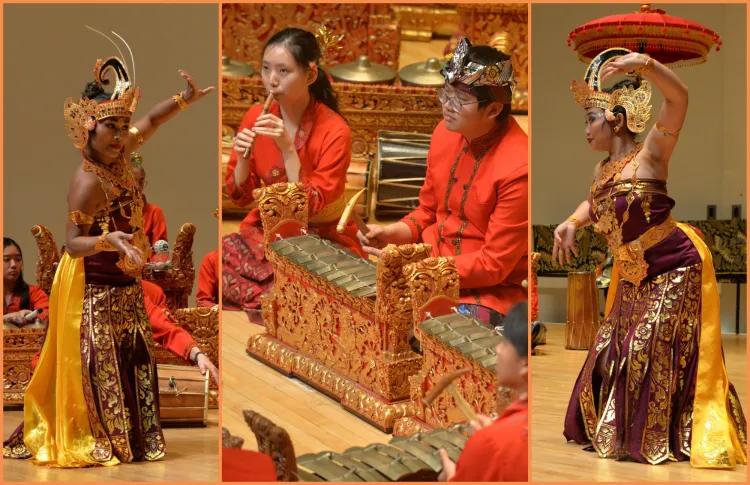
Swarthmore College’s Gamelan Semara Santi was formed in 1997 by professor Thomas Whitman and Balinese teacher and drummer I Nyoman Suadin. Since its initial founding, Gamelan Semara Santi has become a wide-reaching and vibrant communal ensemble, including dancers from the Indonesian Cultural Club of Delaware. Whitman, Suadin, and DC-based dance director Ni Luh Kadek Kusuma Dewi, direct the ensemble together. On Sunday, November 22, Gamelan Semara Santi will take the Lang Concert Hall stage once again for a lively performance.
Gamelan, a derivative of the Javanese word gamel (which means to strike or play with a mallet), refers to the set of traditional Indonesian instruments tuned to work together as an ensemble. Gamelan has ancient Indonesian roots, playing a crucial cultural role in organizing social time since its inception. Gamelan has been preserved through centuries and social moments because of its cultural value as an inherited practice. The music tradition has been institutionalized in Indonesian communities, arts schools, and universities. Furthermore, the Nusantra Museum points to the emergence of international ensembles, like Swarthmore’s own Gamelan Semara Santi, that keep the tradition alive.
Professor Whitman reflected on the impetus to create the Gamelan Semara Santi at Swarthmore, stating that the ensemble provides accessibility to all levels of musicians and encourages cross-cultural learning. By 1997, the process of creating the ensemble was underway. Swarthmore commissioned the necessary instruments from a master musician and instrument maker in Bali. Whitman then visited him in January of 1997, which served as the basis for the formalization of the group. These instruments, which include bronze-keyed xylophones, suspended gongs, bamboo flutes, and drums, are what the ensemble still uses today, and what audience members will be able to observe at the upcoming performance.
Recruitment for the ensemble has been primarily a word-of-mouth process. Whitman notes that concerts tend to entice people to join, and those who have joined typically invite their friends to participate. Beyond Swarthmore students, other members of the broader Delaware County community have joined in the role of both musicians and dancers. The naturally expanding foundation of the Gamelan Semara Santi is one of the most gratifying aspects of the ensemble for Whitman, who appreciates “the sense of participating in a community that makes joyful sound together.” This emphasis on community in the orchestra aligns with traditional frameworks of Gamelan in Indonesia. Historically, it is only through its spirit of cohesiveness and mutual cooperation that the harmony of tones and rhythms that structure social Indonesian life can appear.
Beyond preparing for the approaching performance, some members of Gamelan Semara Santi have also been busy getting ready for their trip to Indonesia, happening over winter break as an embedded study. Their institutional partner and non-profit arts organization, Gamelan Çudamani, will be hosting the group for an exciting two-week program. From instruction in classical dance and shadow play theatre to courses in gamelan music and Indonesian visual arts, the group will be busy with a variety of activities planned by their host group. Their visit will also coincide with Galungan, one of the most important Balinese holidays, which will certainly serve as inspiration for future performances.
Sunday’s performance will include Joged, a Balinese social dance that Whitman says will request participation from the audience. They will also play an instrumental composition from the 1930s titled Sekar Gendot that “goes through a kaleidoscope of contrasting textures.” At the very least, this show will excite audience members, and at most, will recruit new members to the Gamelan Semara Santi. The performance will begin at 3 p.m. in Lang Concert Hall.