Album Release: Precious and Intelligent Metal, by Visiting Assistant Professor Quinn Collins
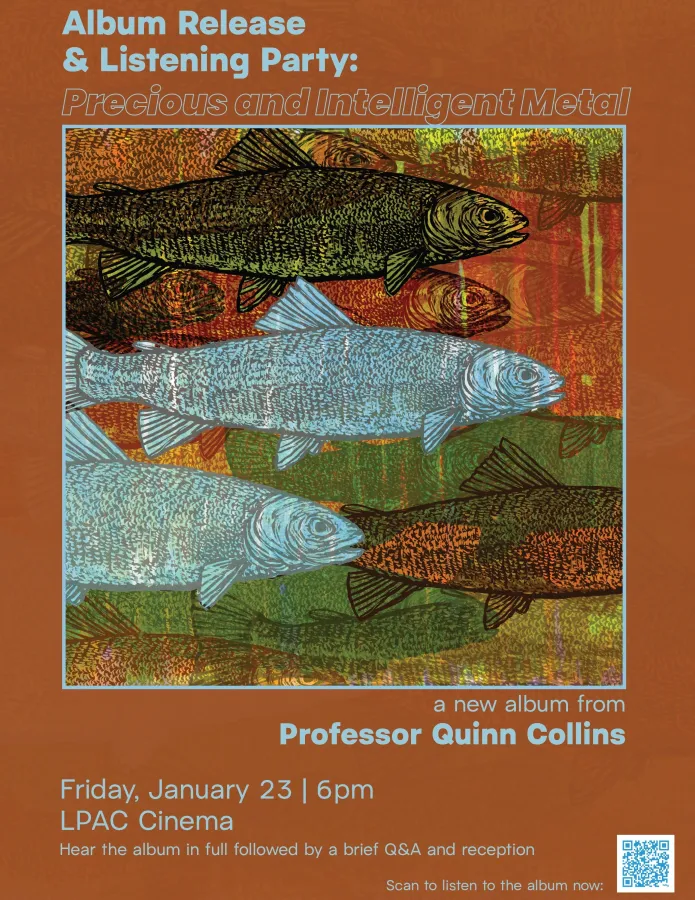
In January 2026, the LPAC Cinema transformed into an intimate listening room for an event held in celebration of the release of Professor Quinn Collins’s piece Precious and Intelligent Metal in album form. Audience members got the opportunity to listen to the full recording of the piece, after which Professor Collins opened up a Q&A session about his work and inspirations.
“It was mostly students that came, they asked really good questions,” said Collins, who teaches music composition and music technology courses at Swarthmore. One of those students was Alexander Hearn ’27, who has taken two classes taught by Collins.“[Professor Collins] had originally shown us [the fourth movement] in class, but it was really cool to then [hear] it with the rest of the whole album,” Hearn said. “It was a really good experience, very trance-like.” Hearn also noted that students got to play a lot of the instruments heard on the recording while in class.
Collins first began working on the piece as a part of his PhD dissertation in composition at Princeton University in 2015, expanding a single movement into a large-scale piece with five separate movements. In 2016, Collins oversaw and engineered the recording of the piece by a group of musicians at a studio in Princeton, but nothing was released. Almost 10 years later, Collins brought those sessions to friend Jascha Narveson, who edited, mixed, and mastered the piece, culminating in the album release in 2026.
The piece is written for a percussion ensemble, which, in the first and fourth movements, plays against pre-recorded electronics. Throughout the music-creating process, Collins took inspiration from writer Richard Brautigan’s novel Troutfishing in America, whose prose and poetry captured sentiments of the 1960s countercultural movement. Brautigan’s work gives equal presence to dark and light, sober and silly, an idea that is starkly evident in the different movements of the piece. Collins has long had an interest in Brautigan and has written other pieces inspired by his work in the past.
Hearn appreciated the “bizarre and funny” sources of inspiration in the piece. While Brautigan might be an “obscure” source of creativity, Hearn felt that its uniqueness made the piece more thoughtful.
The first movement, entitled “And Trout Fishing in America said, ‘The moon's coming out.’ And Maria Callas said, ‘Yes, it is.,’” is inspired by a section of Brautigan’s work that contains a list of numbers in a sequence. It is a catalog of trout fishing trips, all of which were unsuccessful, and Collins used this number series to dictate a series of chords played by the vibraphone in the first movement. Collins took inspiration from 20th century composer John Cage when composing using a number series.. While Cage’s music has a traceable numeric logic, however, Brautigan’s written number series does not. “I like the idea of trying to push the music into a frame that was difficult,” Collins said of the numeric framework in the first movement.
The second movement, “Another Method of Making Walnut Catsup,” is playful and upbeat, marking a dramatic shift in tone. Collins uses various sounds to pictorially represent the text, including two players playing a role on a wooden board and the sound of cracking walnuts. The movement also borrows from a small moment in Igor Stravinsky’s ballet Agon—a connection later found in the fourth movement, when Collins makes reference to ballet. “I wanted there to be connections between the movements that relate to the text,” Collins remarked.
Hearn picked up on this cohesiveness while listening to the piece. “You could really feel the connection between the music and the text that inspired it,” he said.
The third movement, “Like Frost on Iron Doors,” takes inspiration from a section of Braudigan’s text about dead, frozen fish floating in a bathtub. Collins uses tuned metal pipes to evoke an eerie and yet meditative atmosphere.“The Ballet for Trout Fishing in America” is the fourth and most raucous, aggressive movement. Like the opening movement, it contains electronic sounds and live percussion. A section of the second movement reappears in the fourth, but in a different light. The fifth and final movement, “The Mayonnaise Chapter,” is named after the final chapter of Brautigan’s novel. Collins initially buries the movement's melody then builds it slowly, one note at a time.
Collins emphasized the importance of collaboration in the creation of this album. The album’s cover art was done by Erik Ruin, a visual and theatrical artist who Collins has collaborated with musically as a bass player in Ruin’s Ominous Cloud Ensemble. As mentioned previously, audio engineer and composer Jascha Narveson edited, mixed, and mastered the recording. The percussionists on the record include Yumi Tamashiro on glockenspiel, melodica, bass drum, wooden board, pitched metals, Frank Tyl on toy piano, melodica, wooden board, pitched metals, Mika Godbole on vibraphone and pitched metals , and David Degge on hammered dulcimer, pitched metals. You can read more about the piece in Collin’s own words here.
Collins says that the creative process is a continuous force. “[It] is part of your life, it is happening constantly. Each piece you create is just a window into that.” Precious and Intelligent Metals demonstrates this sentiment well: after the first movement was completed in 2015 Collins decided to expand it and wrote four more movements over the next year and a half. It premiered at Princeton University in the spring of 2016, and now, in 2026 is being released in album form.