Josie Low, '27: By the Book
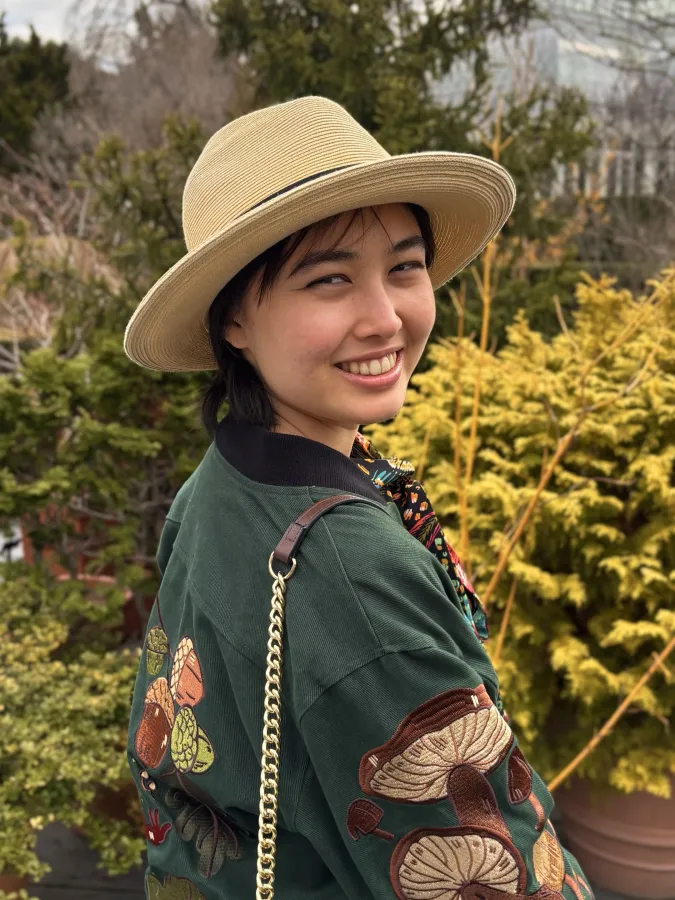
Josephine Sing Yu Low '27, who you can just call Josie, is a senior majoring in biology and environmental studies. She is an educational programs assistant for the Scott Arboretum & Gardens, a researcher in Professor Carolyn Bauer's lab, and a 2025 Moore fellow at Swarthmore Libraries Special Collections. For the past year, Josie has been organizing Swarthmore Fungi Fest, a weeklong Cooper Series event celebrating mushrooms and mycology, as well as a pop-up exhibit on the first floor of McCabe.
What are you reading these days? I’m recently devastated by When They Burned The Butterfly by Wen-Yi Lee. I’ve also been hanging out at Mind’s Eye Comics while I’ve been working in the Twin Cities this summer, and thoroughly enjoying reading and re-reading Paper Girls by Brian K. Vaughan and Cliff Chiang, The Magic Fish by Trung Le Nguyen, Marjorie Liu and Sana Takeda’s Monstress, and Jeff Smith’s Bone series. Otherwise, lots of microbial ecology journal articles (thank goodness for Tripod).
Describe your favorite place to read on campus: On a picnic blanket in the cherry border, on the bench by the goldfish pond at the Arboretum office, on a sun-warmed rock by Crum Creek…and if I have to be inside, then beside a window.
Is there a book you've read multiple times? So many! Lately I've been captivated by This Is How You Lose the Time War by Amal El-Mohtar and Max Gladstone. I notice something new every read.
Who is your favorite author? Robin Wall Kimmerer. Her writing has shaped who I strive to be as a scientist, a creator, and a human being in the larger world, and her visit to Swarthmore campus is by far a highlight of my college experience.
What's the latest book you could not finish even though you thought you should? Right now, A Day of Fallen Night by Samantha Shannon. It’s a prequel to The Priory of the Orange Tree, which I bought while abroad in Australia to keep me company in recovering from an unfortunate injury (side note, always be careful when jumping in puddles), largely because the 800-plus page behemoth looked like the best cost to page ratio in the bookstore. I really enjoyed Priory, but now that I’m back to the chaos of everyday life, I haven’t been able to keep track of the series’ worldbuilding, which includes a lengthy timeline, a glossary, and multiple family trees. Hopefully I’ll pick it back up in a calmer time.
What literary character would you most like to be friends with? Howl from Howl's Moving Castle, specifically the Diana Wynne Jones original, although I also adore the Ghibli adaptation. I think we'd get along marvelously over magic, maximalism, and melodrama.
Do you have a literary nemesis? Does my organic chemistry textbook count?
What is your favorite reading genre? I always gravitate towards the nature writing section. I’m particularly fond of works that blend memoir and nonfiction. In terms of fiction, epic fantasy and graphic novels.
What book do you recommend most often? Lately, Forest Euphoria by Patricia Ononiwu Kaishian has been an immense inspiration, and I've been lending my copy to as many people as I can.
What's the best movie adaptation of a book you've read? It’s actually not released yet, but I’m looking forward to Laika Studio’s adaptation of Wildwood this October. That series was one of my childhood favorites, and though I’m wary of cinematic adaptations that lose the soul of the original work, I’m a big fan of Laika. Project Hail Mary is also fantastic.
What author would you like to meet and what would you ask them? Entangled Life by Merlin Sheldrake was in many ways the catalyst for my obsession with fungi, so it feels surreal that he’ll be visiting Swarthmore as part of Fungi Fest this fall. I’m interested in his thoughts on fungal symbioses in the built environment, in comparison to the idealized nature often seen in documentaries. How do fungi and people shape their surroundings in competing ways, and can we bring our part of that relationship into balance? If you have questions, too, save them for October 1st, and come to Sci 101 at 6 pm! We’ll have tea and sweet treats, and excellent conversation also featuring Pennsylvania’s own conservation mycologist, Hannah Huber.
What book made an early impact on you and why? My favorite book growing up was a well-loved copy of Ronia the Robber’s Daughter. I spent hours imagining myself fearless in a magical forest, just barely evading magical dangers to return home safe and sound. Upon rereading, I’m impressed both by the timeless quality of Astrid Lindgren’s prose and how very young the protagonists are in hindsight. I still try to live a life Ronia would be proud of.
What is one lesson you learned from a book that you think everyone should know? I Contain Multitudes by Ed Yong is an excellent reminder that we are never alone, even within ourselves, when our bodies themselves are ecosystems of microbial diversity. I also found Evolution’s Rainbow by Joan Roughgarden a very moving argument that biology should never be used as a justification for human hatred, when the history of life shows clearly that there are infinite ways to exist in the world.