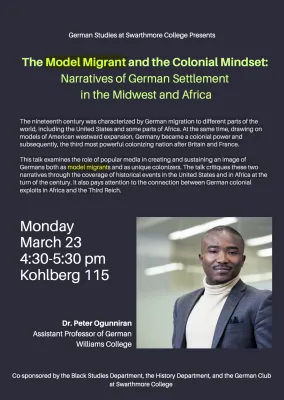
The Model Migrant and the Colonial Mindset: Narratives of German Settlement in the Midwest and Africa
The nineteenth century was characterized by German migration to different parts of the world, including the United States and some parts of Africa. At the same time, drawing on models of American westward expansion, Germany became a colonial power andsubsequently, the third most powerful colonizing nation after Britain and France. This talk examines the role of popular media in creating and sustaining an image of Germans both as model migrants and as unique colonizers. The talk critiques these two narratives through the coverage of historical events in the United States and in Africa at the turn of the century. It also pays attention to the connection between German colonial exploits in Africa and the Third Reich.
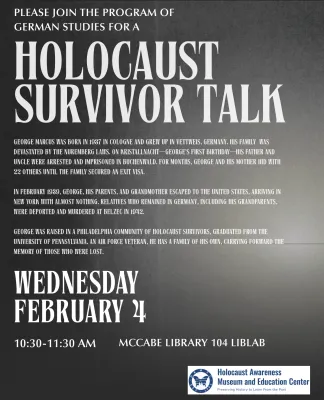
Holocaust Survivor Talk
George Marcus was born in 1937 in Cologne and grew up in Vettweis, Germany. His family was devastated by the Nuremberg Laws. On Kristallnacht – George’s first birthday – his father and uncle were arrested and imprisoned in Buchenwald. For months, George and his mother hid with 22 others until the family secured an exit Visa. In February 1939, George, his parents, and grandmother escaped to the United States, arriving in New York with almost nothing. Relatives who remained in Germany, including his grandparents, were deported and murdered at Belzec in 1942. George was raised in a Philadelphia community of holocaust survivors, and he graduated from the University of Pennsylvania. An Air Force Veteran, he has a family of his own, carrying forward the memory of those who were lost.
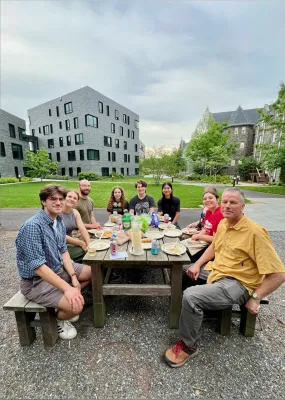
End-of-Semester Grillparty 2025
On May 12, 2025, the German Club, in collaboration with the German Studies Program, hosted an end-of-semester Grillparty, bringing together students, faculty, and friends to celebrate another successful semester. This outdoor gathering, filled with delicious food and great company, provided an opportunity to honor our graduating seniors, with special recognition for Nathanael Brown, who served as a dedicated German Club president and a committed German Studies tutor for the past two years. His leadership, enthusiasm, and support for German Studies at Swarthmore have left a lasting impact.
We wish all our graduating seniors the best in their future endeavors!
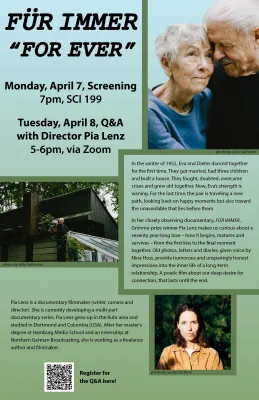
April 7 Film Screening of Grimme Prize nominated documentary Für Immer and Q and A Webinar with Director Pia Lenz on April 8
In the winter of 1952, Eva and Dieter danced together for the first time. They got married, had three children and built a house. They fought, doubted, overcame crises and grew old together. Now, Eva’s strength is waning. For the last time, the pair is traveling a new path, looking back on happy moments but also toward the unavoidable that lies before them.
In her closely observing documentary, FÜR IMMER, Grimme-prize winner Pia Lenz makes us curious about a seventy year-long love – how it begins, matures and survives – from the first kiss to the final moment together. Old photos, letters and diaries, given voice by Nina Hoss, provide humorous and unsparingly honest impressions into the inner life of a long-term relationship. A poetic film about our deep desire for connection, that lasts until the end.
Pia Lenz is a documentary filmmaker (writer, camera and director). She is currently developing a multi-part documentary series. Pia Lenz grew up in the Ruhr area and studied in Dortmund and Columbia (USA). After her master's degree at Hamburg Media School and an internship at Northern German Broadcasting, she is working as a freelance author and filmmaker.
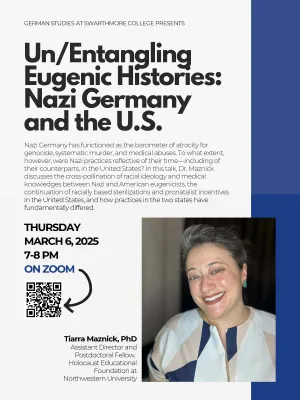
Online Talk: Un/Entangling Eugenic Histories – Nazi Germany and the U.S. (March 6, 2025)
On March 6, the German Studies Program will host an online talk examining the historical intersections of eugenics in Nazi Germany and the United States. Dr. Tiarra Maznick (Holocaust Educational Foundation, Northwestern University) will explore the transatlantic exchange of racial ideology and medical knowledge between Nazi and American eugenicists, the continuation of racially based sterilization policies in the U.S., and key distinctions between the two states.
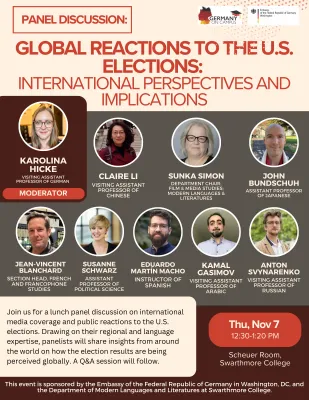
Post-Election Panel Discussion: “Global Reactions to the U.S. Elections: International Perspectives and Implications” (November 7, 2024)
On November 7, the College community participated in a post-election lunch panel discussion that focused on how the U.S. elections were perceived abroad. Professors from the Modern Languages and Literatures and Spanish departments shared insights on international media coverage, political commentary, and public reactions from countries within their language expertise.
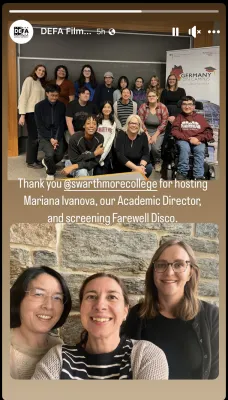
Film Screening & Lecture: Farewell Disco (October 27–28, 2024)
The German Studies section hosted a film screening and lecture on Rolf Losansky’s Farewell Disco (1989), an East German youth drama that explores environmental and social challenges in the late GDR. Dr. Mariana Ivanova (University of Massachusetts Amherst) provided insights into DEFA’s environmentalist films, highlighting their critique of state energy policies and their broader cultural significance. The event was organized with support from the Embassy of the Federal Republic of Germany in Washington, D.C., the Environmental Studies Program, and the Lang Center, fostering discussions on cinema, activism, and political engagement.