Establishing the Dynamics of the Gaze in Portrait of a Lady on Fire
Essay by Margaret Sawa '29 for Critical Approaches to Media Course in Fall 2025
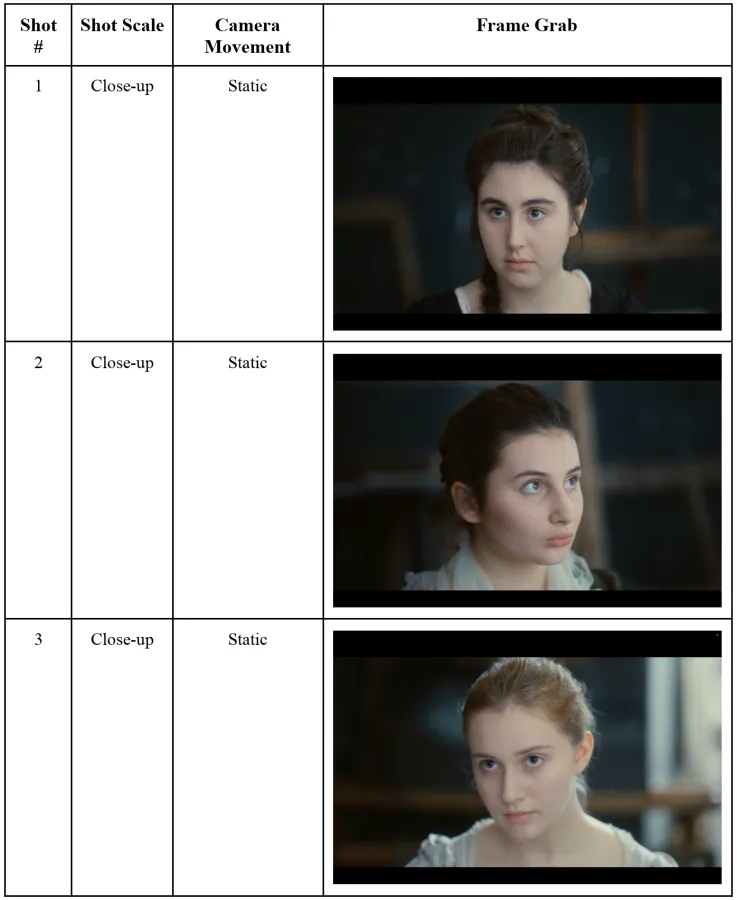
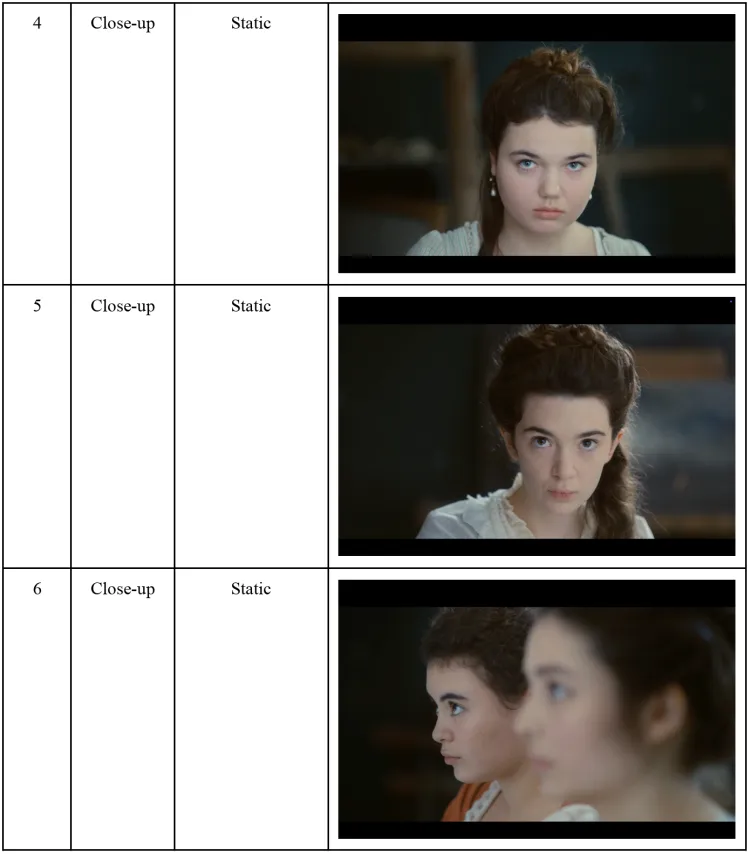
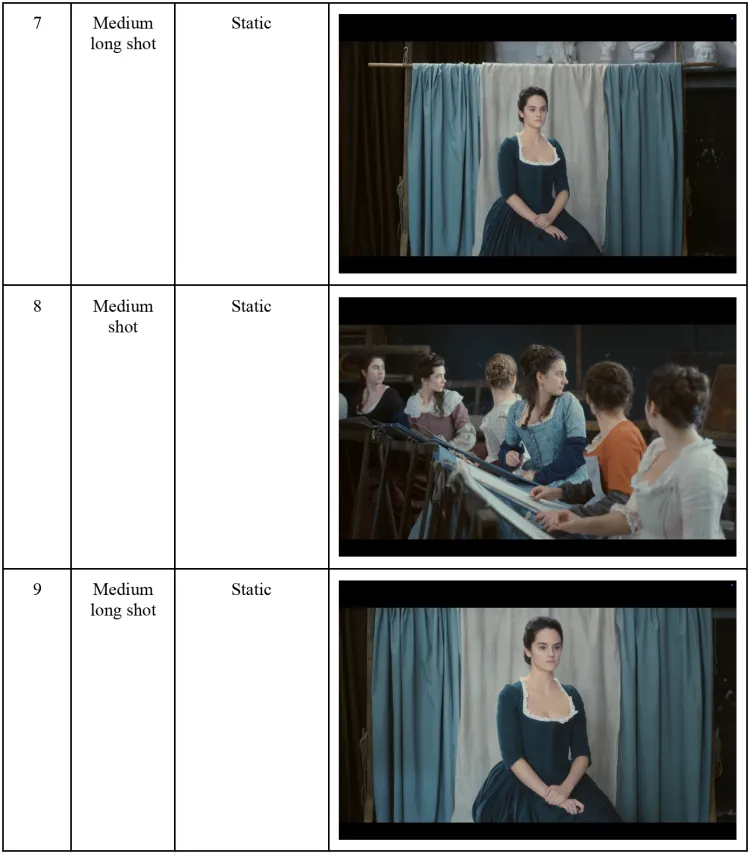
The opening scene of Céline Sciamma’s 2019 film Portrait of a Lady on Fire takes place, fittingly, in an art studio where a group of young women are learning to sketch a portrait. The first few shots of the film frame the face of each individual student as they continually switch their gaze from their sketch to some off-screen subject (presumably their teacher) who provides words of direction. In the seventh shot, the camera cuts to the subject and the audience is suddenly introduced to the film’s main protagonist, Marianne: a female painter and a figure of authority in this enclosed environment. From the very outset of her film, Sciamma already establishes an enduring theme of female agency and artistry against the backdrop of an 18th century setting dominated by men. The rest of the scene unfolds with the revelation of Marianne’s painting entitled “Portrait of a Lady on Fire” and the visceral reaction this triggers within Marianne, thus setting up the film as a recollection of lost love. These are only two isolated examples of how Portrait of a Lady on Fire’s opening scene serves to lay the foundation for the rest of the film’s roughly two hour runtime. Throughout the entirety of the opening scene, however, Sciamma also makes very purposeful use of the scale of each shot and camera movement in order to establish her commentary on the female gaze and the shifting power dynamics between “looker” and “looked-at.”
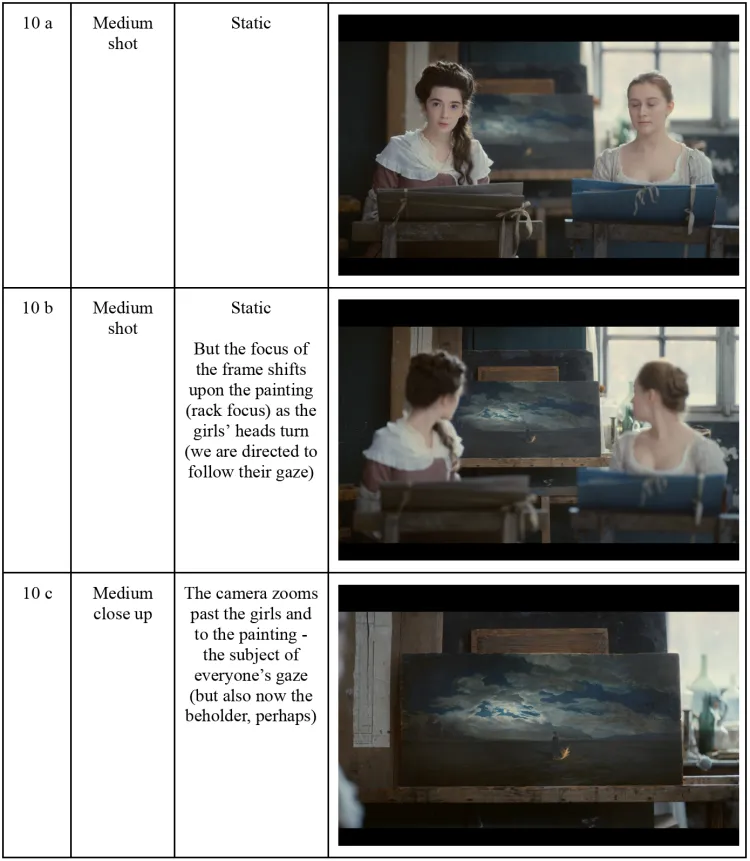
The opening scene of Portrait of a Lady on Fire initiates a very specific pattern in terms of shot scale that is continued throughout the rest of the film and utilized to convey important themes surrounding the female gaze. The pattern itself is deceptively simple: the “looker”, or the character who is looking at another character, is framed in a close-up or medium close-up shot while the “looked-at”, or the character who is being looked at, is framed in a long shot or medium long shot. In the first six shots of the film, the young women in the art class are each framed in a close-up shot that emphasizes their facial expressions and, most importantly, the very vehicle through which they can exercise their gaze: their eyes. In essence, they hold the power of the gaze and the audience, who is also engaged in the act of looking, feels more aligned with their perspective. The seventh shot reveals the subject of the students’ gazes to be Marianne and the fact that it is a long shot not only accentuates the point-of-view of the “lookers”, but also underscores her role as an object of their gaze. On top of this, the distance, combined with her positioning as a sitter for her art students, frames her as a subject in a painting, further signifying Marianne as an object of the gaze. This overall pattern that Sciamma establishes in the opening scene is most noticeably reflected in later scenes in which Marianne observes other characters that are sitting for her as she paints. Since it is Marianne’s gaze that is now emphasized in these instances, she is framed in a close-up or medium close-up shot that provides closer proximity to her eyes and face. The characters that sit for her are instead framed in a long shot, and they are thus signalled as the objects of her gaze. While these patterns can seem almost surface-level when understood only from this perspective, Sciamma quickly complicates all of this when she introduces the shifting nature of these power dynamics.
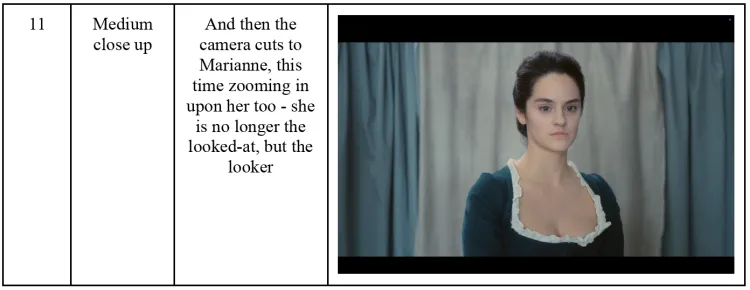
Through the use of camera movement, Sciamma also utilizes Portrait of a Lady on Fire’s opening scene to establish the way in which the roles of “looker” and “looked-at” are nearly interchangeable. After the revelation of Marianne’s painting, the tenth shot of the opening scene uses a rack focus to refocus from the faces of the art students to Marianne’s painting behind them; the painting is then framed in a medium long shot and it is temporarily emphasized as the object of everyone’s, including Marianne’s, gaze. However, the camera then zooms in upon the painting, framing it in a close-up shot and signifying it as an observer rather than an object of the others’ observation. The eleventh shot cuts to Marianne, who was previously framed in a medium long shot, and the camera also zooms in upon her, now framing her as the “looker” rather than the “looked-at”. Here, Sciamma uses camera movement, specifically zoom-ins, to represent the shift that occurs in real time from “looked-at” to “looker” or vice versa.
This concept is revisited and expanded upon in a scene much later in the film in which Héloïse, Marianne’s love interest and the subject of her portrait, sits for Marianne. At the beginning of the scene, Marianne, who is framed in a close-up shot, explains to Héloïse, who is framed in a long shot, all of the idiosyncratic mannerisms that she has observed in her. From the outset, there is a very specific power dynamic that is established: Marianne, the painter, is the observer and Héloïse, the sitter, is the object of her observation. However, Héloïse then instructs Marianne to stand beside her and look towards the easel where she was painting. The camera then zooms in upon the two women in the same frame as Héloïse details all of the mannerisms she has likewise detected in Marianne from her vantage point as a sitter. This specific use of the zoom-in signals a very important shift that occurs in the power dynamics between the two women: Héloïse is no longer the mere object of Marianne’s gaze; she is now reintroduced to the audience as someone who can freely exercise the gaze back at Marianne. Her role as 'looked-at' has effectively shifted to 'looker’, and the audience now understands that she can feasibly function as both. The inverse is true for Marianne, as well: she is now reintroduced as someone who is not only an observer, but also an object of Héloïse’s observation. By the end of this scene, the audience comes away with a much stronger, nuanced understanding of the ideas already introduced in the opening scene.
Through the combination of both shot scale and camera movement, Sciamma utilizes the opening scene of Portrait of a Lady on Fire to familiarize the audience with her ideas surrounding the female gaze and its complex, ever-shifting power dynamics. Sciamma’s use of shot scale in the opening scene establishes her method of visually communicating which character is the “looker” and which character is the “looked-at”. This pattern is then turned on its head when Sciamma introduces camera movement into the opening scene; the specific use of the zoom-in serves to illustrate the shifting nature of these two roles. Ultimately, the culminating result of Sciamma’s efforts is a poignant depiction of equality. The act of looking, both in an artistic sense and a romantic one, is highlighted as a reciprocal act that allocates an equal amount of power to both parties involved. This, in tandem with various other elements such as neutral camera angles, balanced dialogue, and a nearly all-female cast, rejects the traditionally imbalanced dynamic portrayed in most romance films and instead proposes a deeper appreciation for mutuality in romance. Héloïse herself best articulates this sentiment when describing to Marianne the advantages of living in a convent: “Equality is a pleasant feeling” (00:32:08).
Works Cited
Sciamma, Céline, director. Portrait of a Lady on Fire. Lilies Films, 2019.
Shot Chart