A Note About Political Non-Participation
Methodology & Interview Pool
This report is based on 232 in-depth interviews conducted between 2018 and 2024 with low-income and working-class Pennsylvanians. In these interviews, we asked every participant about what politics means to them, what keeps them away from politics, and what might make voting more appealing. We focus on the 144 interviewees who voted irregularly or not at all, in order to understand why many low-income and working-class people don’t participate in politics.
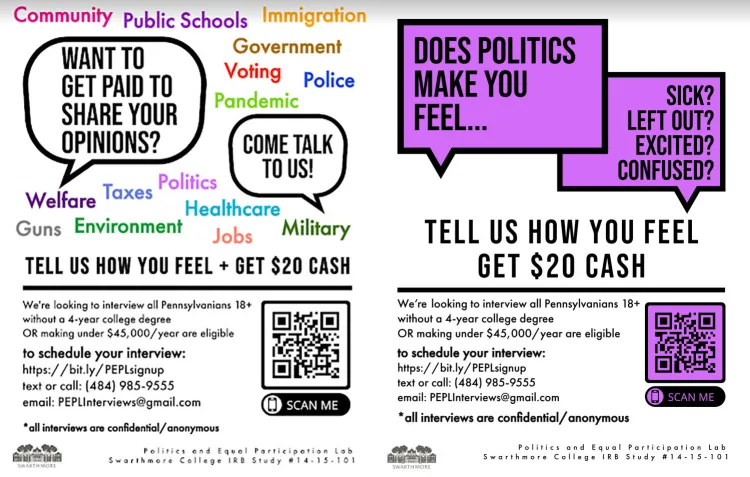
Two posters used to find participants
We recruited on social media, with flyers at transit stops and community gathering places, and through the networks of our undergraduate, graduate, and community-based researchers. Those who participated were compensated $20 for their time. All names used in this report are pseudonyms.
The research group is led by Dr. Daniel Laurison and has included a diverse team of 43 other primary interviewers and researchers: 20 undergraduate students, 14 community-based researchers, and 9 postgraduate researchers. Fourteen researchers are Black, 11 are White, 10 are Latino, 8 are Asian, and one is Indigenous. Thirty come from low-income or working-class backgrounds.
Our research group interviewed low-income and working-class people from both Western and Southeastern Pennsylvania, in small towns, rural areas, suburbs, and major cities. People were eligible to participate if they met one or more of the following criteria:
- They earned less than $45,000/year.
- They did not have a college degree.
- They worked in a job that did not require a college degree.
Our goal in these interviews was to hear how people understand politics and what it means (or doesn’t mean) to them. We did not try to influence their views, and we listened without judgment. Participants generally enjoyed the interviews, and often thanked us for listening to them.
Charts reflect demographics of less politically engaged interviewees (n = 144). Ages range from 18 to 77; 47.9% men, 47.9% women, 4.2% nonbinary.