In Honor of Former Sociology Professor Robin E. Wagner-Pacifici
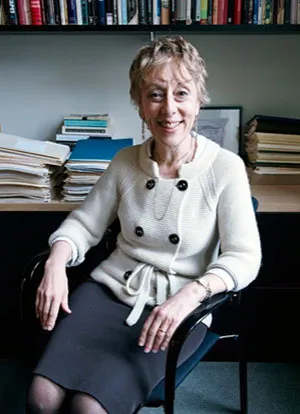
Robin Wagner-Pacifici
Dear Friends,
I write to share the sad news that former Gil and Frank Mustin Professor of Sociology Robin Erica Wagner-Pacifici died earlier this month. She was 72.
For 28 years as a member of Swarthmore’s Sociology & Anthropology Department, Robin’s teaching and research addressed moments of crisis and transformation in public life and the challenges of mediation and representation that they pose. She also mentored legions of students, many of whom she inspired to pursue careers in the academy.
A Philadelphia native, Robin never took a sociology class as an undergraduate at Brown University, where she earned a B.A. in comparative literature. After graduating, she returned to her hometown and got a job as a secretary at the University of Pennsylvania. One fringe benefit was free classes.
“They all ended up being in sociology,” she once recalled. “I wasn’t goal-oriented, they just sounded interesting, and they connected with my literary and political interests. They fit in terms of the narrative process and how society talks about itself.”
Within two years, Robin earned a master’s degree in sociology, and Penn awarded her a Ph.D. in 1983, the same year she joined Swarthmore’s faculty. She was attracted to the College, she said, because “I’d always admired it, and I liked the idea of getting to know people in other disciplines.”
Indeed, at Swarthmore, Robin published with Barry Schwartz in psychology and co-taught with Philip Weinstein in English literature. She wrote the essay for the catalog that accompanied the 2010 List Gallery exhibition Bearing Witness: Recent Work by Daniel Heyman. Her own courses included Discourse Analysis; Power, Authority, and Conflict; Social Inequality; and Standoffs, Breakdowns, and Surrenders.
Robin once said she differed from typical sociologists in being “drawn to events with different interpretations” rather than to charting trends and gauging causes of phenomena. Instead, she was attracted to sociology as “an open discipline that permits a wide range of methodologies, from the very statistical and quantitative to how people say hello on the telephone.” Her published work reflects this focus.
In What Is an Event? (2017), Robin explored how events are constructed out of ruptures and provided a mechanism for understanding them, from the micro-level of individual life events to the macro-level of historical revolutions, contemporary terrorist attacks, and financial crises. In The Art of Surrender: Decomposing Sovereignty at Conflict’s End (2005), she analyzed military surrenders as transfers of power in warfare. Her award-winning book, Theorizing the Standoff: Contingency in Action (2000), examines Waco, Ruby Ridge, and other clashes between anti-system groups and authorities. Two earlier books, Discourse and Destruction: The City of Philadelphia vs. MOVE (1994) and The Moro Morality Play: Terrorism as Social Drama (1986), focused on two such events: the 1985 MOVE disaster in Philadelphia, in which police invoked the threat of “terrorism” to justify using military explosives on a residential block, and the kidnapping of former Italian Prime Minister Aldo Moro by the Red Brigades in 1978, in which the Italian government refused to negotiate for Moro’s release.
In 2011, Robin joined the faculty at the New School, where she chaired the sociology department for four years and served as University Professor and later professor emerita. She also served as a visiting scholar and lecturer in Penn’s Department of Sociology and its Annenberg School for Communication. Her forthcoming book, Scenes and Their Senses: Close Reading as Theory and Method, is planned for publication by the University of Chicago Press next year.
Robin also once said: “I hate to see life rigidly divided into separate spheres. I want to be a good citizen. I want to use being a mother and a scholar. It shouldn’t be a matter of choices. It shouldn’t have to be either/or. The voices of mother, scholar, and teacher should be able to be useful to each other.”
With her sharp wit, generous spirit, and impeccable style, Robin epitomized all three.
Robin is survived by Maurizio Pacifici, her husband of more than 40 years, and their children Adriano, Laura, and Stefano. Additional survivor and memorial information will be shared once it is available.
Sincerely,
Rich Wicentowski
Provost and Dean of the Faculty