Tackling the Political Disconnect: How to Engage People Who Feel Shut Out of the Political System
Swarthmore's HEARD initiative finds voter disconnection and discouragement – not apathy – keep people from the polls.
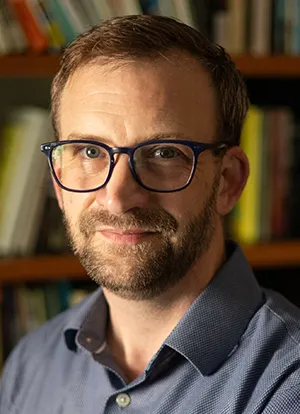
"People want to believe that politics can meaningfully improve their lives – so they need to see clear connections between the real problems they are facing and the solutions offered by politics and policy," Laurison says.
Lower-income people who don’t vote feel profoundly disconnected from our democracy, and political leaders who want to bring them into the polling booths must make serious, sustained efforts to communicate and connect with disaffected citizens, according to a new study published by Swarthmore College’s HEARD Initiative.
“The people we talked to described a deep sense of disconnection from politics,” says sociologist Daniel Laurison ’99, director of the HEARD Initiative, who led the study of 144 low-income and working-class people from across Pennsylvania. “They said they feel left out of the process. Eighty-five percent told us they believe politics is by, for, and about people who are more privileged than they are. They see politics as a game, and they don’t believe that politicians are interested in helping them or their communities.”
In the most recent presidential election, people in families earning under $30,000 a year made up more than a third of eligible voters who did not cast their ballots, and more than half of non-voters earned less than $50,000.
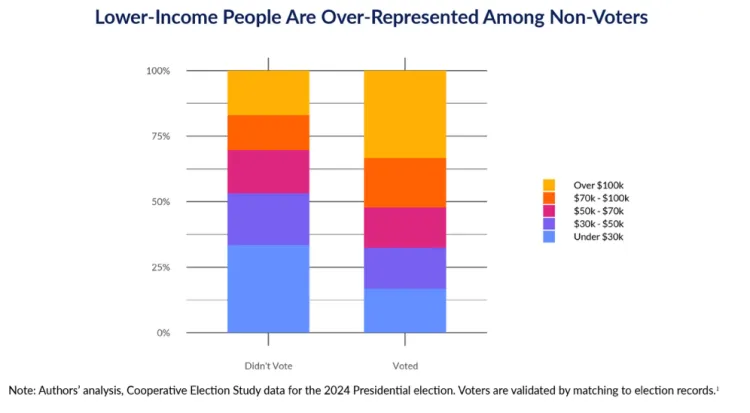
In the most recent presidential election, people in families earning under $30,000 a year made up more than a third of eligible voters who did not cast their ballots, and more than half of non-voters earned less than $50,000.
To find out why lower-income people, those without college degrees, and people of color vote at significantly lower rates than other Americans, Laurison and his team conducted in-depth interviews with a diverse group of 232 Pennsylvanians who earn less than $45,000 a year and/or do not have a college degree. Their report, which focuses on 144 study participants who choose not to vote, found that every single one expressed care about the people around them, and all but two identified specific concerns about their communities and personal lives that are affected by electoral politics.
“Over and over, we hear critics accusing people who don’t vote of not caring about their communities,” Laurison says. “In our research, however, the vast majority of non-voters are making efforts outside electoral politics to improve the quality of life in their communities, whether through helping friends and neighbors, volunteering, or attending protests.
“These non-voters are concerned about being good citizens and good members of their communities, but they feel that people in politics ignore them and their experiences,” he adds. “They think their communities are neglected by people in power, and many pointed to the persistence of poverty, violence, or unemployment as evidence that electoral politics do not make meaningful improvements in their lives.”
Researchers found that Black and Latino respondents talked about this disconnect explicitly in terms of race and social class.
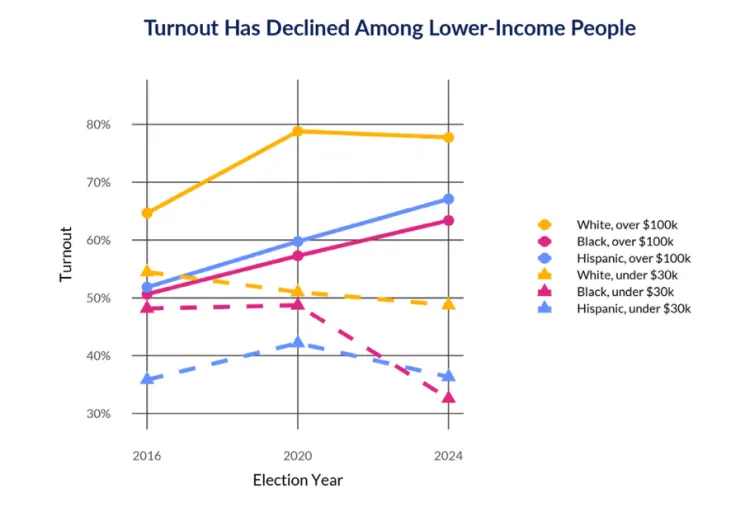
As seen above, voter participation by Black people making $30,000 a year or less dropped by 15 points from 2020 to 2024.
One respondent, a Black single mother in West Philadelphia, said she had not voted in an election since Barack Obama was president. At that time, she had hoped that the first Black president would change her life. But after seeing little progress, she said she lost faith in the power of politics to create the change she envisioned.
“I think as Black people, we feel like our vote doesn’t matter,” she said. That sense of disappointment and disconnection may explain why voter participation by Black people making $30,000 a year or less dropped by 15 points from 2020 to 2024.
As one young Black woman told an interviewer: “I don’t think they care about our votes or our opinions until they need to try to get the last couple of votes in. Like I don’t hear from politicians all year. Until, you know, it’s voting time... And it’s like, ‘Dude, you’re offering nothing that I like, but you’re coming for me because you need more people in my demographic to vote for you. That’s trash.’ … I would appreciate it more if politicians actually put in a little bit more effort to hear what we wanted.”
Other respondents shared similar feelings of exasperation with campaign rhetoric. “Politicians have a very predictable script at this point, and I’m kind of done hearing it,” said Sylvia, an unemployed 33-year-old white woman.
Notably, the vast majority of respondents did not cite logistical and/or administrative barriers as primary reasons for not voting. While 12 participants – less than 10% – said they have been kept from voting due to inconvenient polling locations or hours, problems with the registration process, or the time it would take to vote, 58% reported that it would be easy for them to vote if they chose.
“There is no question that voting should be as accessible as possible,” Laurison says. “No one should be kept from voting by early registration deadlines, long lines, or onerous ID requirements. But it will take more than offering same-day voter registration or shifting to all-mail voting to reconnect with these disconnected voters. The hard reality is, substantial income and racial inequalities in participation persist — and sometimes even increase — when registering and voting are most accessible.”
The study did offer some cause for optimism to political leaders and organizers who hope to engage non-voters, “but only if they’re willing to put in the work,” Laurison cautions. “People want to believe that politics can meaningfully improve their lives – so they need to see clear connections between the real problems they are facing and the solutions offered by politics and policy. People want to see themselves reflected in politics, campaigns, candidates, and government – so party leaders and government officials need to recruit more people from low-income and working-class backgrounds, to serve at every level.
“Perhaps most importantly, people want to feel genuinely listened to and cared about by those who have, or seek, political power – so political leaders need to spend more time in low-income and working-class communities, having meaningful two-way conversations with constituents that don’t end abruptly when the polls close.”
As Marisol, a 50-year-old Latina/white customer service worker told an interviewer: “What would it take for me to get more involved? If I thought I was going to get heard, I might get involved.”
Overall, the study researchers conducted 232 in-depth interviews with low-income and working-class Pennsylvanians between 2018 and 2024. Participants were recruited on social media, with flyers at transit stops and community gathering places, and through the researchers’ personal networks. Those who participated were compensated with $20 for their time. All names used in the report are pseudonyms.
The Laurison-led research group included 20 undergraduate students, 14 community-based researchers, and 9 postgraduate researchers. Of those, 14 researchers are Black, 11 are white, 10 are Latino, 8 are Asian, and one is Indigenous; 30 come from low-income or working-class backgrounds. Their work was supported by the Carnegie Corporation, Swarthmore’s Lang Center for Civic & Social Responsibility, and the Sheila Y. Oliver Center for Politics and Race in America.
Laurison, an associate professor of sociology at Swarthmore College, is the director of the HEARD Initiative and runs the Politics and Equal Participation Lab (PEPL) at Swarthmore. His work focuses on the ways that social class inequalities are produced and maintained – and could potentially be interrupted – in elite workplaces and in our democracy. He is the author of Producing Politics: Inside the Exclusive Campaign World Where the Privileged Few Shape Politics for All of Us (2022) and co-author of The Class Ceiling: Why it Pays to Be Privileged (2019, with Sam Friedman), and Social Class in the 21st Century (2015, as part of a team lead by Mike Savage). Laurison, who has taught at Swarthmore since 2016, previously held a post-doctoral fellowship in the sociology department at the London School of Economics. He holds a Ph.D. in sociology at the University of California, Berkeley.
Learn more in the full study, “Tackling the Political Disconnect: Why Lower-Income People Don’t Vote – and How to Engage People Who Feel Shut Out of the Political System,”