“We’re All Teachers and Learners”: Learning for Life Program Enters New Chapter
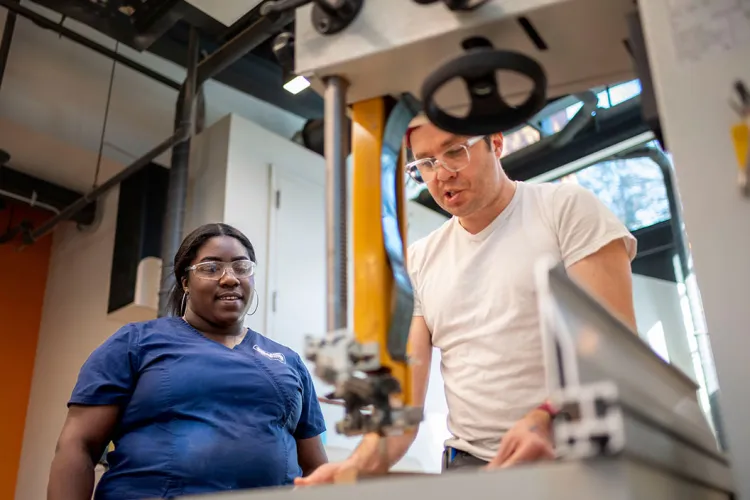
Students and Environmental Services staff gathered in the MakerSpace for a L4L event in February, learning to use machinery, connecting with one another, and creating wooden signs to take home.
Learning for Life, Swarthmore’s distinctive mutual-learning program, was built on a simple but powerful idea: Everyone on campus has something to teach and something to learn. This year, as the program continues its post-pandemic revival and prepares for a leadership transition, that idea feels newly urgent — and full of possibility.
“I want us to be better at seeing everybody here as a teacher and as a learner,” says Diane Anderson, professor of educational studies, a founder of the program in 1998. “We’re all thinkers, we’re all readers, we’re all writers, we’re all doing all of those things.”
That vision has guided Learning for Life (L4L) from its earliest days. What began as a modest component of Anderson’s Literacies and Social Identities course quickly grew into a hallmark of Swarthmore’s commitment to community and social justice. Students and staff were paired as equals, designing their own learning projects — whether building a radio show, learning HTML, or teaching one another piano, knitting, or fitness skills. Over time, those partnerships evolved into lasting friendships.
At its height, the program supported dozens of partnerships each semester. (Read a deeper dive on that history, and especially committed participants like Environmental Services staff member Donzella “Donnie” Franklin.)
But like much of campus life, L4L was disrupted during the pandemic, as in-person programs slowed and key partners retired. Anderson and student leaders have worked to rebuild its rhythm in recent years through workshops, gatherings, and renewed outreach.
This year’s programming reflects that shift. Staff Appreciation Week featured workshops, a panel, and community events designed to reconnect participants across campus. One of the learning spaces — a knitting circle workshop — left a strong impression on Ainsley Jane Tambling ’26 who emphasized the contrast it offered with traditional classroom learning.
“I enjoyed the casual, conversational environment and seeing and learning more about the regulars at the workshop each week,” says Tambling, a biology and economics major from Portola Valley, Calif. “There are so many wonderful people on this campus to meet, and new skills to learn!”
For Eli Cogan ’28, who helps to coordinate programming and collect stories from participants, such experiences reflect what makes the program distinct.
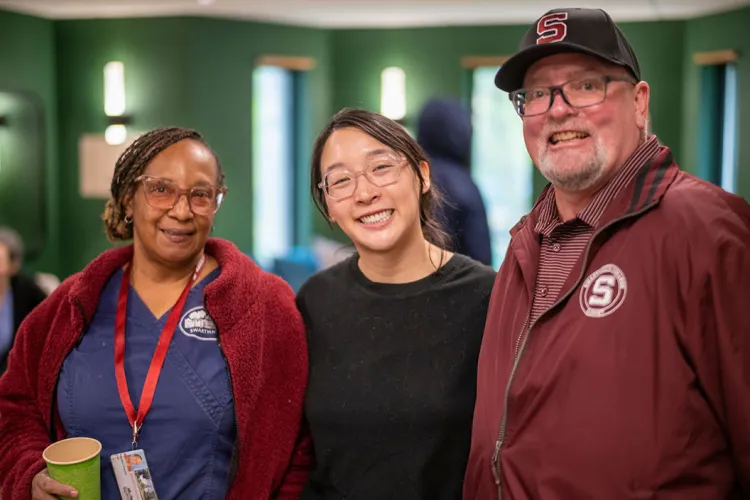
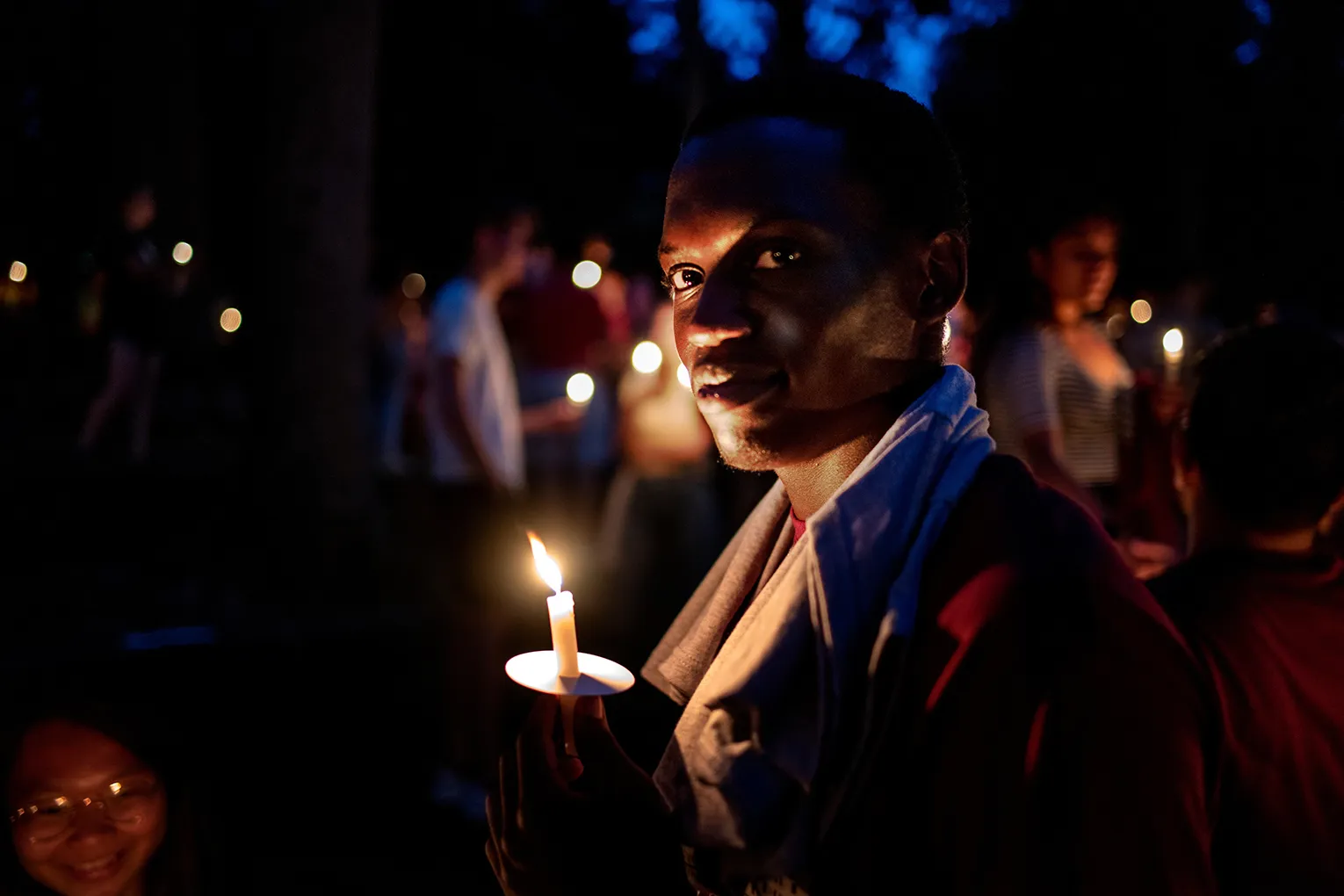
In April, L4L organized Staff Appreciation Week featuring workshops, a panel, and community events designed to reconnect participants across campus.
“It’s provided a community which I wouldn’t have gotten to be a part of otherwise,” says the political science and educational studies major from Cincinnati, Ohio.
That sense of shared discovery also emerged in this year’s digital storytelling workshop, led by Adriana Cavazos ’26. She described L4L as deeply personal and transformative.
“Every participant comes in with an array of experiences, and this is reflected in the uniqueness of everyone's story,” says Cavazos, an environmental studies and computer science major from Salem, Ore. “I find myself wanting to continue to explore digital storytelling as a form of self-expression, and as a form of empowerment for myself and others.”
Other collaborations have centered on making campus spaces feel more open and accessible. Since 2022, the MakerSpace has become one of the program’s most active partners, hosting a series of woodworking and digital fabrication workshops that bring together staff members and students in hands-on learning.
“The energy and vibes are always extremely high,” says Josh Jordan, senior MakerSpace and wood shop manager. “I've learned to adjust my plans to allow for the workshops to grow slightly outside their stated guidelines — to let things go ‘sideways’ a bit, in a good sense — because the participants always want to get into something else once we walk them through a project.”
Those moments are part of a broader effort to strengthen connections that withered as a result of the pandemic. Now, as Anderson prepares for her retirement after 36 years at Swarthmore, L4L is moving under the umbrella of the Teaching and Learning Commons (TLC). The transition, she says, is intended to give the program a stable institutional home while allowing new leaders to shape its future.
That future is one Elaine Allard ’01, associate professor of educational studies and executive director of the TLC, sees as deeply aligned with the Commons’ broader mission. Over the past four years, the TLC has become known for workshops and collaborative learning opportunities that connect people from across campus roles and departments.
“L4L fits really well into that part of our work,” says Allard, a former student of Anderson’s and close colleague. “TLC staff is excited to get more involved in L4L partnerships and to see how we can expand the reach of the program.”
Anderson’s vision for L4L is a return to deeper, sustained partnerships. She hopes that the workshops can serve as gateways to those relationships, creating informal spaces where people meet before choosing to work together more closely.
Equally important, she says, is ensuring that staff feel fully included in the intellectual life of the College.
“We want staff to feel that they are invited into the learning spaces on campus as legitimate members of our community,” says Anderson. “And that they’re welcome in those spaces.”
She sees that work as inseparable from the broader values of a liberal arts education.
“I am firmly against binaries,” Anderson says. “These notions of academic learning and what is non-academic learning — I would like to explode that.”
In practice, that philosophy has meant treating shared activities — from woodworking to gym sessions — as legitimate sites of learning and exchange. It has also meant recognizing the expertise embedded in everyday work across campus, and the ways those experiences intersect with students’ education.
As Swarthmore looks toward the next chapter of L4L, the challenge is not simply to preserve that ethos, but to expand it, says Anderson. That means creating more space for “proximity,” says Anderson.
“If we have more spaces where people can meet, talk, and discover common ground, then we get to know each other and we see each other and we see what we have in common.”
The Learning for Life program is looking for students to participate in the program this summer — a great way to stay connected and learn something new. Find out more here.