Frequently Asked Questions
We continue to update these FAQs based on questions, feedback, and project updates. More recent update are indicated with an asterisk *
General Information | Community Benefits | Sound | Lighting | Fencing & Netting | Visitors, Parking & Traffic | Town Center North | Sustainability | Turf
Why is the College planning to invest in improvements to Cunningham Park?
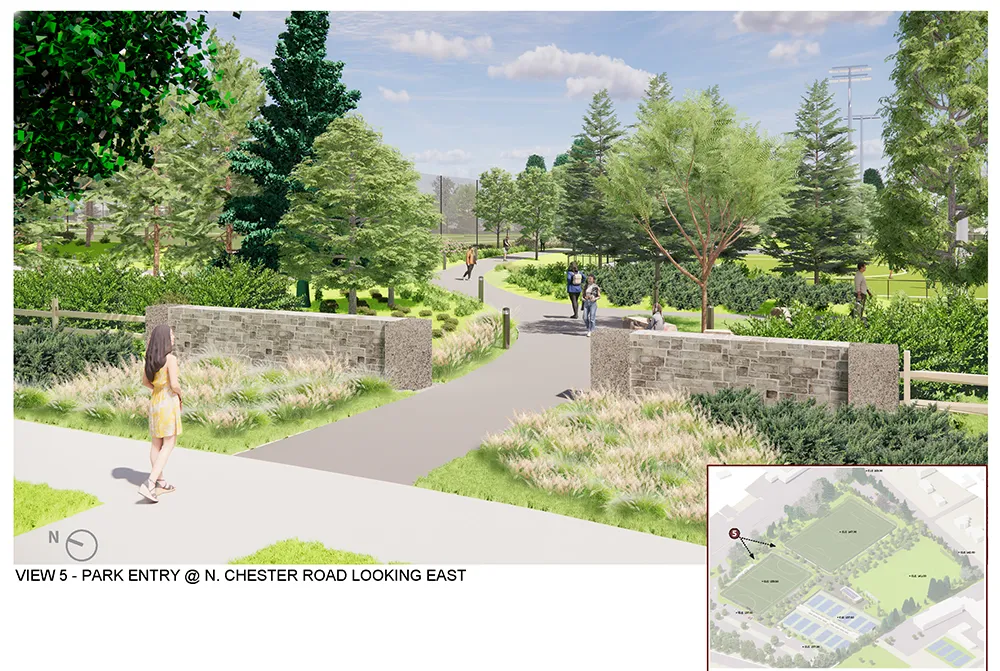
Developing Cunningham Park is an investment in the well-being of our students, faculty, staff, and the border community. Our plans are designed to address a number of challenges posed by our current facilities for our student-athletes, while also enhancing wellness and recreation opportunities for the entire campus community and our neighbors in and around Swarthmore. While final plans are still being shaped based on conversations with local residents and others, the proposed conceptual improvements under consideration include:
- A natural grass field for varsity practices and club sports, with no lighting.
- A synthetic turf field for varsity practices and club sports, with no lighting.
- A synthetic multi-purpose field for varsity field hockey, with lighting.
- Relocating the six existing tennis courts from the north to the south end of the property and adding six new courts, with lights.
- Creating a green space on the north end of the property — a North Arboretum — with community amenities to provide an adequate buffer between College Avenue and the playing fields.
- Creating public sidewalks and pathways and a small pavilion for team rooms, restrooms, and storage.
- Ensuring that Cunningham Park’s landscaping will be enhanced and managed by the College's Scott Arboretum & Gardens.
- Improving parking and traffic flow in the area.
What are some of the challenges with the athletic fields and courts that need to be addressed?
The primary challenges the College hopes to address through Cunningham Park include:
- The field’s natural grass requires significant maintenance (including a significant amount of water, fertilizer, fungicide, and far more diesel and labor than a turf field) and is often unavailable due to weather-related issues, such as drainage and grass recovery time.
- Field Hockey requires a different surface than the turf at Clothier Field, which is designed for soccer and lacrosse. That means the College doesn't currently have an adequate practice or competition field for the field hockey team, so the team often has to travel to other institutions just to practice, leading to equity issues and putting the team at a competitive disadvantage.
- In addition, Clothier Field cannot accommodate the scheduling demands of our club, intramural, and varsity teams' practices and competitions.
- Swarthmore’s 12 total tennis courts are currently split between two locations, including six courts at Cunningham Fields, with no spectator seating.
- This leads to longer matches and scheduling conflicts.
- It does not allow the women’s and men’s tennis teams to practice and compete together.
- This puts us at a competitive disadvantage with many of our peer institutions.
How has the College responded to community feedback so far?
The College is committed to a process that is open, transparent, and grounded in genuine dialogue with both the Borough Council, the Planning Commission, and the community. With that in mind, current design concepts incorporate several significant changes and compromises from the original plans, based on input from the Swarthmore community and Borough officials. These include:
Changes and compromises made by the College to date include:
- Reducing the proposed lighting from four playing areas to two.
- Moving the lighted playing areas away from houses along College Avenue to the south end of the property.
- Committing approximately seven acres of College-owned land for Borough use, including:
- Adding a North Arboretum to enhance green space and provide a buffer between the playing fields and houses on College Avenue.
- Agreeing to work with the Borough to use College land to the south of the property to support the Borough's comprehensive plan.
- Adding trees and plantings along College Avenue and South Chester Road.
- Eliminating a planned fitness court.
- Reducing spectator seating and lowering retaining walls.
- Providing for visitor parking and bus drop-off and parking for visiting teams.
- Designing bollard-height walkway lighting for the paths instead of overhead lighting.
- Committing to a policy that strictly limits the hours during which lighting and amplified sound may be used (more info below).
Is the College pursuing this project to make money?
- The College does not seek to, nor expect to, profit from the operation or programming at Cunningham Park.
If this project gets approved as proposed, how long will it take to install once work begins?
- We are currently planning for construction to take place over roughly 18 months, though a variety of factors, such as weather, can affect the project timeline.
* Why don’t you build this on your campus?
First, it is important to note that Cunningham Field is part of our campus. When people ask why we are not building this on campus, the answer is simple: We are.
That said, we have studied numerous other locations in the interior of our campus, such as Mertz Lawn to the south of Parrish Hall and the space currently occupied by Whittier Parking Lot. Possible alternatives were assessed for playability, safety, environmental impact, student access, and neighborhood impact. In the end, it was determined that there is no other space on our campus that can accommodate the programming proposed for Cunningham.
* The Borough established the current ordinance to protect the community, including from lights at Cunningham. If the Borough approves this project, what's to stop the College from seeking further zoning changes down the road?
It’s important to recognize that the Borough's process for changing zoning ordinances is specifically designed to give the community a voice in decisions like this one. It's rigorous and public, and any future request from the College would go through it, with a full opportunity for residents to be heard.
Community Benefits
How would changing the current field benefit the community?
Swarthmore College is a powerful economic engine for the local economy and across the Commonwealth. According to the Association of Independent Colleges and Universities of Pennsylvania, Swarthmore’s statewide economic impact in 2023 reached more than $387 million across the region, supporting more than 2,430 jobs.
Locally, the College infuses millions of dollars into the economy each year. In fiscal year 2026, the College contributed more than $4.2 million to the local economy, a figure that includes more than $1 million in taxes and a one-time contribution to Swarthmore Borough of more than $630,000 to help close a funding gap that would have otherwise been passed on to people who live and work in and around Swarthmore.
- Current conceptual designs feature accessible pathways for the public and emergency services, and restrooms available during College events and upon request for Borough activities.
- The turf fields would offer expanded seasonal use for the College and the community and would be available for community use when not reserved for College activities.
- Current conceptual designs under consideration commit approximately seven acres of the property to the Borough, including:
- Adding an arboretum area to the north side of the property to enhance green space and provide a buffer between the playing fields and houses on College Avenue.
- The College is seeking input from residents on amenities they would like to see included, such as wellness areas with fitness equipment, water refill stations, picnic areas, etc.
- Agreeing to work with the Borough to use College land to the south of the property to support the Borough's comprehensive plan.
- Adding an arboretum area to the north side of the property to enhance green space and provide a buffer between the playing fields and houses on College Avenue.
- For the College, the renovated fields would offer new opportunities for physical education, club sports, and recreational programming, and strengthen our commitment to student and community health and wellness.
- The current conceptual designs feature accessible pathways for the public and emergency services, and restrooms available during College events and upon request for Borough activities.
- We are working with the Swarthmore Recreation Association (SRA) and Swarthmore-Rutledge School to determine how often they could use the park for their activities. In February 2026, the College executed a memorandum of understanding with SRA to ensure this cooperation.
- The College’s Scott Arboretum & Gardens would add more than 200 new trees and preserve 112 of the field’s 171 existing trees at Cunningham, including new tree species that are not currently in its collection.
Can the Swarthmore Recreation Association use the new fields?
- We have partnered with SRA on a memorandum of understanding outlining how the College can support SRA, including through the use of Cunningham Park. This collaboration aims to benefit the local community by providing accessible recreational spaces, supporting SRA's initiatives, and enhancing community engagement.
* What sort of access will the community have to the facilities at Cunningham Park?
When the fields and tennis courts aren't being used by the College, we expect that community members will use them much like they do today, and with better facilities than currently exist. We've also already had conversations with the Swarthmore Recreation Association (with whom we’ve already entered into a memorandum of understanding) and the Wallingford-Swarthmore School District about additional ways we can support their needs and programming.
We are committed to measuring and, where possible, expanding community use to ensure it remains a resource for the College and the community.
* How will the fields impact Swarthmore-Rutledge School?
We want the renovated Cunningham Fields to be a resource for Swarthmore-Rutledge School. The College plans to make the facilities available to the district when scheduling allows. And we're committed to restricting amplified sound and other potentially disruptive activities during school hours so students and teachers next door aren't affected by what's happening on the fields.
Sound
How will the College keep noise from being a problem?
- The College will abide by the Borough’s existing noise ordinance.
- We will put rules in place that restrict music and announcements to 30 minutes before games and up to 30 minutes after games.
- We will prohibit portable sound systems and warm-up music for intercollegiate and club sport practices.
- The College is working with a sound engineer to focus sound directly at spectators and minimize sound levels at the property perimeter. The technology will prevent the volume from exceeding the decibel limits required at the property edge.
- The College is working to design and install the same technology at Clothier Stadium as well as for baseball and softball.
Lighting
In response to community feedback, the current conceptual designs reduce the proposed lighting from four playing areas to two — for field hockey and tennis — and move those two playing areas to the south end of the property, away from homes on College Avenue. In addition, a proposed North Arboretum will add a buffer between the lighted fields and homes along College Avenue.
When would the lights be used, and how late would they stay on?
- Lights are planned primarily for practices and games from October to early December and late January to March.
- For practices, lights will be off by 8 p.m.
- Field hockey is the only sport that would host evening competitions, typically only 4 to 5 events per season in the fall. Lights for those events would be off no later than 10 p.m.
- There is no plan to use the lights during the summer months.
- At no point would the lights ever stay on all night, unless the Borough requested that low-level walkway lights remain on for safety reasons.
How big are the proposed scoreboards?
- The College proposes two tennis scoreboards, which are crucial for NCAA competition, that would face the courts and be no taller than 12 feet and illuminated with LED bulbs. One proposed field hockey scoreboard would be less than 10 feet tall.
* How tall will the light poles be, and will the landscape buffers screen them effectively?
Light poles for field hockey are planned at approximately 70 feet; tennis poles at approximately 60 feet. That may sound tall, but the height actually helps; it allows the lights to be directed more precisely downward onto the playing surfaces, which is one of many factors that will prevent light spill beyond them.
The project also includes landscape buffers and berming to soften the visual impact from nearby homes. Newly planted trees will take time to fill in, but the design team is working closely with the Arboretum to select plantings that offer some screening from the start and improve as they mature.
Fencing & Netting
* What will the venue fencing and netting look like, and how tall will it be?
Current plans call for the field hockey venue to have a 4-foot perimeter fence, with approximately 20 feet of netting at the north and south ends to keep balls in play. The tennis courts will be enclosed by a 10-foot fence, similar to the existing fence around the courts on the north side of the site.
For the natural grass and multipurpose turf fields, fencing and ball-control netting are planned at the north and south ends, with the possibility of a 4-foot perimeter fence around the turf field as well. Final configurations will be confirmed as the field layouts are completed.
Visitors, Parking & Traffic
How many spectators does the College expect to host at Cunningham Park?
Field hockey and tennis competitions draw relatively modest crowds. Swarthmore field hockey typically attracts 75–150 spectators for regular-season games and 100–200 for postseason play. Tennis draws about 25–40 spectators for regular-season matches and 75–125 for postseason competitions. Roughly 20% are current college students, and 80% are community members, along with players' friends and family.
Based on historic figures and comparisons with peer institutions, we don't expect these numbers to increase significantly in the future.
How will this plan impact parking and traffic?
- Current plans call for the existing parking lot at the north end of Cunningham to be removed, and for parking and bus traffic, including drop-offs, to take place on the south end of the property. Based on recent parking and traffic studies, this would eliminate the need for visiting buses to queue along College Ave. and prevent any additional traffic issues there.
- The College is currently evaluating options for additional parking on campus. The College will conduct updated traffic studies once the Cunningham Park plans are further developed.
Where will the student cars that currently use the South Cunningham lot go if that lot is used for visitors?
- Those student parking spaces would be reallocated on campus. The College is evaluating options to create additional parking on campus.
- Most students aren’t allowed to have vehicles on campus, and we continue to reduce the number of students with permission to do so.
Town Center North
* How does this project connect to the Borough's plans to create a Town Center North at the south end of the property near the SEPTA train tracks?
The Borough's 2025 Comprehensive Plan identifies the development of a Town Center North as a priority that will strengthen connections, activity, and economic vitality in Swarthmore.
The College owns about two-thirds of that land; SEPTA owns the rest. We've signed a Memorandum of Understanding with SEPTA to start planning together so that the Cunningham Fields renovation and whatever comes next for Town Center North are designed to complement each.
Sustainability
How is the College prioritizing its commitment to sustainability in this project?
From our investments in our innovative To Zero By Thirty-Five energy plan, to our Zero Waste efforts, to our Carbon Charge program, our long-standing and demonstrated commitment to environmental sustainability informs all that we do. At the outset of this project, we commissioned an independent study to ground our decisions in evidence rather than assumption. And as we continue to develop plans for Cunningham Park, we will weigh both the benefits and environmental impact.
Some of the project’s sustainability-related considerations include:
- A lighter resource footprint over time. Maintaining natural grass is surprisingly resource-heavy. A grass field size of Cunningham requires roughly 1.4 million gallons of water a year, along with seasonal fertilizer, fungicide, and far more diesel fuel and labor. A synthetic field requires no irrigation, fertilizers, or pesticides.
- Designing responsibly for the full life of the field. Sustainability also means planning for what comes later. We're committed to using turf that is certified as PFAS-free when it leaves the factory, as well as natural infill materials throughout the project. In addition, end-of-life options for synthetic turf are improving quickly, including newer programs that recycle old fields into raw material for new products rather than sending them to landfill.
- More time for wellness and recreation. Because synthetic turf drains quickly and withstands heavy use, it stays open through the weather and seasons that force natural grass to close. That means more usable hours for students, staff, and neighbors to be active outdoors, enhancing wellness activities for all of Swarthmore.
Balancing priorities openly. These upgrades ask us to weigh sustainability goals alongside other institutional needs and wellness benefits, and we recognize that the choice of synthetic turf has been the most discussed sustainability question in this project. We've addressed it directly and transparently. Learn more about turf and sustainability below.
* How will stormwater be managed if facilities shift east and existing basins are removed?
Stormwater management is a formal part of the approval process, and any land development application must include a comprehensive plan that the Borough Engineer reviews and approves before it goes to the Planning Commission or Borough Council.
The current concept moves from a surface basin on the east side of the site to underground stormwater facilities beneath the fields, tied into the site's existing infrastructure and the rain garden near the south parking lot. The details will be confirmed as the design develops, but the standard the final plan has to meet is clear: runoff must be properly controlled.
Turf
Why is the College planning to add turf fields to Cunningham?
- While grass and natural landscaping will remain a significant part of Cunningham Park, grass playing fields limit when the fields can be used. Natural grass is easily damaged by heavy rain and sits unusable for stretches of the year. To stay in good condition, a grass field can handle only about 15–20 hours of use per week; a synthetic field can handle far more, drains quickly after storms, and can even be cleared for use after snow. That means more consistent, year-round access for everyone who uses the park.
- Field hockey requires a specific surface. U.S. Field Hockey requires a high-quality, low-pile synthetic surface for elite-level play. Clothier Field is built for soccer and lacrosse and uses a very different playing surface; as a result, our women’s field hockey team often has to travel to other institutions just to practice, which creates real equity issues. Most of Swarthmore's competitors already have these fields, putting our team at a disadvantage without one.
- Natural grass is far more resource-intensive to maintain. Keeping the current grass fields playable requires substantially more water, fertilizer, fungicide, diesel, and labor than synthetic turf. A natural field the size of Cunningham uses roughly 1.4 million gallons of water a year for irrigation, plus fertilizers and pesticides that turf doesn't need at all.
- The College is evaluating a balanced field system that preserves natural grass and open space, where appropriate, while using synthetic turf selectively to support field reliability, athletics, recreation, and wellness programming.
How is Swarthmore addressing concerns about "forever chemicals" (PFAS) in artificial turf?
Safety will drive our decision-making: Our project team is carefully assessing all project materials with a focus on health, safety, and sustainability. Importantly, both synthetic turf systems will be required to meet PFAS-free specifications as they leave the factory.
*Our testing standard: Following industry best practices, materials will be tested by a third-party testing agency using EPA Method 1633A — a standardized, multi-laboratory validated procedure — to ensure the fields are safe for our students and community.
What an independent study found: Because the health of our student-athletes and neighbors is a top priority, we commissioned an independent study (PDF) from Haley & Aldrich comparing the health, safety, environmental, and sustainability profiles of synthetic and natural turf fields, drawing on peer-reviewed research and regulatory guidance. The findings include the following:
"Recent studies of synthetic turf received directly from manufacturers show that PFAS are infrequently detected in synthetic turf, and when they are, they are present at concentrations below levels that are protective for direct exposure and leaching to groundwater. Furthermore, PFAS are detected more frequently and at higher concentrations as a background condition in soil than in synthetic turf that has not been exposed to the environment."
The study also concluded that thoughtful design choices, such as avoiding crumb rubber infill, address the most common concerns about artificial turf, including PFAS, heavy metals, and microplastics.
More to come: As specifications are refined, the College will provide additional information about materials, coatings, backing, shock pads, drainage components, and testing protocols.
*What kind of materials do you plan on using?
While final decisions on the turf material have not yet been made, the College is committed to using turf that is certified as PFAS-free when it leaves the factory, as well as natural infill materials throughout the project. Among the options the team is evaluating is the Poligras Paris GT Zero system. This groundbreaking turf system is manufactured using green electricity and consists of up to 80% sugarcane rather than fossil fuel-based materials. It is the world’s first certified carbon-neutral turf.
Will the walkways be turf?
- No, walkways will be paved.
How much water is needed for “watered turf,” and will this be more water than is currently used on the field?
Wetting the field hockey turf is a best practice before competition to optimize ball speed and reduce friction.
- The amount of water used will depend on how often the wetting cycle is initiated.
- The existing fields' watering requirement is weather-dependent. The hockey field watering schedule would be competition-dependent.
- The field-wetting water would be provided by the existing well on the site. It will not come from the Borough’s drinking water supply.