Introduction by Mark Lewis '10
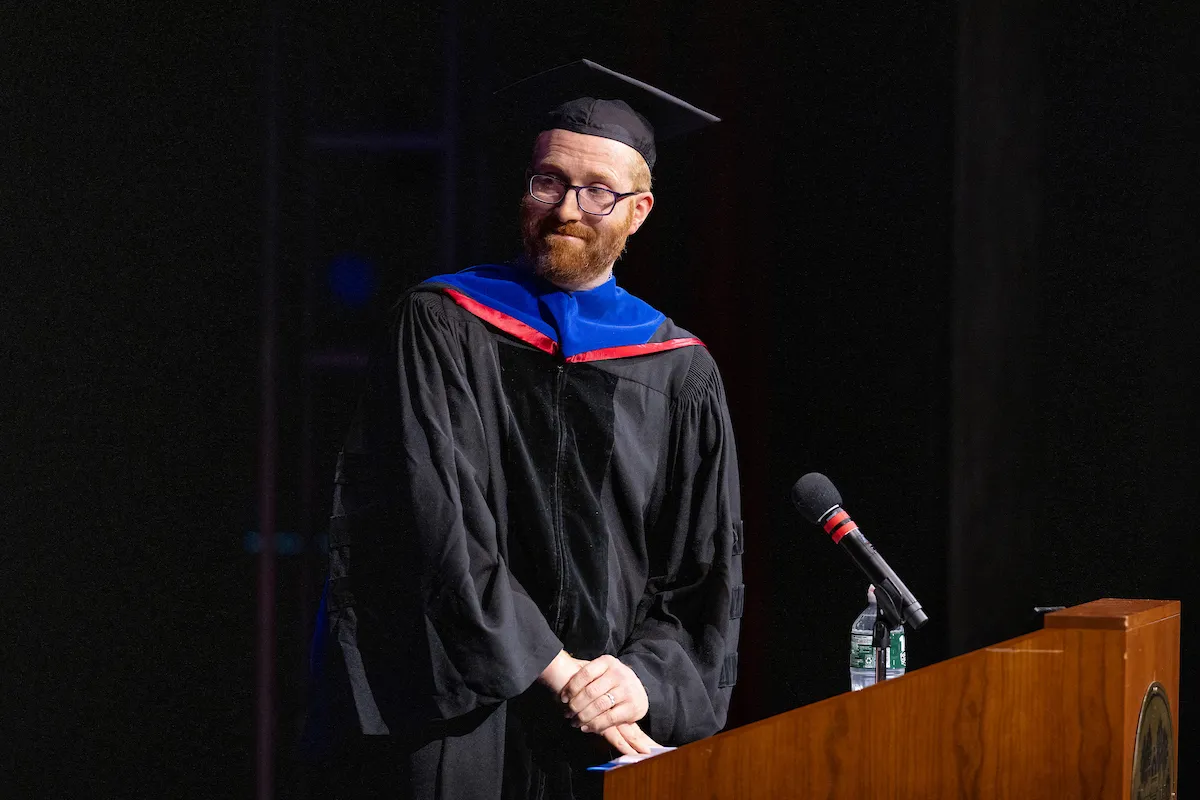
Good afternoon. I have the honor of introducing Professor of Educational Studies Diane Anderson.
Some of you know her very well, and others she has never met. My job is to give you a small preview of Diane. These remarks are the last homework she’ll ever give me.
Almost 20 years ago, I met Diane as my first-year advisor, and soon my teacher in a first-year seminar. Later: more classes, an honors seminar, my thesis. I learned so, so much from her … so much that I can read her mind — right now. And I can tell she is thinking something like, “I learned from you, too!”
As a scholar of literacy, Diane is always learning from and with her students. She would tell you there is something she can learn from anyone. In the acknowledgments of her dissertation, which centered on literacy and gender identity in a third and fourth grade classroom, she wrote: “I am in awe of the children in this study who shared their literacy and social lives with me. I am grateful that they allowed me to learn among them.”
Throughout her career, Diane has brought awe to the ways people of all ages use literacy, especially how we use literacy to build our identities and our communities. When she directs her attention to learning in schools, she uncovers the ways in which some forms of literacy are routinely excluded in academic spaces, even, sometimes, at Swarthmore.
Her work is one of many pathways we find in the liberal arts toward understanding and cherishing some facet of what it’s like to be a person: to be matter, to be alive, to make art, to move in a body, to come from a community, to grow and change on a precious planet, among countless stars.
Diane is retiring this year, and her invitation to speak at this gathering recognizes her many contributions to the College. Yet, in the spirit of giving you a preview, I believe it’s important to tell you that her path to this stage is unlike many other faculty.
Diane joined Swarthmore College in 1990, overlapping the end of a two-decades-long career as a teacher, reading specialist, and curriculum developer in New Jersey. When she arrived at Swarthmore, her main role was serving in the teacher certification program here. At the time, Educational Studies was not a “department,” it was a “program,” and Diane was not any kind of “professor” but rather a “lecturer,” because she didn’t hold a doctoral degree. For some of those early years, she was working two jobs: teaching courses here while still a curriculum supervisor in New Jersey. She started her Ph.D. four years after her job here began, finishing in 1998. Gaining her Ph.D. turned her into an “adjunct assistant professor” at Swarthmore. Adjunct, meaning on an uncertain and temporary contract. The next year in 1999, alongside Environmental Services staff, she developed the Learning for Life program, which pairs students and College staff to pursue voluntary, self-directed projects centered around mutual learning – a program I know she will tell you more about.
In 2003, 13 years after she began to teach here, Diane became a tenure-track professor. Now vested with a new kind of recognition, her contributions to academic life at the College accelerated. She served on major committees shaping curriculum policy and faculty procedures and, shortly after receiving tenure in 2008, she served as the dean of academic affairs for eight years. As dean, she oversaw the landscape of academic advising and supported students through some of their greatest personal challenges. Over these years, she also gave the Last Collection address a whopping three times in 2006, 2010, and 2017. If you like her speech today, go back and read those too – they’re all great!
Despite my brief stint here as Diane’s biographer, I only have a fraction of the story. But I know that she spent years sometimes feeling at the margins of the academic elite at the College, not so different from the margins she so intently documents and questions in her scholarship. I’m certain some of the graduates we celebrate today have felt on the margins here, too. I did, some of the time — but never with Diane. She will forever be one of my greatest teachers.
I’ll end my preview with this: even if you’ve never met Diane, keep in mind she knows a lot about this place. She’s seen it from more angles than most. If you do get a chance to sit down with her, she would know she could learn from you. She would be in awe. Let’s hear what she has to say.