Sangina Patnaik - Last Collection
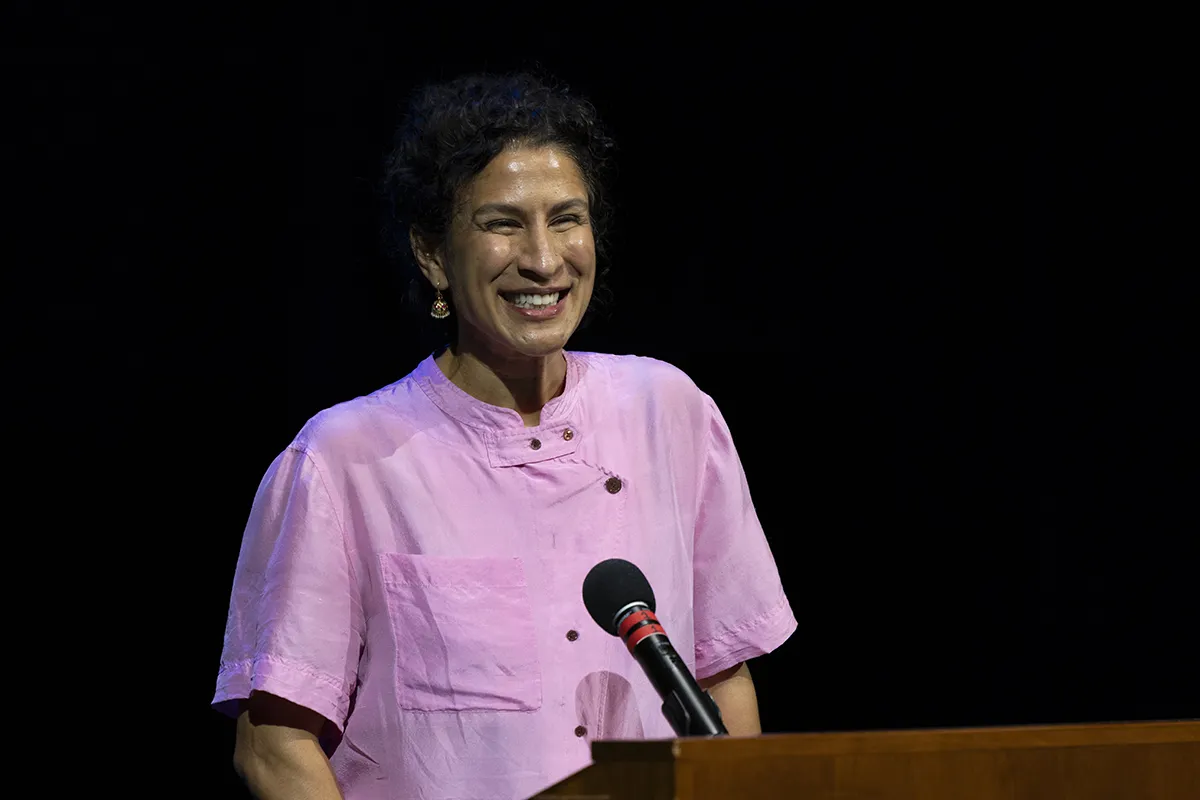
Good evening, Swarthmore College Class of 2026. I have to admit that, like many of you, I was devastated to get the email notifying us that Last Collection would not be taking place in the Amphitheater but instead in the ever-so-slightly less magical LPAC auditorium. Since LPAC is my home turf, I am going to take this as an invitation from the universe to subject you to something that I occasionally do at the start of my classes.
Take a minute to think about a few adjectives or phrases that describe how you feel right now – in your body, in this moment, in the world.
Usually I would go around and ask each of you for your words, but there are a few of us, and it might take a minute, so I cheated. Don’t worry, I didn’t ask AI to read off your feelings. I hear that’s a popular move in graduations this year, and it’s not going so well. I did, however, ask seniors from my classes to send me their responses. Here are some of their answers: “fruitful - both in the sense of success and in the sense of overabundance,” “very tired,” “body:antsy; moment: grateful; world: curious,” “infuriated,” “frustrated,” “unbelievably anxious,” “fed up,” and “radically hopeful.”
I'll be honest, sometimes I pose this question because I know that there are moments in the semester when students seem ready to slip out of their chairs and puddle on the floor. But I also believe it is important to put into language who and how we are, because these are the conditions with which we engage the world, whether we are debating an idea or harmonizing in a choir or organizing a collective.
You came to this campus hungry for knowledge, experiences, community, and purpose. And you have pursued those things and more in classrooms and the Crum and late-night SEPTA trains and rehearsal studios and encampments and softball pitches. When I'm asked to describe Swarthmore students, I say, “they go hard.” You read all of the assigned reading and the secondary sources, and then you email me for additional reading because something in the footnotes got you started talking with another classmate at Narples, and you haven't been able to stop thinking about it, and do I have any recommendations? It is not clear to me that you sleep. I would recommend that you begin.
As I look out at you now, though, you are breathtaking in your courage and curiosity and intelligence. It is an honor to share this last collection with you.
I’m often preoccupied by the concept of lineage: the ideas that shape us, the people and places that influence the way we think and question and act. Perhaps this is why I am drawn to the study of literature. As Walter Benjamin writes, “traces of the storyteller cling to the story the way the handprints of the potter cling to the clay vessel.” Tonight, I’d like to share with you some of these traces–the conditions by which I engage in teaching and researching and humaning in the world–as a way of echoing, hopefully, the labor you have undertaken on this campus and envisioning a path for the days and years ahead.
When I was a graduate student, one of my advisors, Steven Goldsmith, won a University of California-wide teaching award. There was a very fancy ceremony with very fancy cocktails, and Steve was asked to give an acceptance speech. In it, he said, “the thing about studying English literature is if you get it wrong, nobody dies.”
It would be easy to hear Steve’s words as resignation–maybe the arts and humanities are just those whimsical things you dally with when you don't want to face the hard facts of the world. Or, more broadly, maybe this rarefied, precious gift of four years of study on a college campus is abstruse at best and, at worst, insignificant. If you have an Instagram feed at all like mine, your mind might be turning to those think pieces ruminating on whether or not artificial intelligence will soon obviate the credentialing that a four-year college degree provides. Every time I scroll past something like that, I see the specter of my uncle, an Iowa farmer from a long line of Iowa farmers, who makes sure to remind me every time he sees me that a college education isn't all that it's cracked up to be. He’s not wrong. Firstly, Uncle Craig is one of the smartest men I know. And secondly, I’m fairly confident that every single one of you has had this thought at some point in the last four years.
But I think Steve meant something very different. It is precisely because you can get it wrong without killing anyone that the study of literature–much like art, drama, history, dance, music, and film–constitutes some of the most serious, high-stakes work you can undertake. At its best, studying literature pushes us to understand the relationship between living beings and the institutions, infrastructures, and forces of power which work on them. It allows us to take risks–to stretch our creative and critical capacities past their limits and then to self-correct. It asks us to engage in play as a serious endeavor, to imagine our way into worlds and lives outside of our own, to feel the shape of someone else’s words on our tongues, and to grapple with the frustrating and humbling fact that we often just have to admit uncertainty. It hones our edge. It is a place of refuge. It is a form of practice.
And make no mistake- we need practice to enter this world of ours. As the Palestinian historian Sherene Seikaly writes, “Today, the realities we inhabit continue to outstrip our capacity to analyze them. We witness the kidnapping, capture, and deportation of immigrants throughout the United States; the targeting of everyday dissidents through shoot-to-kill policies in Minneapolis; the toppling and capture of the president of Venezuela; the ongoing realities of genocide in Palestine and Sudan; the unbridled US-Israeli war on Iran, Israel’s latest aggressions in Lebanon; and Iran’s response throughout Iraq, Jordan, Israel, and the Arabian Peninsula.”
If you've read the news in the past week, you've encountered something of a time warp: the Supreme Court dismantled the Voting Rights Act of 1964, the FCC, in a move straight out of the 19th century, is contemplating warning labels for media featuring LGBTQ+ characters, and despite declaring a ceasefire in October 2025, Israeli attacks on Palestine have increased 35% in the last six weeks– bringing the death toll since the declaration of a ceasefire to almost 900. Or, in the words of the poet Fady Joudah, “after the genocide, the genocide.”
In the strange Alice-in-Wonderland logic of our present, we can gauge what matters by what is being taken. We know the votes of Black and indigenous peoples shape democracy because they are being suppressed. We know immigrants are the beating pulse of our communities because they are being disappeared. We know that queer people define culture because their very presence is labeled as dangerous. We know journalism is vital because journalists are deliberately targeted. We know education is essential because every university in Gaza has been destroyed. These are dark lessons for dark times.
I wish this were the moment when I could whip out the three lessons you should take away from your education at Swarthmore to bring light to yourself and to the world. As you’ve probably gleaned by now, this isn't that sort of talk. Instead, I'd like to share with you two writers, Virginia Woolf and June Jordan, who have modeled for me the sort of sustained, deliberate attention needed for thinking in dark times. They're compelling not because they’re great writers at the top of their game–although they are–and not because they figured out the perfect way to intervene. They’re compelling precisely because they haven't. In these texts, Woolf and Jordan do not yet have the words to meet their moment, but they choose the practice of writing as a way of being in and toward the world. What’s more, they develop radically different points of entry into this work, which I find comforting when I don't know where to begin.
I.
In 1938, Virginia Woolf publishes Three Guineas, a book-length essay that works its way towards contemplating photographs of the wreckage of the Spanish Civil War–houses split apart by bombs, undistinguishable human limbs, dead children. The text is framed as a response to a well-meaning admirer who writes to ask her, “How in your opinion are we to prevent war?” Woolf's answer, out of the gate, is to ask, who are you to say ‘we’ to me? With the sort of impertinent wit that characterizes much of her nonfiction, she promptly proceeds to imagine him: middle-aged, fairly prosperous, “a little grey on the temples; the hair is no longer thick on the top of your head.” He is, she states, a white upper-middle-class English person, much like herself. But. And it is this ‘but’ that will drive the next one hundred eighty-seven pages of her response: although they may attend the same dinner parties and speak in the same accent, as a woman in the early twentieth century she is structurally precluded from the kinds of power that would allow her to intervene in response to his question:
“Your class possesses, in its own right and not through marriage, practically all the capital, all the land, all the valuables, and all the patronage in England. Our class possesses, in its own right and not through marriage, practically none of the capital, none of the land, none of the valuables, and none of the patronage in England.
"That such differences make for very considerable differences in mind and body, no psychologist or biologist would deny. It would seem to follow then, that, as an indisputable fact, “we,” meaning by “we” a whole made up of body, brain, and spirit, still differ in some essential respects from “you,” whose body, brain, and spirit have been so differently trained and so differently influenced by memory and tradition. Though we see the same world, we see it through different eyes. [...] Therefore, before we agree to sign your manifesto or join your society, it might be well to discover where the difference lies, because then we may discover where the help lies also.”
Confronted with the rise of fascism, Woolf turns her eyes not to the European continent, where Hitler and Mussolini are ascendant, but to the institutions that shape patriarchy in England–which she takes as a microcosm of Western Civilization. With meticulous attention, she dissects the ways women are precluded from higher education, the workforce, and the public sphere. If she is to speak to the question of preventing war, she argues, it can only be from the position of an outsider: "For,’ the outsider will say, ‘in fact, as a woman I have no country. As a woman I want no country. As a woman, my country is the whole world.’" The fear and need for dominion that drive men to seek control over women in the home are different only in degree from the fear and need for dominion that create the tyrant and the dictator; the “tyrannies and servilities” of the private world are “inseparably connected” to the tyrannies and servilities of the public. Hitler is not an evil unto himself; he is the logical conclusion of Western Civilization. (We might pause here to hear echoes of Aimé Césaire and Hannah Arendt in Woolf’s train of thought.)
Three Guineas is a wild ride, and perhaps for that reason, it's rarely considered one of Woolf's greats. Last week, The Guardian published its list of the 100 Great Books. Three of them were written by Woolf. None of them were Three Guineas. In class this semester, students unearthed some pretty incredible tea: the book drew tepid praise from her husband Leonard, confusion from her dear friend John Maynard Keynes, and sparked a sharp break with her longtime lover, Vita Sackville-West, who accused Woolf of using her formidable command of language to hoodwink the reading public.
What interests me in Three Guineas–what makes me return to it over and over–is that Woolf refuses to leave behind the limitations of her own situated experience, turning them instead into a through line that allows her to theorize the conditions under which fascism thrives.
II.
In 1982, June Jordan published the poem “Apologies to All the People of Lebanon” in the Village Voice after learning of the massacre of thousands of Palestinian refugees living in Sabra and the Shatila refugee camp in Beirut during the 1982 Israeli invasion of Lebanon. The poem begins with a dedication “to the 600,000 Palestinian men, women, and children who lived in Lebanon from 1948-1983.”
I didn’t know and nobody told me and what
could I do or say, anyway?
They said you shot the London Ambassador
and when that wasn’t true
they said so
what
They said you shelled their northern villages
and when U.N. forces reported that was not true
because your side of the cease-fire was holding
since more than a year before
they said so
what
They said they wanted simply to carve
a 25 mile buffer zone and then
they ravaged your
water supplies your electricity your
hospitals your schools your highways and byways all
the way north to Beirut because they said this
was their quest for peace
They blew up your homes and demolished the grocery
stores and blocked the Red Cross and took away doctors
to jail and they cluster-bombed girls and boys
whose bodies
swelled purple and black into twice the original size
and tore the buttocks from a four month old baby
and then
they said this was brilliant
military accomplishment and this was done
they said in the name of self-defense they said
that is the noblest concept
of mankind isn’t that obvious?
They said something about never again and then
they made close to one million human beings homeless
in less than three weeks and they killed or maimed
40,000 of your men and your women and your children
But I didn’t know and nobody told me and what
could I do or say, anyway?
[...]
Yes, I did know it was the money I earned as a poet that
paid
for the bombs and the planes and the tanks
that they used to massacre your family
But I am not an evil person
The people of my country aren't so bad
You can expect but so much
from those of us who have to pay taxes and watch
American TV
You see my point;
I’m sorry.
I really am sorry.
Poetry, for Jordan, is the mode for thinking into a collective humanity. The breathless refrain “I didn’t know and nobody told me and what/could I do or say, anyway?” hurtles itself against the stanzas that surround it, stringing together conjunctions (“and…and…and”) that exhaust even the speaker’s ability to maintain the pretence of innocence. Jordan writes with an “I” that signifies a “we.”
Yet after publishing this poem, Jordan falls silent. For a few years, her prolific publishing and reading and speaking career grinds to a halt. She will later describe a fallout that includes the fracturing of her black lesbian poet collective (including a break with her close friend and interlocutor Audre Lorde) over the question of when and how far community should extend.
In 2024, Marina Magloire, an English professor at Emory, unearthed a trove of letters between Lorde and Jordan, including an unpublished open letter that Lorde and several other poets worked to suppress. In it, Jordan accepts responsibility as an American for Israel’s genocide of Palestinians. She writes, “I believe that you cannot claim a people and not assume responsibility for what that people do or don’t do. You cannot claim to be human and not assume responsibility for the value of all human life.” The letter, written in 1982, only arrived to the world in 2024. I think about the 42 years between 1982 and 2024, and I am astounded by the courage Jordan shows in summoning a “we” in a moment that must have felt incredibly lonely.
Both Woolf and Jordan grapple with the practice of situating the self in and towards the world. In their texts, the “I” - personal experience becomes either a way to construct metaphors for broader patterns of violence or a jumping-off point for a radical embrace of collective humanity.
They used their writing to call for what Jordan would describe as “living room”– that kind of intimate, casual, taken-for-granted space needed for all humans to live and move and think an breathe in the world. But they did not get there immediately. And they did not get there alone. Instead, they engaged in what my colleague, Lara Langer Cohen, describes as “burrowing.” As an interpretive method, Lara writes, "burrowing does not presume a singular object, a locatable object, or an object that can be brought to light. Rather, it is an action of tunneling patiently, of submersion without a known destination, of study that honors its subject's elusiveness." Woolf spent four years scouring the news, amassing notebook after notebook filled with clippings of women at high society events, labor strikes, and domestic worker collectives. She taught night classes in a workers' college, hand-set the type for her printing press to publish the works of Sigmund Freud and C.L.R. James, and convened a memoir club that gathered the economists, politicians, dancers, writers, and artists of her day into her living room every month. Jordan spoke at the UN on apartheid South Africa, worked with architect Buckminster Fuller to envision a public housing project dubbed “Highrise for Harlem,” travelled to refugee camps in Palestine, taught in college classrooms around the country, and founded the Poetry for the People project, which organized and taught with Black, Latine, and Asian American communities and poor people of color under the banner, “write or be written.”
Both writers gathered bits, scraps, and fragments, piecing together archives of the worlds they inhabited and the worlds they wanted to instantiate. They committed themselves to what Fred Moten calls “study:” a kind of intellectual work that is always social. As Moten explains, “study is what you do with other people. It’s talking and walking around with other people, working, dancing, suffering, some irreducible convergence of all three, held under the name of speculative practice. The notion of a rehearsal–being in a kind of workshop, playing in a band, in a jam session, or old men sitting on a porch, or people working together in a factory –[…]To do these things is to be involved in a kind of common intellectual practice.”
If I can challenge you to anything tonight, it is to carry with you this notion of practice as radical play, of study as collective practice. Because Swarthmore College as an institution is not just an amalgamation of buildings and rankings and a certificate you hang on your wall. It is the you that is fruitful and fed up and radically hopeful, here in this moment; the you who has spent these past four years engaged in the exhilarating and tiring and heady pursuit of knowledge, committing, again and again, to a collective “we.”
Study is the practice of voicing this collective “we,” one that can think, organize, work, and dream together in the face of dark times.
Graduation is more than a rite of passage in which a degree conferred upon you allows you to move into the next stage of your life. It is also a moment to pause, to reaffirm the bonds of knowledge, trust, and faith that you have built with each other. As you go forward in life, these are the things that matter. So study. It is time to begin.