SPRING 2027
The Black History of Public Health in Philadelphia (HIST 055/BLST 054C)
Elise Mitchell, History, SC
Monday 12:15-3:00pm
How have Black Philadelphians contended with public health crises and sought to redress racial health disparities? Together, we will explore this question and more to learn about the intergenerational struggles Black people have engaged in as they employed public health concepts and redressed gaps in government-supported public health initiatives over generations. The course beMonday,Elisgins with students mapping the current public health landscape in Philadelphia and the components of it designed specifically to meet the needs of Black communities. Working backwards, we will then study Black community members’ responses to the COVID-19 Pandemic, responses to gun violence and drug use, and the early days of the HIV/AIDS epidemic. As we continue moving in a reverse chronology, we will also address the history of the Black Panthers’ free clinics in Philadelphia, the founding of the Black Cross Nurses, Black community members’ responses to tuberculosis, networks of nineteenth-century Black physicians and medical professionals who served their communities, the role of the Philadelphia Lazaretto in multiple yellow fever epidemics and the slave trade, and Black community leaders’ responses to false narratives about Black people’s immunity to diseases, notably yellow fever. We will engage with public historians, historians of medicine and science, and public health workers throughout the semester. Students will also work together as a class to create a chronological zine and website that charts the Black history of public health in Philadelphia from the founding of the United States to the present. Eligible for SC Concentrations: Gender and Sexuality Studies; Science, Medicine & Environment; ESCH. This course will be taught in Philadelphia as part of the Tri-Co Philly Program.
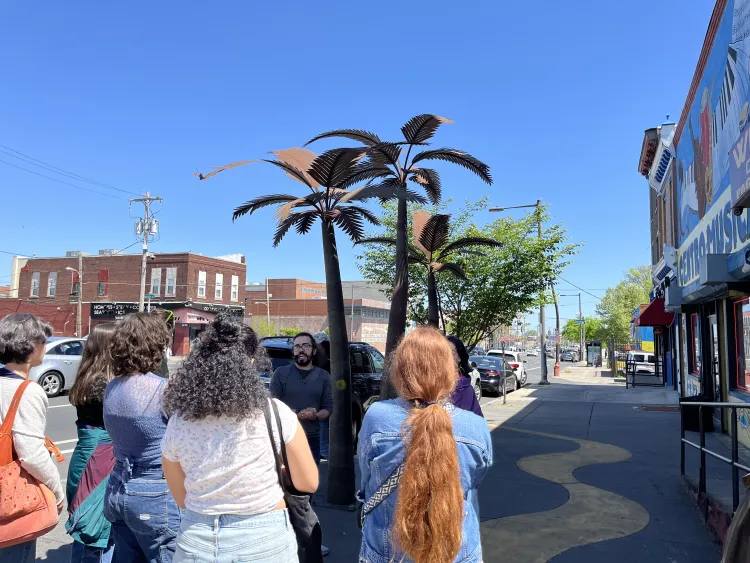
Social Epidemiology (HLTH H228)
Anna West HC, Health Studies
Wednesday 12:15 - 3:00pm
How do the places we live and work shape our health? Why is life expectancy well over 80 years in some Philadelphia neighborhoods, but 64 in others? The interdisciplinary field of social epidemiology offers tools for answering these questions and many more. Social epidemiologists study the relationship between health outcomes and the social environment. “Social” and “environment” are expansive concepts that include everything from average household income and unemployment rates to racially exclusive zoning, parks and tree canopy, proximity to industry, and social cohesion, to name but a few. Social epidemiology theory locates these neighborhood characteristics in large structural forces and local histories alike, and posits physioAnna logical mechanisms by which unequal environments (and inequality itself) impact physical and mental health. Because epidemiology is a probabilistic science, researchers must identify measurable variables that can stand in for complex social phenomena. Critical perspectives on quantification drawn from science and technology studies (STS) offer guidance as we read, assess, and discuss the policy and programmatic implications of research on health and social environments. Students will gain an appreciation for the kinds of analyses, arguments, and action that social epidemiology makes possible, as well as some of its limitations.
The Spring 2027 section of this course is offered through Tri-Co Philly, affording a unique opportunity to integrate ways of seeing and knowing the city: students will explore Philadelphia’s neighborhoods through social epidemiological literature, mapmaking, field trips, conversations with residents and civic organizations, and structured observations of public space.
A City of Homes: Housing Issues in Philadelphia (SOCL B260)
Nora Taplin Kaguru, BMC, Sociology
Thursdays 12:15-3:00 pm
In the late 19th century, Philadelphia’s boosters described the city as the “City of Homes” to celebrate its success compared to other major cities in the US in providing housing and opportunities for homeownership for its growing population of workers. This class investigates the unique history of housing in Philadelphia. We will cover the problems the city has faced and still faces in providing affordable housing, fair access to housing and creating diverse and vibrant neighborhoods and its great legacy of innovation in this area. We will use Philadelphia as a case for investigating the relationship between housing, the economy, locational resources, and neighborhood development. We will see how racial capitalism shapes what housing is built, where it is built and who has access to it.
Through the Tri-Co Philly program students will engage with this literature as part of an immersive experience in the city and gain a deeper understanding of the practice of engaging with housing issues for professionals and political actors. Students will have opportunities to meet with organizations working on affordable housing, fair housing and historic preservation,Thur and to do neighborhood tours related to the texts we read (possibly including touring Society Hill, Chinatown and the historic 7th Ward). When possible, we will invite local residents, practitioners and scholars in the field to lead these neighborhood tours. Students will become familiar with a variety of different professionals and community members working on housing issues from urban planners to community organizers. This course will be taught in Philadelphia as part of the Tri-Co Philly Program.
FALL 2026

Ecologies of Cooperation: Modeling Participation and Ecological Practice Through Philadelphia-Based Arts, Culture, and Environmental Co-Operatives
(ENVS/VIST H317A)
Dylan Gauthier, HC
Monday, 12:15-3:00 p.m.
Ecologies of Cooperation is an interdisciplinary TriCo Philly course that explores how visual arts, the humanities, and cooperative organizing shape contemporary ecological thought and practice in an urban context. Students will engage directly with Philadelphia’s networks of artist-run organizations, cooperative businesses, community gardens, and mutual aid formations to investigate how environmental awareness, care, and stewardship is not only represented, but actively reproduced and continually renewed through participatory, emergent, and collective practices.
Philadelphia is a rich terrain for studying and practicing the social production of ecological thought and action. Through readings, expert guest and site visits, cooperative engagements, and arts-based research, students will immerse themselves in the living networks of people, places, and practices shaping the city’s environmental future(s).
Combining seminar discussion with field-based research in Philadelphia as part of the Tri-Co Philly Program, students will draw on environmental humanities, political ecology, social practice art, and urban studies to analyze how collective structures emerge, endure, and transform. The city will serve as our primary text, offering grounded examples of how shared ownership, collective decision-making, and cultural production can help imagine more just and resilient ways of living together in a time of environmental precarity. This course will be taught in Philadelphia.
ENVS/VIST H317A: Ecologies of Cooperation
Biostatistics: Data, Health and Ethics in Philadelphia (MATH B195)
Chaegeun Song, BMC
Wednesday, 12:15-3:00 p.m.
This course introduces biostatistics through the public health and medical landscape of Philadelphia. We explore how data are used to understand health outcomes, evaluate interventions, and inform policy in urban settings. Students will learn core statistical ideas such as descriptive statistics, study design, comparison of groups, and correlation using examples from public health and clinical research. The course also highlights the role of biostatisticians and the ethical responsibilities involved in working with health data.
As part of the Tri-Co Philly Program, the course engages with the city’s rich health ecosystem. Classes meet in Center City and include visits and conversations with professionals at local hospitals, universities, public health organizations, and related institutions, as well as a visit to the Mütter Museum to reflect on the history and ethics of medical research. Through lectures, discussions, and analysis of real data, students gain both practical skills and insight into health-related career paths.
This course will be taught in Philadelphia as part of the Tri-Co Philly Program.
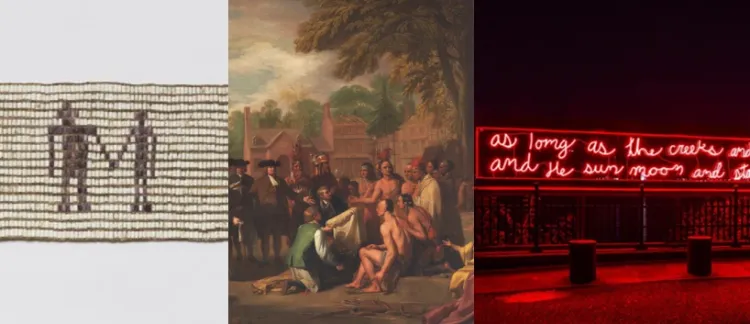
Left to Right: Wampum Belt ("Penn's Treaty Belt"), 1682, likely made by Lenape women artisans. Historical Society of Pennsylvania Collection / Atwater Kent Collection at Drexel, photo by the Philadelphia Museum of Art; Benjamin West, Penn's Treaty with the Indians, 1771-72. Oil on canvas, 75 1/2 x 107 3/4 in. Photo by Pennsylvania Academy of the Fine Arts, # 1878.1.10.; Duane Linklater, In Perpetuity, 2017. Neon, transformers, aluminum, polycarbonate, and handwritten text by Sassa Linklater. Photo by Monument Lab.
Art and Culture of Indigenous Philadelphia: From Shackamaxon to the Present (ARTH061/ENVS056)
Christopher Green, SC
Thursday, 12:15-3:00 p.m.
Near the entrance to Penn Treaty Park, a rusting sculpture made from perforated metal rises from a traffic island on Delaware Avenue. The silhouettes of two cut-out figures can be made out against the sky, standing hand-in-hand. The figures are based on the Penn Treaty wampum belt, a woven belt of white and purple quahog shells that commemorated the Treaty of Shackamaxon, named for the important Lenape site at the present-day park where William Penn and Chief Tamanend of the Lenape signed the founding agreement of Pennsylvania under the Treaty Elm. The figures represent the joining of Penn and Tamanend in a peace that would be infamously broken in subsequent years by Penn’s sons, resulting in the forced removal and deterritorialization of the Lenape and other nearby Indigenous communities. A plaque next to the sculpture, Moon Over Indian Land, made by Chiricahua Apache artist Bob Haozous, reads “This is Indian land.” Countering the pervasive myth of the vanishing race, Haozous’s inscription asserts an ongoing and active Indigenous presence, refuting the idea that Indigenous peoples have disappeared since early colonial contact and reminding passers-by that such history pervades the earthen foundations of the city’s landscape.
This course will take up this missive and examine the visual and material histories of Indigenous communities, artists, and leaders of present-day Philadelphia and its surrounding ancestral territories, from pre-contact to the present. We will consider the history of the city and the land upon which it stands as an Indigenous place, one that has been occupied since time immemorial by Indigenous peoples and that has served as a gathering place and cross-roads for the travelers, diplomats, and storytellers of many Native nations. We will consider how the Indigenous history of Philadelphia and Pennsylvania more broadly reflects on and is interrogable through present-day sites and constructions of civic identity, and how to this day a resurgent Indigenous community calls Philadelphia home. Among topics for close study are the archaeology and material culture of the Eastern Woodlands and ancestral Lenape territory, including earthworks, beadwork, and pottery; Euro-American representations of Indigenous peoples from early contact through the twentieth century, including history paintings such as Benjamin West's Penn's Treaty with the Indians and portraits of Indigenous leaders and diplomats passing through the city as part of delegations to the nation’s capital in Washington, DC; Indigenous oral histories of and visual representations of such histories, such as the Shackamaxon wampum belt; Philadelphia monuments and the memorialization of colonial history; and modern and contemporary Indigenous art and exhibitions that reflect Philadelphia as vibrant urban Indigenous center. We will visit Philadelphia-area museums, art collections, and public sites including the Penn Museum, Philadelphia Museum of Art, Barnes Foundation, Penn Treaty Park, Welcome Park, City Hall, and more in order to engage in close-looking and hands-on object and site analysis to better understand the ways that Indigenous history undergirds the foundation of the city and, more broadly, the nation.
This course will be taught in Philadelphia as part of the Tri-Co Philly Program.
Arts and Humanities.
1 credit.
Eligible for ENVS, ESCH
Fall 2026. Green