Swarthmore Collaborates with AccessAbleUSA to Create Digital Access Guides for Campus Spaces
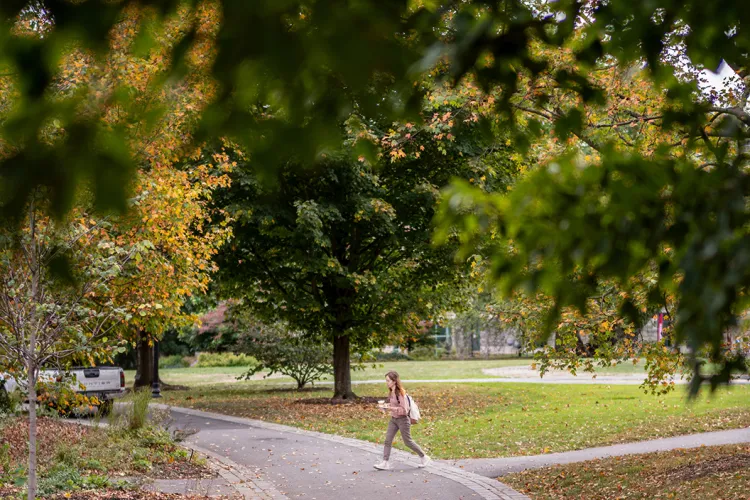
In an effort to make Swarthmore more accessible to students, faculty, staff, and visitors, the College has partnered with AccessAbleUSA to create comprehensive detailed access guides for more than 50 campus buildings. The guides, covering everything from academic buildings to residence halls to the Matchbox fitness center, were released to the campus community in November.
Each space will have its own guide, viewable on the AccessAbleUSA website, as well as in various locations on Swarthmore’s own site. Users will be able to review the specific details they need to prepare to navigate campus based on their individual preferences and requirements. From planning where to enter a building as a wheelchair user, to identifying which spaces offer assistive listening systems, to locating all-gender single-user restrooms, these detailed guides aim to be an invaluable resource thanks to their depth and clarity.
“If the guides are able to lessen the anxiety because you see that there is a way for you to navigate a space, or maybe you say after looking at a guide, 'OK, that space is not going to work for me, so I’m going somewhere else,' that was the motivation,” says Swarthmore's Americans with Disabilities Act (ADA) Compliance Program Manager Susan Smythe.
Smythe highlights a core part of AccessAbleUSA’s mission: The organization does not rate or modify spaces. Instead, it provides detailed accessibility information and photographs so that users can make informed decisions based on their own needs. As Smythe notes, having access to this level of detail benefits everyone — not only people with disabilities.
Rose West ’26, a blind student who travels with her guide dog, Nara, reflects on the challenges she has experienced when navigating campus.
“I don’t think I’ve ever gone into an academic building that is straightforward and conceptually easy to understand,” she says. “A lot of times there are curving hallways and corridors or staircases hidden behind doors. There are also strangely placed braille signs, which — especially when I first got to campus — made independent travel really difficult.”
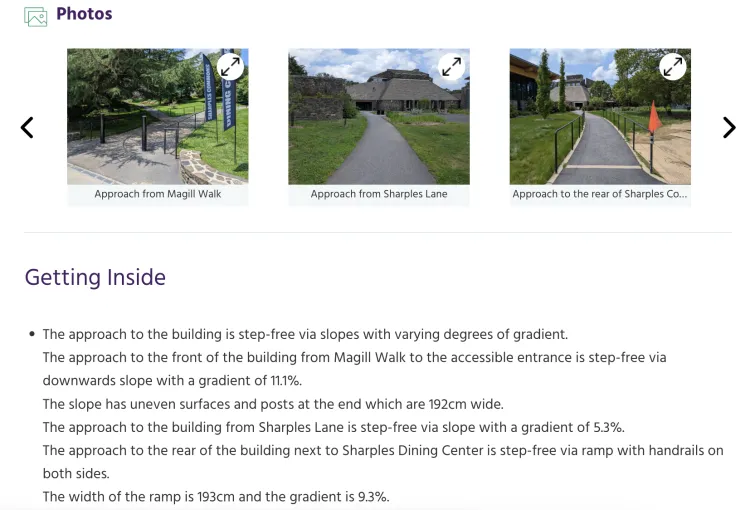
From planning where to enter a building as a wheelchair user, to identifying which spaces offer assistive listening systems, to locating all-gender single-user restrooms, detailed guides aim to be an invaluable resource thanks to their depth and clarity.
West is enthusiastic about AccessAbleUSA’s detailed access guides. “Being able to access information on demand that allows me to understand the layout of buildings and navigate more effectively increases independence,” she says.
She adds that the guides will also benefit visitors. “Events open to the public can be difficult when you’re a disabled person, figuring out what building to go to and how to navigate it. I appreciate that there will be more disability-centered events open to the public because people won’t have to rely on a host to assist them.”
In addition to providing ADA-required information, such as ramp gradients and turning-space dimensions in restrooms, AccessAbleUSA includes data informed by the International Standards Organization (ISO) and consultations with disabled persons organizations.
“For example, people with certain neurological conditions can literally be thrown off balance by highly contrasting patterns in carpet, so we survey for that," says AccessAbleUSA’s Vice President for North American Partnerships Lesley Davis. “We also note visual elements, lighting levels, and noise levels so that people with neurodivergences, low vision, hearing loss, and others can be better prepared to navigate new spaces. And we capture a very important piece of information that many people with disabilities find helpful — the ‘transfer’ or open side of the toilet — because everyone needs a bathroom that works for them.”
Smythe also notes that chronic illness is the second-largest category of registered disabilities on campus. “For people who have limitations on distance stamina, this is another way to use less energy,” she explains. The guides will make it easier for users to plan the most efficient route from point A to point B, and identify places to rest along the way.
Swarthmore has taken many steps over the past two decades to create a more accessible campus environment. “We’ve spent a lot of time on enhancements to our campus map, and in signage — identifying things like inaccessible entrances and directing people to accessible ones,” Smythe says. “We have done quite a bit to be welcoming and give people advance information, and this just seemed like the next layer.”
Even after the guides are posted, Smythe notes that the work doesn’t stop. “Something else I really like about AccessAbleUSA is the ability for users to suggest changes if they encounter something in a space that is different from what appears in the guide. Users click a button and fill out a simple web form, and those changes will get made. I think that’s a wonderful aspect of the system, the ability of actual users to influence what they get is a critical element.”
The campus will celebrate the launch of the AccessAble guides with a study break event on Thursday, December 11 from 10:00am - 12:00pm in the McCabe LibLab.