Steven Mukum ’26 to Explore Human Displacement Across Five Countries as Watson Fellow
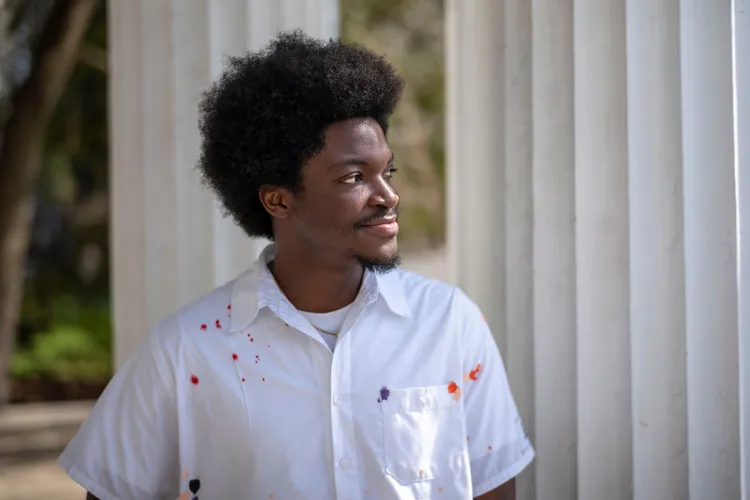
Steven Mukum ’26 has been named a 2026 Thomas J. Watson Fellow — the latest in a string of accolades he has earned while at Swarthmore.
Mukum will embark on a year of international exploration to investigate how internally displaced persons and climate refugees find visibility and agency in a world that too often overlooks them.
For Mukum, the fellowship is the culmination of years of research, community engagement, and deeply personal reflection on forced migration. His project centers on a vital gap in international law: the millions of people displaced by conflict, climate change, and environmental hazards who fall outside the legal protections afforded to refugees.
“Who speaks for those that the law does not recognize?" asks Mukum, an economics and international development major from Cameroon. “My Watson year explores how internally displaced persons and climate refugees — largely unprotected under international law — find visibility and agency through local policies and organizations."
Mukum joins the 58th class of Watson Fellows, a cohort that will collectively travel to more than 70 countries to pursue projects ranging from local theater to global cancer care, mountain communities to music technologies. The Watson Fellowship — one of the most prestigious postgraduate awards in the country — provides graduating seniors the freedom to pursue an independent and fully funded project overseas.
Mukum will travel to Benin, Mozambique, Martinique, France, and Australia — five countries offering distinct windows into how displacement is lived and navigated across vastly different political and geographic contexts.
The Watson news arrived earlier than Mukum had expected. He was in McCabe Library on a Friday afternoon during spring break, working on his thesis, when the email arrived.
“I saw the word 'Congratulations' and immediately broke down in tears,” he says. “Although I had put a lot of work into my application, I knew that the competition was immense, and that I could only hope.
“The first thing I did was call my mom,” he adds, “because I had been talking to her about this application since August of last year, and I wanted to share the news right away."
Mukum’s Watson Fellowship project builds directly on work he has pursued throughout his time at Swarthmore. Through the Lang Center for Civic and Social Responsibility — which awarded him a Lang Opportunity Fellowship — Mukum developed the research and community-based foundation that now anchors his fellowship proposal.
He has also been recognized through the Davis Projects for Peace program and received the John Lewis Leadership Fellowship and The Diana Award. Among his other achievements at Swarthmore was envisioning and organizing the African is Rising symposium in 2024.
Reflecting on his time at the College, Mukum expressed gratitude for the community members who shaped him, including Carina Yervasi, associate professor of modern languages & literatures, French & Francophone studies; Kathryn Riley ’10, associate professor of chemistry; Emily Paddon Rhoads, associate professor of political science; Jen Magee, director of program development, implementation and assessment at the Lang Center; and Alexandra Gueydan-Turek, associate professor of modern languages & literatures.
“They have been more than professors — they have been guiding lights,” says Mukum, who also thanked the Lang Center for offering “a home for the kind of engaged scholarship I have come to value."
During his Watson year, Mukum plans to speak with internally displaced persons, interview the people and the organizations that serve them, and pursue formal internship experiences related to migration. But he is equally committed to the personal dimension of the fellowship.
"My greatest challenge will also be my greatest assignment: to truly live in the moment," he says. "I want to give myself permission to slow down, to be fully present, and to genuinely experience the places I will encounter."