Physics Major Hannah Poon ’27 Co-Authors Biology Education Activity

When Hannah Poon ’27 first encountered a 1905 paper by zoologist George Wagner, she wasn’t looking for her next publication. She was captivated by a series of meticulous, hand-drawn diagrams documenting the behaviors of Hydra — tiny, 1-millimeter freshwater polyps that cling to rocks in riverbeds. In those sketches, she saw not just careful observation, but possibility.
That possibility has since become a published article: “Measuring is believing: Quantifying adaptation behaviour of Hydra,” co-authored with Associate Professor of Biology Eva-Maria Collins and recently published in Science in School, a nonprofit journal dedicated to supporting teachers in delivering STEM curricula and encouraging students to pursue careers in science.
“We set out to design a hands-on science activity for middle and high school students to introduce core biology concepts and walk through the steps of scientific inquiry,” says Poon, of Houston, Texas.
The activity centers on Hydra’s adaptation response to simulated river currents and emphasizes the power of quantification for biological discovery. In the wild, a Hydra contracts into a ball when it senses a sharp change in current, protecting itself from being swept away from the rock surface to which it adheres. Once the current steadies, it adapts — elongating its body and tentacles back to a resting state, even under higher-intensity flow.
Poon was drawn to the project for its elegance and accessibility.
“In these hand-drawn diagrams of the Hydra adaptation response, I saw potential in the relative quickness of the response, the simple experimental setup for replicating these water currents, and the excitement of watching the Hydra slowly elongate over time,” she says.
In the lab, Poon and Collins recreated river currents by rocking a portable, low-cost microscope. Students can observe and measure the Hydra’s contraction and elongation in real time, measuring a biological response that is both simple and profound.
There was also a tinkering element she loved. Early prototypes involved servo motors and even popsicle-stick tappers to create vibrations for the Hydra before the team realized that moving the base of the microscope itself was the most manageable solution to ensure steady imaging conditions during water movement, which are essential for the quantification of motion.
The final breakthrough came just a few weeks before submission, when the team realized that moving the microscope itself was the solution.
Additionally, Collins found a scrap of felt that could be mounted on the microscope’s bottom and smoothed the rocking motion — a key aspect, as felt can be easily affixed and removed, and is an inexpensive item that is usually available in a school setting.
Soon after, Poon and Collins finalized their 24-page manuscript — complete with worksheets and supplemental fact sheets developed in tandem with the procedure — over the span of five months, and sent it off to the Science in School editors.
For Poon, a physics major whose work bridges into biology, the publication process was both rigorous and energizing.
“This was one of the first manuscripts I put together for publication: It required a journal-specific format and clarity in the details presented,” she says, adding that tight deadlines meant dropping in and out of the lab between classes, sometimes leaving petri dishes on the bench before rushing to a seminar.
“But I didn’t mind,” Poon says. “I truly loved the process of creating, exploring, and trying again.”
When the publication acceptance came, Poon felt elation and gratitude. But mainly, she drew satisfaction from imagining teachers around the world using the experiment to spark curiosity in their own classrooms.
Also top of mind for Poon was the mentorship that made it possible.
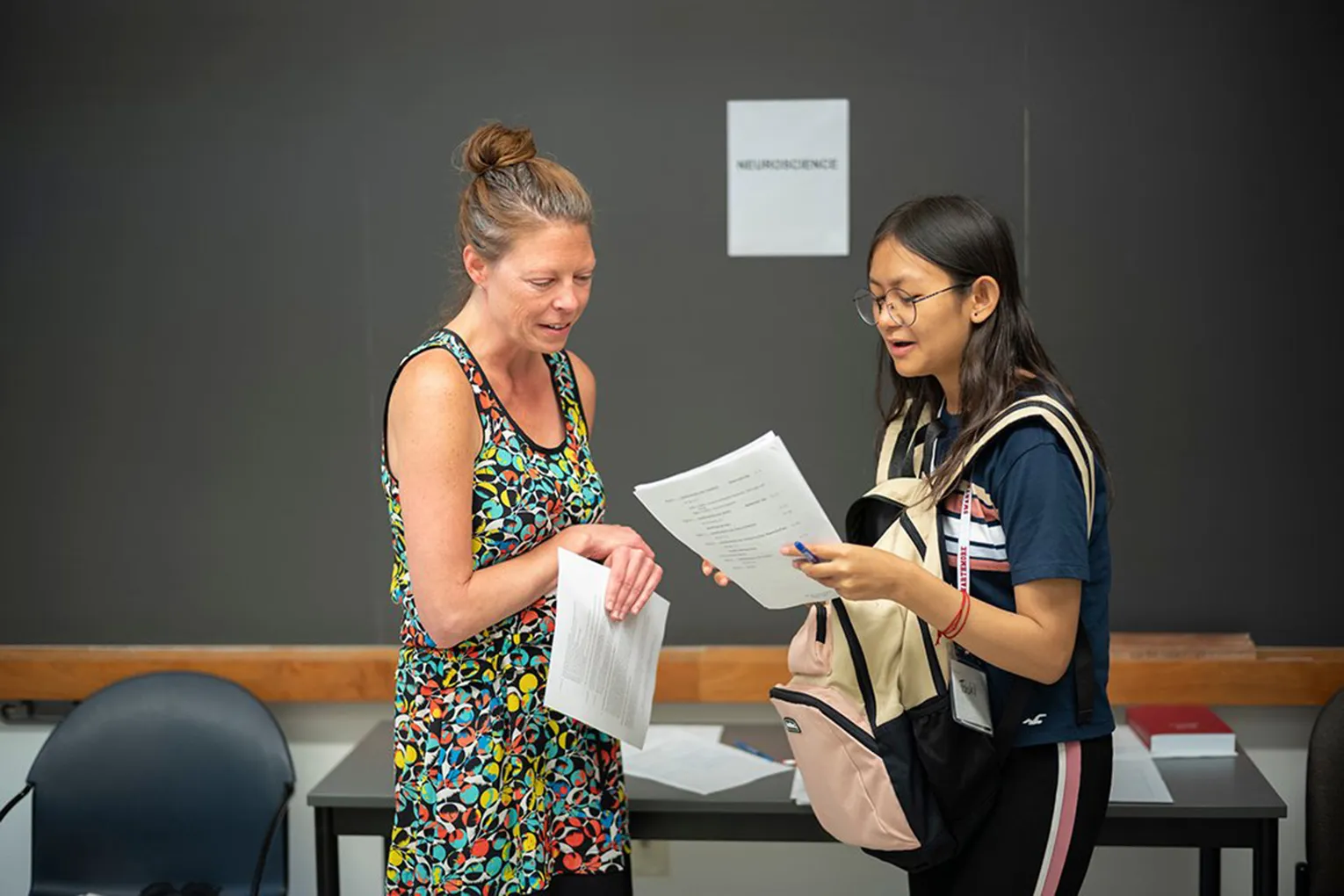
“I could not have done it without my mentor, Professor Collins, who very patiently walked me through the entire manuscript-writing process and made time in her busy schedule to troubleshoot with me,” she says.
Poon also expressed gratitude to Associate Professor of Physics Cacey Bester, who reached to congratulate her on the work; Vivien Zheng '28, another member of the Collins Lab, who tested the science outreach activity and offered feedback to help with troubleshooting; and Collins' children, "who tested the activity and provided valuable feedback directly from our target audience," she says.
Education and public engagement have long been central to Poon’s path. She began working with children at age 11 and later ran classes in her community to help students catch up academically. While developing the Hydra activity, she pictured her younger self — a student who would have loved exploring “these weird-looking animals” and learning how to think like a scientist.
“I think so much important work is accomplished through education,” she says. “A child’s ability to dream, their confidence to embrace new things, and that confidence to enter spaces that seem unfamiliar or ‘not meant’ for them.”