Investigative Journalist and Author Ted Gup Champions Free Press Amid Threat to Democratic Institutions
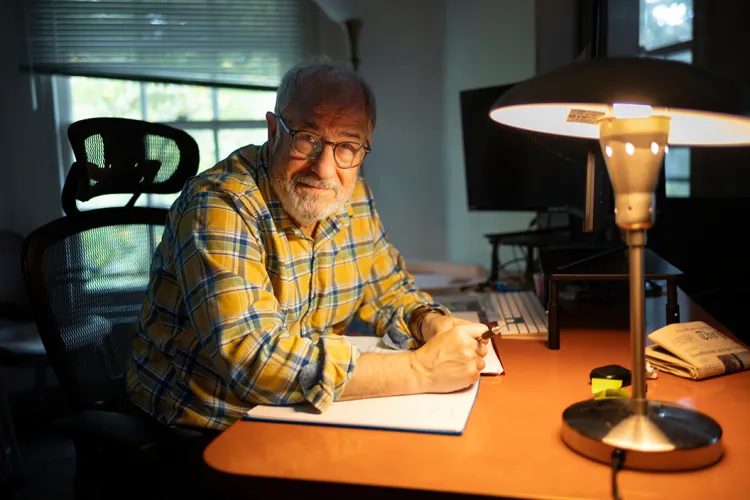
“Investigative reporting is deeply patriotic,” says Gup. “It reflects a belief that a country can reform itself, that it can be better. It’s about rigid self-assessment, not denial — the opposite of attempts to rewrite or sanitize history.”
Ted Gup, a veteran investigative journalist and author, serves as Lang Visiting Professor for Issues of Social Change at Swarthmore. He’s teaching a timely new course on investigative reporting. A former member of Bob Woodward’s team at The Washington Post, Gup has also written for Time, and The New York Times tackling themes of secrecy, democracy, and civil liberties. He is the author of three acclaimed nonfiction books and is at work on his fourth, about the Jewish ghetto of Rome during World War II.
What appealed to you about this opportunity?
When I was in high school in Ohio, Swarthmore was actually my first-choice college. I flew in for an interview, and when the interviewer looked over my file, he suggested I was wasting my time. I don’t take rejection well, and half a century later I finally found a way to get in. But more seriously, Swarthmore represents something special. I’ve never felt more privileged than being here. The College has a kind of intellectual integrity and humility that sets it apart. Its students are gifted, but they’re also willing to listen, to wrestle with ideas, to grow. To me, that’s at the core of the institution.
What does your investigative journalism course entail?
I’ve taught investigative reporting before, but this course is different. America itself is in a different situation, so this is not a generic investigative journalism class. We’ll be focusing on civil liberties under attack and the threats to democratic institutions. It’s a course designed to be responsive to the times in which we live. That means students will be grappling with very real, fraught issues. Investigative reporting is the hardest form of journalism, in my opinion. That’s also why I’ve brought in Vernon Loeb, a journalist of enormous experience and talent, to help mentor the students. We work in teams to support one another when the going gets tough.
How do you view journalism at this moment in American history?
At 74, I’ve lived through a few cycles and periods. But this period is truly different. We are in uncharted waters. In my opinion, our democracy has never been so threatened: on both fronts, the civil liberties of the populace, and the press itself. What we are seeing now is not simply a swing of the pendulum. It’s not just a president’s pet peeve. It’s a wholesale redefinition of power — a stripping away of the guardrails of democracy. This is autocracy. We have courts under threat, checks and balances eroding, intimidation of the press, even blurring of civilian and military roles. It’s not hyperbole to say this is an existential threat to who we are as a people.
People close ranks, wave the flag, and resent reporters who ask inconvenient questions. Journalism itself has become fragmented, an echo chamber that amplifies people’s biases. That makes it even harder for truly independent investigative work to break through. At this moment, investigative journalism may feel embattled, but it is also indispensable.
What else do you have planned for your year at Swarthmore?
I’m working on a book about the Jewish ghetto of Rome during the Nazi occupation in World War II. I stumbled upon the story three years ago in Rome, speaking with the grandson of the chief rabbi of the ghetto. It’s a powerful narrative — virtually unknown to American readers, and to most Italians under 85. It’s about survival, martyrdom, fascism, and the peril of believing “it can’t happen here.” Inevitably, it carries resonances with our own moment in history.
As for Swarthmore, being here is itself the gift. I regard Swarthmore as a place of independent thought and critical inquiry — the very qualities that make dictators fear such institutions. After decades in journalism and teaching, I feel I’ve found a home here.
Editor’s note: This article originally appeared in the Fall 2025 Bulletin.