In Honor of Retired Statistics Professor Gudmund Iversen
President Valerie Smith shared the following message with the campus community on May 14, 2026:
Dear Friends,
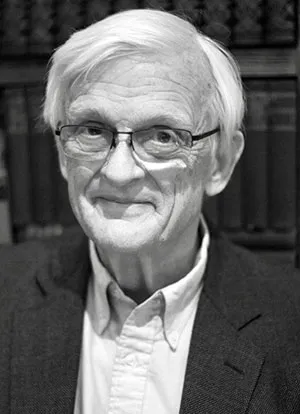
With deep sadness, I write to share the news that Professor Emeritus of Statistics Gudmund Ragnvaldsson Iversen died in Springfield, Pa., on Saturday, May 2. He was 91.
Gudmund, who served on the faculty for 30 years, is remembered for introducing statistics to the College’s curriculum, and his vision laid the foundation for today’s flourishing program.
Gudmund is survived by Roberta “Bobbie” Rehner Iversen, his wife of 52 years; children Kirsten, Eric, John, and Gretchen; eight grandchildren; and his sister Reidun and her family. Services will be private. In lieu of flowers, the family welcomes contributions in Gudmund’s memory to the American Swedish Historical Museum, where he served on the board, or Rotary International’s PolioPlus fund.
I invite you to read more below about Gudmund and his many contributions to our community.
Sincerely,
Val Smith
President
Roy J. and Linda G. Shanker Presidential Chair
In Honor of Retired Statistics Professor Gudmund Iversen
Professor Emeritus of Statistics Gudmund Ragnvaldsson Iversen died Saturday, May 2, at age 91. With his passing, Swarthmore has lost the pioneering scholar who — as the College’s first statistician, and one of the first at any small liberal arts college — established and grew the statistics program to become an integral part of the College’s academic offerings.
“Gudmund is the driving force behind why we have hundreds of students take and enjoy our primary statistics courses every year,” says Professor and Chair of Mathematics and Statistics Lynne Steuerle Schofield ’99. “I will be forever grateful for his collaborative work to put us in this place.”
“The demand for his classes was so large that I got pulled into teaching the introductory statistics course my second year here,” says Aimee Johnson, the John Watts Roberts '39 and Jane Martin Roberts '39 Professor of Mathematics who arrived in Fall 1994. “That meant I had a lot to learn, and Gudmund was very patient and supportive. I could see why he was such a popular teacher.”
“Gudmund recognized, as H.G. Wells famously predicted, that statistical literacy was critical,” says Professor of Statistics Phil Everson, who joined Iversen as the department’s second statistician in 1996. “He created a true liberal arts statistics course, showing how it affects our lives and teaching students to be responsible consumers of information.”
Iversen was born and raised in Trondheim, Norway, where his father was a linguistics professor at the university. He lived through the town’s German occupation during World War II, which began when he was 5. Well into retirement, he clearly recalled taking shelter with his family in their basement during British bombing raids, going to school across town at night because Germans used the closest one for offices, and the day his friend’s father was picked up and killed with other men from town, “as an example.”
“They shot them and dumped their bodies in the ocean,” Iversen said. “Then they took over his house, so my friend and his mom had to leave.”
Iversen’s favorite memory of that time came when the war ended in Europe: May 8, 1945. As word spread through town, neighbors tore down the mandatory blackout curtains from their windows and burned them in the streets. Decades later, he still remembered seeing those big bonfires, as well as cheering in the rain the following month when Norway’s king returned from exile.
After graduating from Trondheim Cathedral School, Iversen studied mathematics, statistics, and sociology at the University of Oslo, graduating in 1958. He completed compulsory military service in Lillehammer, Norway, serving in the signal corps. Iversen was then invited to study at the University of Michigan.
At Michigan, Iversen earned two M.A.s, in mathematics and sociology. In 1962, he married Catherine Sharp in New York City before returning to his undergraduate alma mater for two years as an instructor in sociology and economics. Iversen then earned a Ph.D. in statistics from Harvard University in 1968, and he, Catherine, and their children, Kirsten and Eric, moved to Ann Arbor, Mich.
Many social scientists view the late 1960s and early 1970s as the halcyon days of federal funding support for their research. From 1969-72, Iversen served as an assistant professor of sociology at Michigan while also leading the summer training program for its International Consortium for Political and Social Research. At that time, the consortium, initially established as an effective mechanism for sharing a seminal collection of scientific data, educated 300-400 researchers each year in introductory to advanced training in statistics, data analysis, and quantitative research methods.
In 1972, Iversen joined Swarthmore’s mathematics faculty. After Catherine’s untimely death in 1973, he married Roberta Rehner, creating a new family of six with John and Gretchen.
At Swarthmore, Iversen brought a similar interest to the College’s mathematics faculty and began to expand its use of statistics. Meeting with academic departments across campus, he spent time learning how students would use statistics and assessing the statistical needs of those departments.
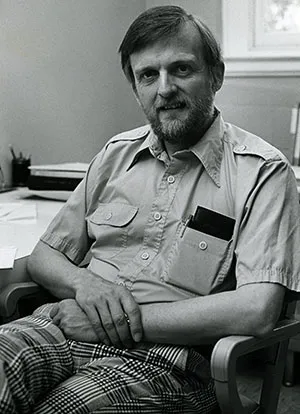
Iversen joined Swarthmore’s mathematics faculty in 1972.
“Gudmund encouraged colleagues to give him, and future statistics faculty, the responsibility and privilege of teaching introductory statistical methods and thinking,” Schofield says. He did this, she says, by helping those colleagues “recognize that statistics is a discipline unto itself, and that statisticians have both the pedagogical and disciplinary expertise to teach statistics, rather than have individual faculty teach the limited tools needed for their own specific research.”
In the process, says Everson, “he managed to centralize the teaching of statistics in our department.”
Before then, Everson says, statistics courses were taught primarily by mathematicians and tended to emphasize calculus and probability theory. One mathematics colleague at the time even reportedly derided statistics as “cocktail party math.”
“Gudmund instead focused on real-life data examples,” Everson says, “and how to understand terms like ‘statistical significance’ and ‘margin of error’ when we encounter them in news or journal articles.”
Iversen made his views clear in a 1985 article for The American Statistician: “If statisticians do not provide statistics instruction for the liberal arts curriculum, then as has happened before, somebody else will, with the end result that it will not be done as well. … Liberal arts education is not a static list of classical subjects; it is an education offering the best of what the arts and sciences, including statistics, currently provide so that students can develop an understanding of themselves and the society in which they live.”
Upon arriving on campus, Iversen also served as the statistician for the College’s new Center for Social and Policy Studies (CSPS). Then located in the lower level of Beardsley Hall, where Iversen also had his office, the CSPS was intended to bring about in the social sciences at Swarthmore the kind of mathematical investigations, using empirical data and theoretical models, that were already common in the natural sciences.
Iversen, who ultimately served two terms as CSPS director, recruited students to work for the center as consultants, assisting faculty and students in quantitative research and statistical analysis. He also used its lecture series to bring colleagues from other institutions who were active in policy-related studies, often involving mathematical modeling, to give afternoon talks.
Iversen’s leadership of the CSPS also benefited new programs. In 1977, its support for empirical work provided an institutional base for the creation of the College’s public policy program, which grew from existing courses in health policy and energy policy and operated for almost 40 years.
In 1992, the name of the Mathematics Department expanded to Mathematics and Statistics, reflecting the growing importance and popularity of Iversen’s work. At the time, 50 to 60% of Swarthmore graduates regularly took his courses. Today, Stat 1/Analytical Thinking and its focus on understanding the role of statistics in everyday life is still one of the most popular natural science courses among non-science majors at Swarthmore.
It is also the subject of Iversen’s popular textbook, Statistics: The Conceptual Approach (1997). In it, he and co-author Mary Gergen shifted the discussion toward an understanding of statistical thinking and its meaning and use in daily life and work. He had previously authored or co-authored seven other books or monographs, including the widely used Analysis of Variance (1976), in which he discussed the basic technique in the understanding of social science data. An updated second edition in 1987 added material linking the use of that technique to regression analysis and using it for experimentally gathered data.
After he retired, Iversen continued to live on Elm Avenue in Swarthmore and remained active in the community. He revived his high school interest in photography, contributing photos of numerous community events to The Swarthmorean and Philadelphia arts organizations. He was also active for many years in the Swarthmore Rotary Club and the Swarthmore Senior Citizens Association.
Reflecting in 2002 on the occasion of his retirement, Iversen said Swarthmore was “just the right place” for him. Of his departmental colleagues and administrators, he “couldn’t have asked for a better group of people to be together with. They’ve been a great inspiration.”
But his impressive list of publications notwithstanding, Iversen revealed that research was not his first priority. “The emphasis on teaching [at Swarthmore] appealed to me,” he said. “Teaching is what it’s all about.”