Creative Writing Program Thriving with New Faculty, Robust Course Offerings
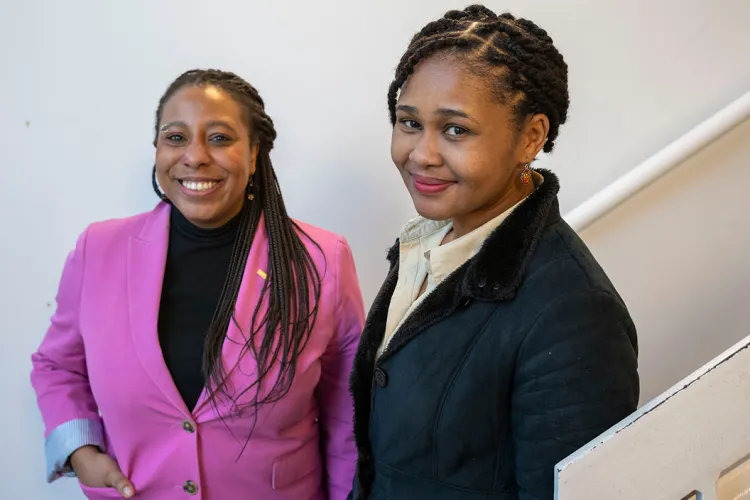
From left: Morgan Parker and Chinelo Okparanta.
The Creative Writing Program (CWP) has grown tremendously in the last five years. The addition of a new faculty member in Fall 2025 means more diverse course offerings, more mind power to help plan Writers’ Week 2026, and, hopefully, no more having to turn away students from writing workshops.
Assistant Professor of English Literature Morgan Parker is a Pushcart Prize winner, National Endowment for the Arts Literature Fellow, and the newest addition to the team.
Director of the Creative Writing Program Chinelo Okparanta is thrilled with the addition of Morgan Parker.
“Our students are equally excited," she says. "One student was overcome with tears and was at a loss for words when she heard Morgan Parker would be coming to Swarthmore.”
“We are so lucky and fortunate to have a new poetry professor whose work is so brilliant,” says Visiting Assistant Professor of English Literature and Creative Writing Moriel Rothman-Zecher. “It feels like the program is suddenly and immediately more robust.”
Rothman-Zecher joined the College in 2023 and teaches both fiction and hybrid (fiction and poetry) courses. Okparanta joined the College in 2021 and teaches mainly fiction, including a popular fantasy and sci-fi class. Both mentioned having to turn away students in the past because writing workshops are capped at 12 students. With the addition of Parker, the program is now able to offer more classes every semester.
“The fact that we can now offer fiction, hybrid forms, and poetry simultaneously feels like such a gift to the program, and such a gift to the students,” says Rothman-Zecher.
“Gift” is also the word Parker used to describe Swarthmore students’ intelligence and enthusiasm for the creative writing classes.
“It adds so much to the classroom dynamic when students are eager to learn,” she says. “They’re all just so curious!”
Parker is currently teaching the Poetry Workshop and a class called Contemporary Poetry And Its Concerns. While the first class focuses on craft and familiarizing students with traditional forms of poetry, the latter is centered on exposing them to as many different types of poetry as possible.
“I want to give students an idea of the breadth of work that’s out there, and that there are many ways to approach the same topic,” says Parker, who uses the class to show students that poets are engaging with all types of topics, from race and queerness to family, grief, and loss.
“It’s not like you have to write a poem about a tree that everyone will love,” she adds.
Parker sees much of her job as giving students permission to write what feels authentic to them.
“I think often we don’t see the material of our everyday lives as poetic enough,” says Parker. “So part of it is just allowing students to see their worlds as fodder for poetry.”
In addition to teaching, all three CWP faculty are hard at work planning for Writers’ Week 2026, set to take place in late March. The College hosts three to five working authors who visit classes, give readings and lectures followed by Q&As, and have dinner with students and faculty.
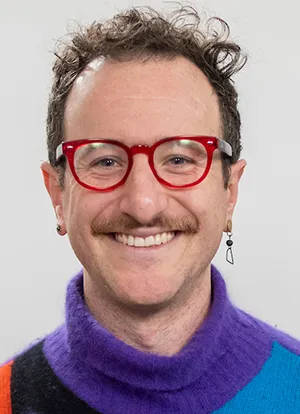
“The fact that we can now offer fiction, hybrid forms, and poetry simultaneously feels like such a gift to the program, and such a gift to the students,” says Rothman-Zecher.
“When we teach a survey course, we gauge student interest,” says Okparanta. “They really like certain stories, and they react strongly to certain authors.”
Authors of the stories that most engage the students are then invited to participate in Writers' Week.
The visiting authors also serve as judges for the Annual Student Writing Competition. The prize categories are fiction, poetry, and essays, and each is judged by an expert in the field. Submissions are judged without any names or identifying information about the authors attached. Winners receive cash prizes as well as the adoration of their peers.
One of the writing prizes is named for Alexander Griswold Cummins Professor Emerita of English Nat Anderson, longtime director of the Creative Writing Program.
“In some ways, it became [Anderson’s] baby, which she really cultivated during her time here,” says Anthony Foy, chair of the English Literature Department, which houses CWP.
Faculty members Betsy Bolton, Peter Schmidt, and Craig Williamson also made significant contributions to the program by teaching writing workshops, but Foy credits Anderson for “keeping everything going.”
“Nat’s very connected and very well-networked in local writing communities, and she was amazing,” he says. “She always made sure that we knew about any and every event involving a major writer in the Philadelphia region.”
The student writing competition “can feel like a really nice way for students to have this moment of external recognition from someone who is a working novelist or a working poet,” says Rothman-Zecher.
The evening begins with the judges reading from their own work, then announcing the student winners, then the students read their winning works for the audience.
“It’s always one of the best-attended events of the year,” Rothman-Zecher says. “It’s wonderful to see how many students submit for these contests and how much they come out to support each other.”
On Wednesday, Dec. 10, the Creative Writing Program’s End-of-Semester Celebration will begin at 4:30 p.m. in the Martin Hall Lobby. Refreshments will be served.
For Writers' Week, which will be held from March 24-26, 2026, the CWP will host writers Angela Flournoy in fiction, Angela Pelster-Wiebe in nonfiction, and Chet’la Sebree in poetry. Sarah Yahm will be the alum guest author.