Collaborative Canoe Carving: A Week of Events with Lenape Artist Denise Bright Dove Ashton-Dunkley
March 19th, 2026
Nia King
(Left to right) Associate Dean & Director of Case Management in Student Affairs Michelle D. Ray, Senior Lecturer in Dance Chandra Moss-Thorne, Emma Shi ’28, Annie Hauze ’27, and former Inclusive Excellence Fellows Initiative Program Manager Carol Pérez Quezada have been working to bring artist Denise Bright Dove Ashton-Dunkley to campus for over a year.
Bringing Lenape artist Denise Bright Dove Ashton-Dunkley to campus to share and speak about her art is the culmination of an Inclusive Excellence Fellows Initiative (IEFI) project Annie Hauze ’27 and Emma Shi ’28 have been working on for years. Ashton-Dunkley is an award-winning master artisan, educator, tribal councilwoman, and enrolled citizen of the Nanticoke Lenni-Lenape Tribal Nation of New Jersey, with over 25 years of experience at the intersection of climate justice, Indigenous law, and the arts.
The effort of the students will pay off when Ashton-Dunkley comes to Swarthmore as a Cooper Series Event — from Fri. March 20 to Fri. March 27 — offering an artist talk and dinner, a traditional wood-carving workshop, a painting workshop, open studio hours, and inviting campus to the opening ceremony of her exhibition.
The purpose of the Power the Narrative Through Art project is to explore and raise awareness on campus of Swarthmore’s history and relationships with local Indigenous communities, specifically the Lenape.
“We talk about this being a Quaker institution, holding these values of peace and acceptance. And then we separately talk about being on Lenapehoking, the unceded territory of the Lenape people,” says Hauze, a children's theater and performance special major from North Pomfret, Vt. “This [project] is a unique lens that puts those things together and layers them.”
Hauze spent much of her first year at the College buried in the archives at the Friends Historical Library (FHL) learning as much about the Lenape and the College’s relationship to them as she could. She was particularly intrigued by the abundance of letters between Nora Thompson Dean, a Lenape woman who taught language classes and made and sold traditional crafts, and Leonore Hollander, a Quaker member of the Lenape Land Association and the Society of Friends Indian Committee of Philadelphia, from 1968-1984.
FHL's archives also include documents from the Lenape Land Association, Lenape language tapes, and craft catalogs.
“All of it is really focused on the preservation of this diasporic community and finding all the ways possible to keep it alive,” says Hauze.
“The Friends Historical Library has so many resources that I think are largely underutilized,” she adds. “It can be really meaningful for students to go in and learn more about a topic just by looking through all of these firsthand sources.”
“The letters [between Hollander and Thompson Dean] really humanize a lot of this history,” adds Shi, of Englewood Cliffs, N.J. “It’s one thing to hear or read about history, but it’s another thing to be able to see it up close and touch it. It makes it feel much more real.”
Hauze and Shi curated two events to raise awareness about these artifacts and this history within the campus community. The first was a monthlong exhibition in the library, during October 2024, showcasing the FHL’s collection of Leonore Hollander’s papers. During the second event, held on February 6 of this year, participants were invited to read and touch these items in the LibLab.
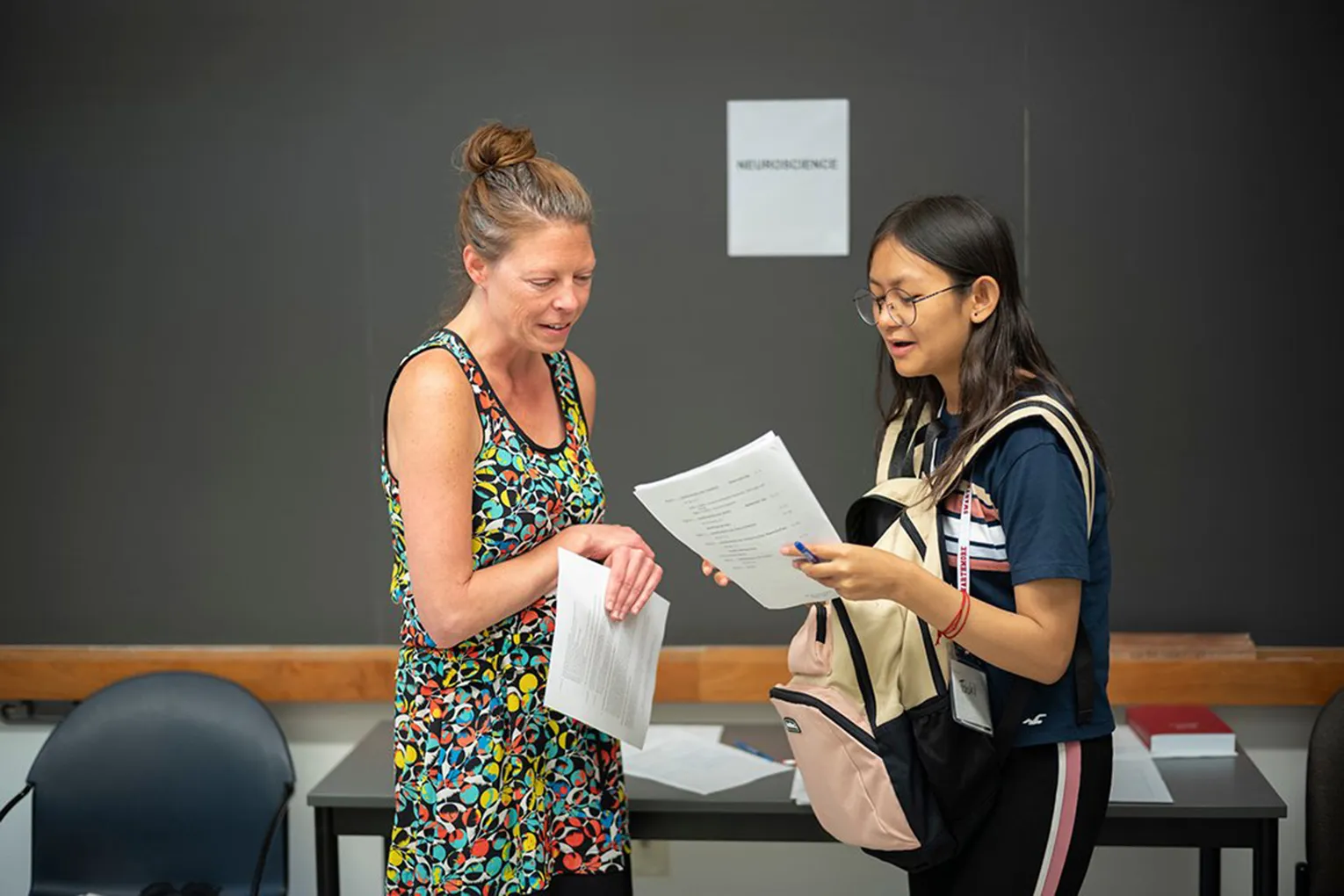
On February 6, members of the campus community joined the IEFI Power the Narrative Through Art team to explore documents and materials from the Friends Historical Library highlighting the history of the Lenape people connected to Swarthmore.
On February 6, members of the campus community joined the IEFI Power the Narrative Through Art team to explore documents and materials from the Friends Historical Library highlighting the history of the Lenape people connected to Swarthmore.
Photo/
1
of
4
“The year before I joined, Annie and June [Shin ’25], who was working on the project before, found Denise [Bright Dove Ashton-Dunkley] after a long search for an artist to invite,” says Shi. “Our work together was really figuring out, ‘What does it look like to meaningfully engage campus and how do we make that happen?’” This involved brainstorming events, applying for a Cooper grant, and soliciting input from campus partners, with support from Senior Lecturer in Dance Chandra Moss-Thorne and former Inclusive Excellence Fellows Initiative Program Manager Carol Pérez Quezada.
“The project sits in this very intersectional space, in terms of academic interests,” says Shi, who reviewed the course catalog and identified classes related to Indigenous art history, climate justice, and socially conscious art-making. She then reached out to the professors of those courses to ask in what ways they might like to be involved.
Associate Dean & Director of Case Management in Student Affairs Michelle D. Ray, who runs the Inclusive Excellence Fellows Initiative, is eager to finally have Ashton-Dunkley on campus.
“We’ve been talking about her art for a long time. She is pre-building [pieces] so that the Swat community can help finish them,” says Ray. “I’m excited about the end, when we’re going to have all the art exhibited in the Intercultural Center for a month.”
Ashton-Dunkley has been working on carving a dugout canoe out of a log (weighing over 2,000 pounds) since November of 2025. She estimates having spent about 25 hours a week on it throughout the winter, despite freezing temperatures. She debarked the entire tree by hand, and has been carving out the inside mostly with hand tools and burning, though she has employed a chainsaw on a couple of occasions.
“What the students will do is finish chiseling it out as best they can,” says Ashton-Dunkley. “They will get a hands-on experience of what it is to physically work with a log, and what it would have been like to do this 200 years ago with hand tools.”
Ashton-Dunkley says she’s excited to meet more Swarthmore students, after connecting with one of Giovanna De Chiro’s classes who came to see a mural Ashton-Dunkley did for Mural Arts in Philadelphia, and having worked with Hauze and Shi for the past year.
“I’m humbled by the fact that Swarthmore has entrusted me to do this,” says Ashton-Dunkley. “They are not just acknowledging Indigenous presence in the area, but actually putting the work in to elevate those voices and be real allies.”
Submissions Welcome
The Communications Office invites all members of the Swarthmore community to share videos, photos, and story ideas for the College's website. Have you seen an alum in the news? Please let us know by writing news@swarthmore.edu.