Alan Baker Awarded Guggenheim Fellowship for Philosophy
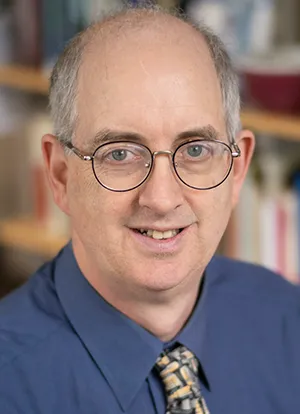
Professor of Philosophy Alan Baker was recently named in the 101st class of Guggenheim Fellows.
Baker is one of 223 fellows this year and one of only three philosophers. The John Simon Guggenheim Memorial Foundation selected the fellows through a rigorous application and peer review process from a pool of nearly 5,000 applicants, based on applicants’ prior career achievement and exceptional promise.
Baker is the second philosopher from the College to receive this distinguished honor, and the first in over 75 years. In 1950, Monroe Beardsley, who taught philosophy at the College for more than two decades, received a Guggenheim for philosophical and literary inquiry into the use of metaphor in the English language.
“I feel very honored to have been awarded a Guggenheim Fellowship,” says Baker. “On the practical level, the funding it provides will enable me to take a full year of sabbatical leave during the 2026-2027 academic year to pursue my book project on mathematical explanation in science. On the symbolic level, this feels like a validation of the scholarly trajectory that I have been following since coming to Swarthmore College in 2003.”
Baker’s research lies at the intersection between philosophy of mathematics and philosophy of science. As a platonist, he defends the position that mathematical entities such as numbers, sets, and functions, really exist, and that the aim of mathematics is to truly describe this realm of abstract objects. He explores case studies where mathematics is used to explain physical phenomena and argues that these applications of mathematics establish that the mathematical entities are real.
The fellowship represents two decades of Baker’s work in developing and defending philosophical arguments for platonism, in particular the so-called Enhanced Indispensability Argument (EIA). He presents the EIA in his co-authored book Indispensability (Cambridge, 2023) and in various articles in peer-reviewed philosophy journals.
An important part of EIA rests on case studies from science, such as explaining why 13-year and 17-year periodical cicadas emerge at prime intervals. In his Mind Journal articles “Are There Genuine Mathematical Explanations in Science?” (2005) and “Science-Driven Mathematical Explanation” (2012), Baker discusses a possible mathematical explanation for this phenomenon, based on the way in which prime period lengths minimize the frequency of intersection with periodical predators.
Baker says he is appreciative of the way in which Swarthmore values both teaching and research.
“I really enjoy being immersed in the liberal arts college environment,” he says. “However, this balance between teaching and research can make it challenging when competing for awards such as the Guggenheim with peers from more research-focused institutions.”
“It has been many years since any Guggenheim Fellowship has gone to a philosopher at a liberal arts college,” adds Baker. “There is definitely an affirming aspect to this award in that it provides concrete evidence that the impact of my previous scholarship has been recognized.”
With his fellowship, Baker intends to complete his first single-authored book project, whose working title is Mathematical Explanation in Science. The book will explore philosophical debates around the question of whether the role of mathematics in scientific explanation gives good grounds for taking the mathematical entities to be real.
“We are so insanely proud of Alan,” says Associate Professor and Chair of Philosophy Krista Thomason. “It's rare that you get to have a colleague who is a wonderful human and a rock star scholar at the same time. We in the department have always known that his philosophical work is of the highest quality, and that he's one of the leading experts in his field. Now with the Guggenheim, the outside world knows it, too. We're so glad he's getting the recognition he deserves.”