Life-Changing Courses: Wargames and Simulations in International Relations
By Ryan Dougherty
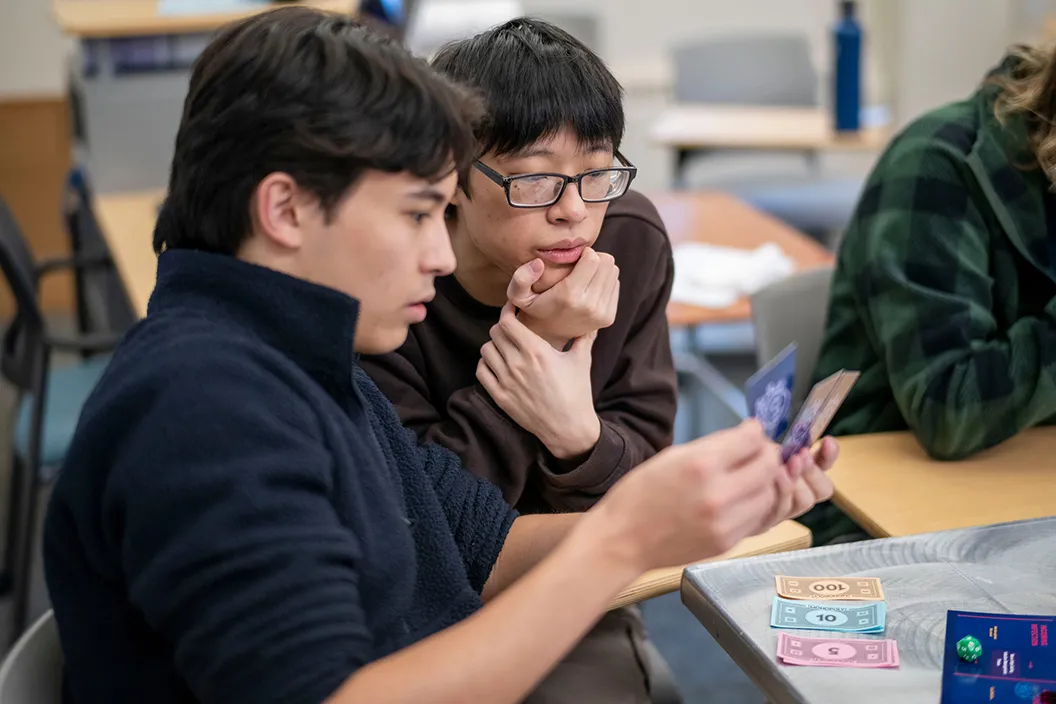
In a seminar room humming with anticipation rather than the clicking of keyboards, students recently confronted nuclear deterrence, humanitarian crises, and climate catastrophe — not through lectures alone, but by playing games.
The new course, Wargames and Simulations in International Relations, taught for the first time this fall by Professor of Political Science Dominic Tierney, asked students to grapple with the dilemmas of global politics by inhabiting them. Dice rolled, alliances shifted, and carefully laid strategies unraveled. In the process, abstract theories of international relations became lived experience.
“In the first ever class of its kind, the students play and discuss various games that capture dynamics in global politics,” Tierney says. “We looked at game theory, visited the Peace Collection to explore peace games, and played a game about a humanitarian crisis.”
Guest speakers joined the class to discuss “the use and abuse of games by policymakers,” adds Tierney, including a former Marine who brought in a war game he designed about conflict over Taiwan.
The appetite for the course was immediate. Forty-four students signed up for just 18 slots, drawn from across disciplines and backgrounds. That diversity was by design.
“There’s a lot of pedagogical value to games and simulations,” Tierney explains. “The class is extremely diverse in studying war games and peace games.”
Games, Tierney argues, offer something lectures cannot.
“They are an incredible tool for engaged teaching,” he says. “For one thing, they are fun. Students also get to directly experience the dilemmas of global politics, whether it’s managing a crisis over North Korea, solving the climate crisis, battling Chinese forces around Taiwan, or handling the aftermath of a humanitarian emergency.”
More than reenacting outcomes, they illuminate causes.
“Students understand not just what happened,” says Tierney, “but also why.”
The course was supported by the Lang Center for Civic and Social Responsibility, which has increasingly backed experiential and publicly engaged teaching. Ben Berger, associate professor of political science and executive director of the Lang Center, sees the class as part of a broader pedagogical moment.
“Games have pretty much always been a part of teaching, but in the present tech era, when we're trying harder than ever to capture students' attention, they seem to be having their own moment,” he says.
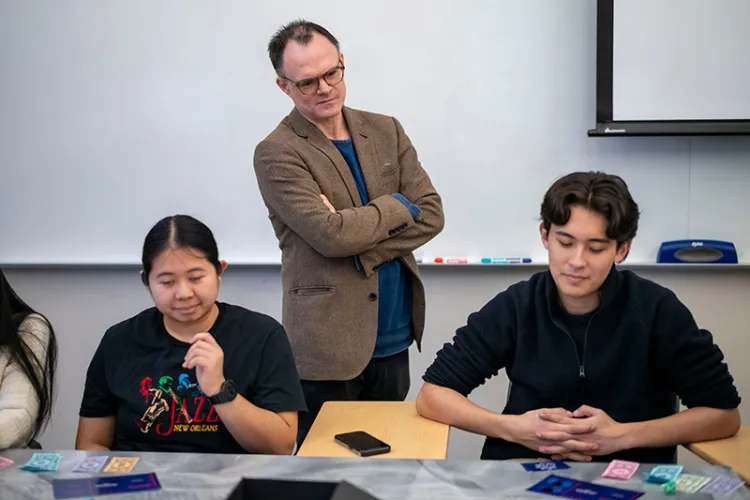
What makes Tierney’s course especially resonant, Berger adds, is its tactile, communal nature.
“The best thing, from a liberal arts and classical education point of view, is that the games we're talking about are analog and in-person,” says Berger, adding that he hopes the class becomes a model.
That thrust of the course extended beyond traditional war games. Laura Melbourne, public services archivist for the Libraries and the Peace Collection, visited the class to introduce students to an alternative lineage: games designed not to simulate conflict, but to practice nonviolence.
“There is a rich history of activists using games to practice non-violence, and that history is accessible to students through Swarthmore’s Special Collections,” Melbourne told the class. “The session on peace games gave students the chance to engage with special collections and to look at alternatives to war games.”
For students, the course’s appeal often lay precisely in its unfamiliarity.
“It's not often that you get to discuss the concept of wargames, let alone have an entire course dedicated to it,” says Jennifer Placido ’26, a biochemistry major from Glenalden, Md., who came to the course with little exposure to international relations.
“When I was playing a simulation, I unknowingly embodied political philosophies I was unaware existed,” she says. “It was both frightening and fascinating how much it humanized international relations to me.”
Bradley Holland ’27 entered with a strategist’s instinct, shaped by years as a competitive chess player.
“Given the niche nature of the class, I correctly assumed it would attract a passionate and engaged class and professor,” says Holland, a philosophy, political science, and economics major from the U.K.
The simulations, Holland notes, reframed game theory away from equations and toward lived decisions, “collapsing complex policy making decisions into something more tangible.”
His memories range from the playful to the apocalyptic: “playing diplomacy and betraying my classmates, unleashing nuclear armageddon in two separate simulations, and designing and playtesting our own games.”
For Daniel Wu ’26, the games became a laboratory for values.
“What appealed to me about this course was the opportunity to explore strategy and human behavior in a controlled, yet dynamic, environment,” says Wu, an economics major from Vestavia Hills, Ala.
One aggressive strategy he deployed quickly led to “distrust, instability, and systemic breakdown,” Wu says, while a more values-based approach “built credibility, enabled negotiation, and produced lasting stability and progress.”
The course culminated in a capstone exercise. Student teams designed and played original games, modeling negotiations at the 1815 Congress of Vienna, the global climate crisis, and international relations during a future pandemic.
“These were terrific,” Tierney says, already envisioning future iterations in which “the game designers return to class and run their games again.”
One of Tierney’s own designs didn’t go quite as planned — a game on nuclear deterrence went “slightly haywire,” he says. But even that, he reflects, became a teachable moment. In a course built on uncertainty, that may be the point.