Solar Energy Center Begins Operations with Support from Swarthmore
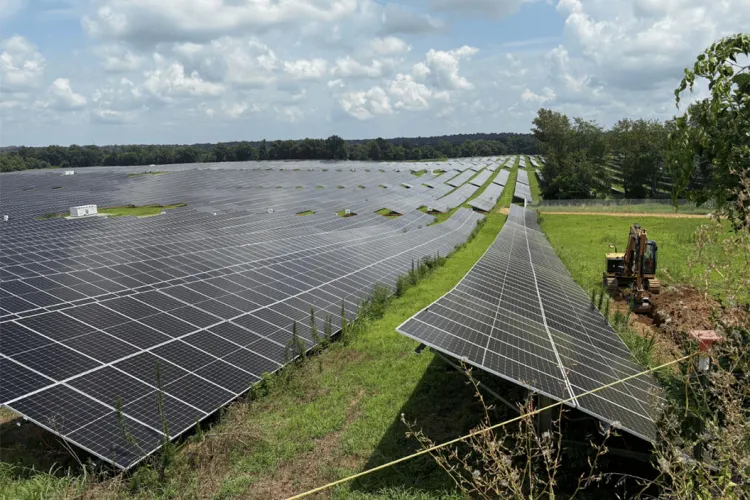
The 150-megawatt solar facility, Sebree Solar II Energy Center, will help meet Henderson County, Kentucky’s growing electricity demand, supplying enough energy annually to power more than 20,000 homes.
Swarthmore and eight other colleges and universities in North Carolina and Pennsylvania have collaborated to bring a western Kentucky solar energy center online.
The 150-megawatt solar facility, Sebree Solar II Energy Center, will help meet Henderson County, Kentucky’s growing electricity demand, supplying enough energy annually to power more than 20,000 homes. Sebree Solar II will also contribute more than $15.5 million in new tax revenue over the life of the facility, money that could be used by the county to enhance schools, roads, and other essential services.
The higher education consortium supporting the project with a Power Purchase Agreement (PPA), coordinated by ERM Coho, also includes Davidson College, Dickinson College, Elon University, Haverford College, Lafayette College, Lehigh University, Muhlenberg College, and Wake Forest University. A subsidiary of NextEra Energy Resources, LLC, developed the solar center, which became operational on Aug. 7, 2026.
Participating in the project will help the College achieve its target of carbon neutrality by 2035. Carbon neutrality was established as an institutional goal in 2012, and is part of the College’s energy plan, To Zero By Thirty-Five (20X35).
“Reaching this operational milestone is a critical step forward in our carbon neutrality journey and moves us closer to achieving our 20X35 commitment,” says Interim Director of Sustainability Clare Hyre. “Swarthmore is now able to use renewable energy credits received from this project to account for greenhouse gas emissions related to purchased electricity.
“By coupling geoexchange with renewable energy,” Hyre adds, “20X35 will eventually eliminate up to 90% of campus greenhouse gas emissions related to the College’s Scope 1 and 2 emissions.”
“Emissions from purchased electricity (Scope 2 emissions) are roughly a third of the College's total emissions annually,” says Climate Action Manager Melanie Patapis. “We are excited to be able to both offset these emissions through Sebree II and provide additional renewable energy to the electric grid.”
While electricity generated by the Sebree Solar II Energy Center cannot be transmitted directly to the consortium campuses because geographic distance prevents the direct transmission of the electricity, the benefits of investing in new additional renewable energy will still be realized by the schools. Swarthmore will receive renewable energy credits equal to 85.6% of the electricity used by our campus, which can be used to account for greenhouse gas emissions related to purchased electricity.
The nine colleges and universities involved in the project will also receive access to data from the Sebree Solar II Energy Center for classroom use, as well as campus speaking engagements, opportunities for site visits, and student internships.
“The Sebree Solar II Energy Center builds on our long-term presence in Henderson County and reflects continued investment in the region,” says Lester Morales, senior project manager of development at NextEra Energy Resources. “Projects like this support local economies and contribute to meeting growing energy needs.”