Physics & Astronomy Students Share Research at Regional Conference
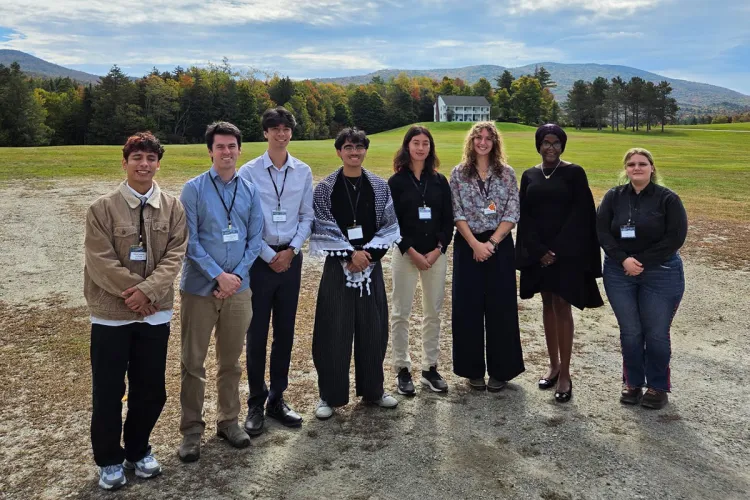
Angelo Phillipe Valencia '27 (fourth from left), Leilani Fleming '28 (fifth from left), and Abby Reed '28 (sixth from left) outside the Bread Loaf Campus at Middlebury, Vt.
Seven Swarthmore students traveled to Middlebury College in Vermont in late September to present research, exchange ideas, and connect with fellow undergraduate astronomers at the annual Keck Northeastern Astronomy Consortium (KNAC) fall research symposium.
Accompanied by Brian Zanger, visiting assistant professor of physics & astronomy, the students joined peers and faculty from liberal arts colleges across the Northeast for the two-day gathering at Middlebury's Bread Loaf Mountain Campus.
Founded in 1989, KNAC brings together astronomy departments from smaller colleges to foster collaboration and provide undergraduate researchers with opportunities to share their work.
“This way, we can all function a bit more like a larger research university, sharing expertise and resources to give our students the best undergraduate research experience possible and prepare them for the larger research world,” says Zanger.
All seven Swarthmore students conducted research over the summer, and six presented their findings at the conference.
Angelo Philippe Valencia ’27, Abigail Reed ’27, and Isaac Chu ’27 delivered research talks to the assembled students and faculty. Valencia discussed his work with Jesse Rivera, observatory manager and laboratory lecturer, to reconstruct a distant galaxy distorted by gravitational lensing. Reed presented research conducted at the University of Sydney simulating how clumps of stars evolve within galaxies, while Chu discussed his work with Carolyn Raithel, assistant professor of physics & astronomy, on gravitational waves and tidal distortions in binary neutron stars.
For Valencia, the experience underscored the remarkable research opportunities available at a small liberal arts college.
“Swarthmore's Physics & Astronomy Department granted me research that asks us questions about the evolutionary picture of the universe overall,” he says. “That's amazing.”
Reed valued the opportunity to develop her communication skills and forge connections within the astronomical community.
"Being at the conference was an amazing experience,” he says. “Not only did I learn more about the research being conducted at institutions similar to Swarthmore, but I was able to expand my scientific communication skills tremendously through presenting and discussing with many new people.”
Chu also appreciated the chance to meet fellow researchers from institutions with similar academic environments.
“Since the research landscape is dominated by more traditional R1 universities, the chance to interact with so many folks from a liberal arts background was unique,” he says.
Three other students shared their research through posters. Wilber Valente-Gutierrez ’28 examined how galactic bars affect gravitational lensing signals, while Josephine Tuft ’28 investigated the influence of galactic asymmetries on galaxy rotation speeds. Both worked with Zanger. Leilani Fleming ’28, working with Rivera, presented research reconstructing another gravitationally lensed galaxy.
Nichelle Sawyer ’28 also attended, discussing her summer research with Professor of Physics & Astronomy David Cohen on outflows from high-mass stars.
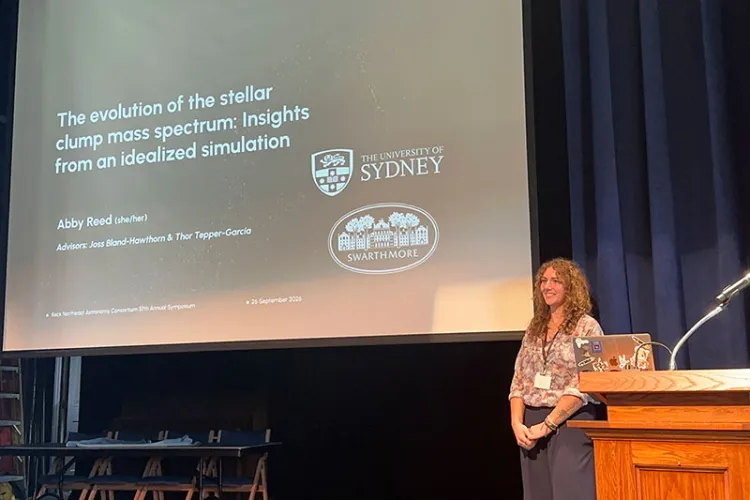
Abigail Reed ’27 was one of several students who delivered research talks to the assembled students and faculty.
Valencia, Reed, and Chu also published papers in the conference proceedings.
Beyond presenting their findings, students had opportunities to explore unfamiliar areas of astronomy, build professional relationships, and gain confidence explaining their work.
“Having experiences where students get to be public-facing experts on their research is definitely important to developing the confidence of undergraduates,” says Zanger, who also enjoyed exchanging ideas with faculty from Colgate, Haverford, and Middlebury.
The students’ experience will come full circle when Swarthmore hosts the September 2027 KNAC symposium, welcoming around 100 students and faculty from member institutions.
For Valencia, the gathering illustrated the broader value of a liberal arts approach to scientific discovery.
“Being at the conference brought me solidarity that anyone can be curious and want to learn something new,” he says. “The interdisciplinary aspect of liberal arts colleges granted the opportunity to do rigorous research while also excelling in clear scientific communication.”