Physicist Tristan Smith Elected American Physical Society Fellow
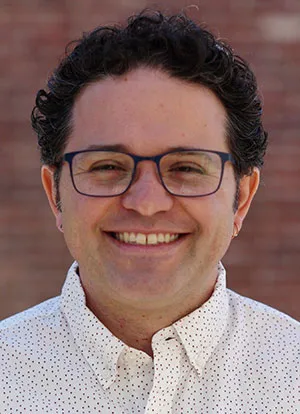
Associate Professor of Physics Tristan Smith has been elected a 2026 Fellow of the American Physical Society (APS).
The APS Fellowship Program was created to recognize members for exceptional contributions in physics research, important applications of physics, major contributions to physics education, and leadership in or service to the APS community. Less than one percent of the society’s membership is recognized by this honor each year.
Smith was selected through the Division of Astrophysics, “for broad contributions to theoretical astrophysics, including seminal work on the Hubble tension and important ideas for gravitational-wave astrophysics and cosmology.”
“I was surprised and deeply honored,” says Smith. “The honor itself is a recognition of the impact my research has had on the broader cosmology and astrophysics community. That recognition feels particularly significant to me as a professor at Swarthmore, where undergraduate research assistants play an important role in much of my research.”
Smith was nominated by his Ph.D. advisor and an honorary Ph.D. advisor who had visited his graduate research group several times.
“Knowing that they took the time to nominate me was especially meaningful,” he says.
At Swarthmore, Smith’s research interests center on early universe cosmology, tests of modified theories of gravity, and the cosmic microwave background.
“[Gravity] occupies a unique place among the fundamental forces of nature,” Smith writes on his website. “As the ‘universal force,’ it plays an essential role in the evolution of the universe, from the big bang to today; as the only known force that cannot be written within a consistent quantum theory, its underlying nature will help elucidate the ‘theory of everything’; lastly, as the weakest force, gravity may allow us to see the universe as it was immediately following the big bang.”
Smith also focuses on the importance of communicating science. For several years he co-ran a workshop on science communication, along with Associate Professor of Acting and Directing Elizabeth Stevens. More recently he has developed a module for an introductory physics course which focuses on science communication.
“A key ingredient of this workshop is the improvisational acting games that we lead,” he says. “The games call on us to connect directly with those around us — an essential skill if our message is going to find a receptive ear."
APS is the premier professional society for physicists, and the fellowship a distinct honor signifying recognition by one’s professional peers. Swarthmore’s most recent recipients were Professor of Physics Catherine Crouch in 2021, and Walter Kemp Professor Emerita of Natural Science Amy Graves in 2018.