Privacy Navigator
Bridging the gap between privacy policies and user understanding
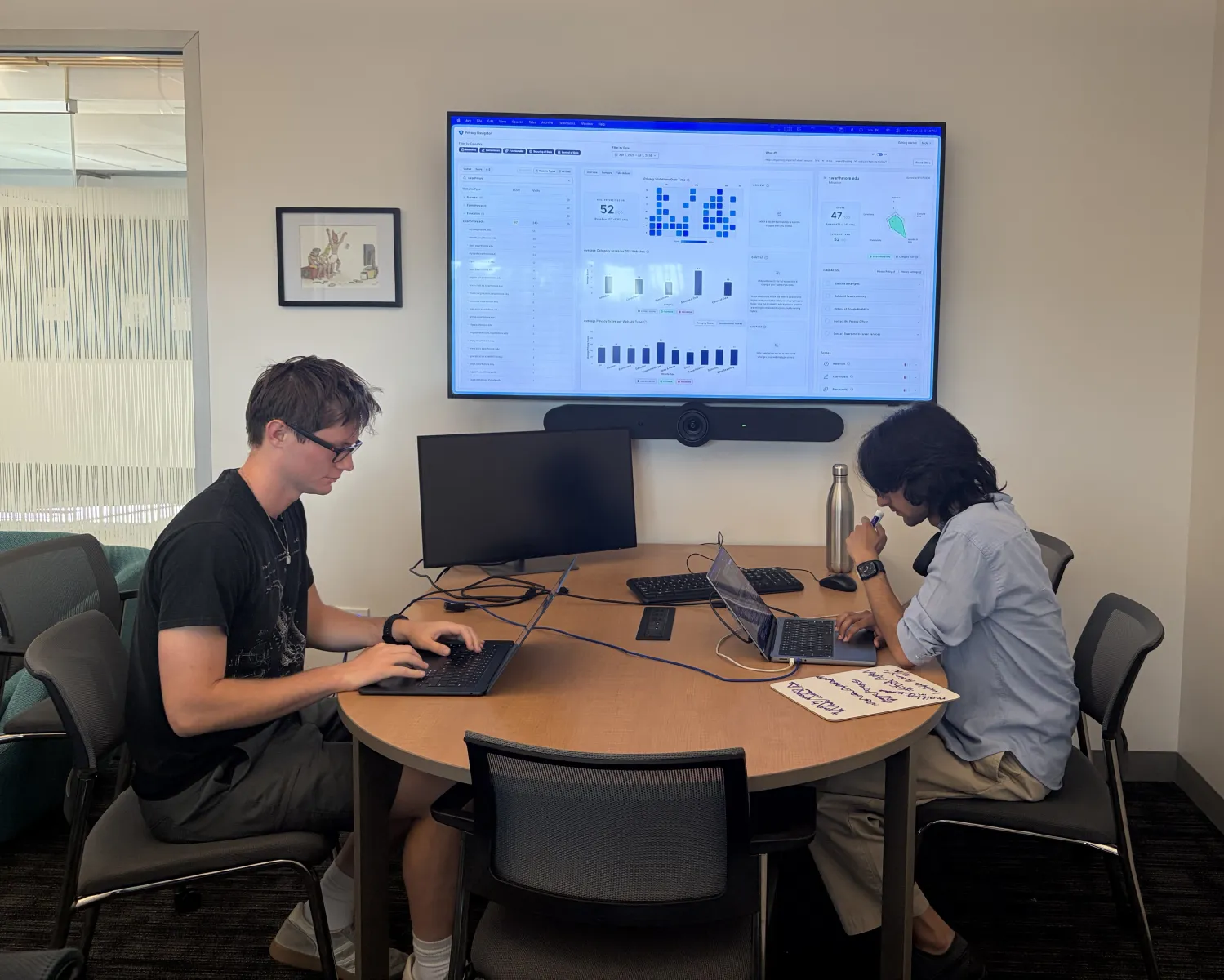
Project title: Privacy Navigator: Bridging the gap between privacy policies and user understanding
Advisor: Sukrit Venkatagiri
Students: Nicholas Matese, Nate Hoffman, Ahmad Fayyaz, Owen Hoffman
Users report caring about their online privacy, but rarely read website privacy policies because of their length and use of jargon. Tools that enhance the transparency of privacy policies often focus on individual websites, rather than users’ overall browsing practices and take a “point in time” perspective to evaluate policies. Users also report feeling demotivated because a score only tells them how good or bad a website’s privacy policy is, with few options to improve their privacy.
To address these problems, we built Privacy Navigator to give users a macro-level, longitudinal, and action-oriented perspective of their online privacy. Privacy Navigator allows users to visualize their past browsing habits and explore “what-if” scenarios, make alternative decisions in the present through just-in-time notifications, and better protect their privacy in the future through action items.
We conducted a pre-post user study with 14 participants to evaluate Privacy Navigator. Our evaluation revealed that, after using our system, users rated their self-efficacy significantly higher than before (Wilcoxon Signed-Rank Test, p-value < 0.05). For this test, we also observed a large effect size (r = 0.87), indicating that users felt more confident in their ability to understand and protect their privacy online. Similarly, users had an average response efficacy score of 26.8, indicating that they overall found our tool helpful in helping them understand and protect their online privacy. Participants also reported that Privacy Navigator effectively distilled dense privacy policies and influenced their future privacy decisions.
Our research shows that a macro-level, longitudinal, and action-oriented perspective towards browsing history and privacy policies can better support user empowerment.