Life-Changing Courses: Critical Approaches to Film and Media
By Olivia Huang ’29
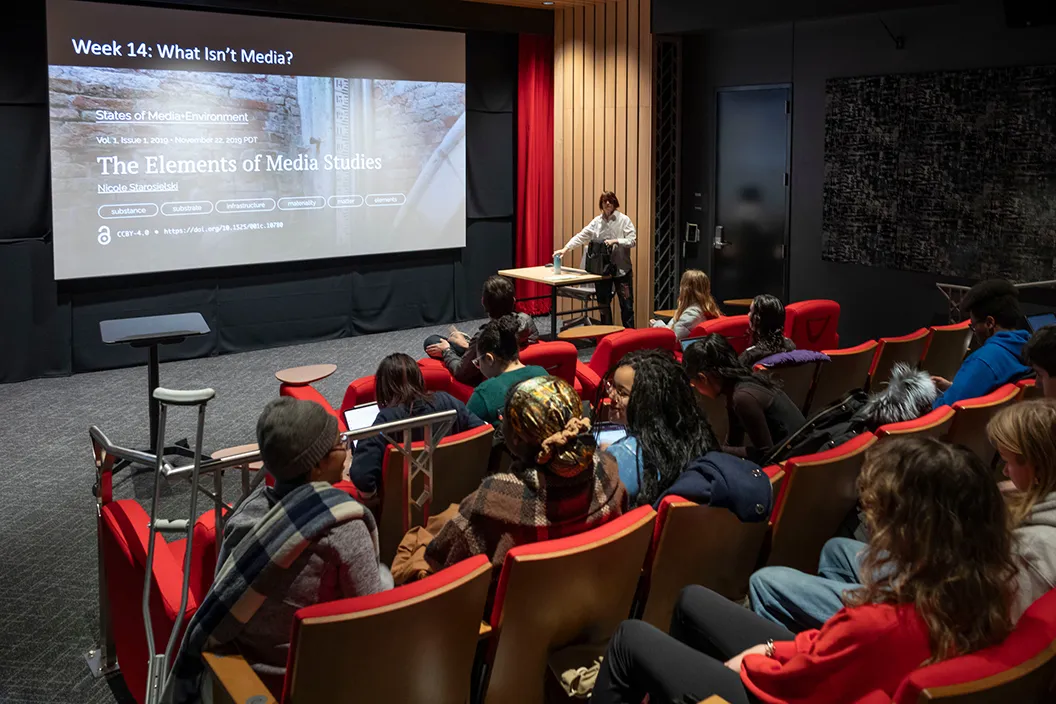
As technological innovation continues to accelerate, our lives are increasingly dictated by different forms of media. With the influx of digital content, internet access, and the use of art as a form of protest and expression, it’s difficult to decipher how we should conduct ourselves in terms of the media we consume. To what extent should we use art to inform our identities? How do we decipher what media is real and what isn’t? How can we analyze media in a productive way that helps us better navigate our digital world?
As someone who has loved movies from a young age, I was incredibly excited to take Critical Approaches to Film and Media (FMST 001) in my first semester here at Swarthmore. Taught by Centennial Chair and Professor of Film & Media Studies and Aydelotte Foundation Director Patricia White, this course serves as an introduction to both film and media analysis, as well as a gateway for students to study the ways in which different forms of media tangibly affect our day-to-day lives.
White breaks the mold of how we traditionally perceive media and frames media in a larger cultural context. How is art shaped by socio-political environments? How do systemic injustices persist and affect whose stories are told? How do we understand our identities in relation to the media we consume? How does media reinforce/resist stereotypes? The class doesn’t offer direct answers to these questions, but rather serves as an outlet for students to discuss them with like-minded peers. The discussion-based format of the class allows students to openly share their opinions and connect with others in an intimately intellectual manner. There are no overbearing lectures or droning speeches — it is a class that wants students to think for themselves and learn directly from their peers.
The class covers a large range of media, spanning from sitcoms to silent films to modern documentaries.
“One aspect of the course I really appreciate is the variety of media we cover,” says Sophie Davis ’29, of Punta Gorda, Fla. “We could be watching a classic film like Citizen Kane one week, then a modern sitcom like Abbott Elementary the next… the diversity in the media we watch expands my perspective beyond the boundaries of Hollywood cinema.”
The class consists of a screening every Tuesday — consisting of classic films, documentaries, and TV episodes — followed by a group discussion facilitated by students in the next class. Each screening is drastically different from the last, not only giving students exposure to a wide range of genres, but allowing them to experience different stories and develop their personal tastes.
“I've found that the most rewarding part of the class is the Tuesday night screenings,” adds Margaret Sawa ’29, of Glen Ridge, N.J. “I really appreciate having the opportunity to watch all sorts of movies and TV shows in a theater-like setting for free and among people who are similarly interested in film.”
These Tuesday night screenings are also available to the broader campus community, making it a fun activity for friends to come and watch a great film together.
“Professor White is kind, approachable, and extremely knowledgeable” says Nayla Punjabi ’26, a peace & conflict studies major from Indonesia. “She covers a wide range of mediums in her class while touching on intersectional social and political concepts.”
White’s clear enthusiasm about what she teaches is palpable — you can hear it in her voice when she talks about her favorite films, goes off on side tangents, or asks eager questions to the class. She has a clear passion for not only the content she teaches, but also the success of her students, always offering extra help reviewing essays or going over class material. White’s teaching is a great mix of approaching class content in an academic sense through essay and textbook readings, as well as letting students geek out over their favorite films or talk about class content in relation to current events. Having such an enthusiastic professor during my first year makes me excited to take more classes in the Film & Media Studies Department, and I would encourage anyone interested in any form of media to take this introductory course!