In Honor of Retired Art History Professor T. Kaori Kitao
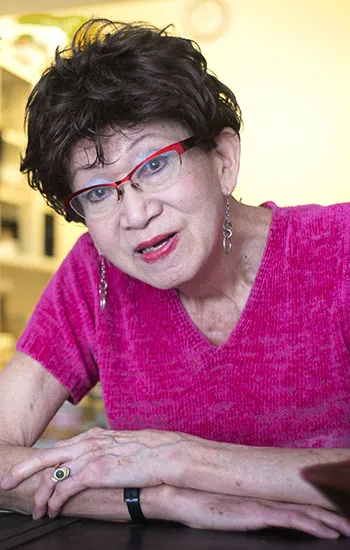
T. Kaori Kitao, 2018
President Valerie Smith shared the following message with the campus community on October 5, 2026:
Dear Friends,
With deep sadness, I write to share the news that T. Kaori Kitao, the William R. Kenan Jr. Professor Emerita of Art History, died in New York City on Monday, Sept. 21. She was 93.
Kaori, who served on the faculty for 35 years, is remembered as a brilliant, pioneering scholar whose passionate advocacy for the arts at Swarthmore expanded and strengthened the curriculum and demonstrated their intrinsic and academic value to the life of the College. Praised as a mentor to countless students and colleagues, she was known for her myriad academic and intellectual interests and the lifelong study she devoted to them.
Kaori was predeceased by renowned fiber artist Tokiko Kitao, her wife of 38 years, who died in 1995. She is survived by her son, Giulio Kitao, and nieces and other extended family in Japan. Contributions in Kaori's memory may be made to an arts organization of your choice. Interment will take place on Saturday, Oct. 17 at 11 a.m., in Greenwood Cemetery in Brooklyn, N.Y.
I invite you to read more below about Kaori and her many lasting contributions to our community.
Sincerely,
Valerie Smith
President
Roy J. and Linda G. Shanker Presidential Chair
In Honor of Retired Art History Professor T. Kaori Kitao
William R. Kenan Jr., Professor Emerita of Art History T. Kaori Kitao died Monday, Sept. 21, at age 93. With her passing, the College has lost a Renaissance scholar in the truest sense of the term, both in her formal expertise and in what she cultivated over a lifetime of dedicated study. As the College’s first openly transgender faculty member, she also modeled what it means to pursue both intellectual rigor and fearless personal integrity.
“Kaori was the most brilliant mind I encountered in my life as an educator and scholar,” says Scheuer Family Professor Emeritus of Humanities Michael Cothren. “She was fiercely dedicated to supporting and developing the place of studio art and art history within the study of the liberal arts at Swarthmore, at a time when many saw them as peripheral, rather than central, to the educational priorities of the College.”
"I began to hear about Kaori — always identified by her first name — as soon as I stepped onto campus a decade ago,” says Associate Professor and Chair of Art History Brian Goldstein. “I know that I live in her wake as an architectural historian at Swarthmore, and it is a very wide one created by someone who was as curious about Renaissance Rome as Japanese gardens. Most of all, she taught students how to see."
“As many on campus know, Kaori was a generous and extraordinary spirit who brought joy, whimsy, and her razor-sharp wit to every space she entered,” says Professor of Art History Tomoko Sakomura. “Her boundless curiosity continues to inspire me in the classroom and in life.”
“In addition to film, I was hired to teach gender and sexuality studies, and I found Kaori an inspiration,” says Centennial Chair Professor of Film and Media Studies Patty White. “Since 1971, she had been visible as Swarthmore’s first transgender faculty member. She deserves greater recognition as a pioneering trans scholar.”
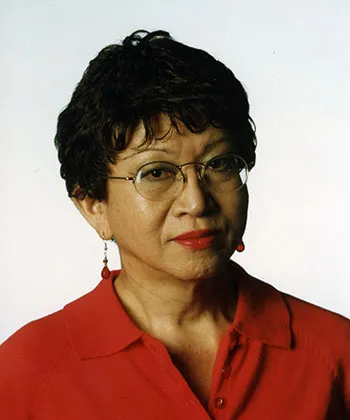
T. Kaori Kitao, 1997
Kitao once said: “I can best describe that I assumed a male identity until I was 38, when I regained my rightful womanhood.”
Born Timothy Kaori Kitao, she was raised in the Aoyama area of Tokyo, where her father, Harumichi Kitao, was a prolific architectural historian. The family’s life changed drastically during and after World War II.
Kitao remembered as a child starting early in the morning with her mother, due to the dire food shortages, “to walk miles into the countryside and beg the farmers for rice and other staples, more often reject yams and pumpkins, in exchange for our city clothes they were eager to have. … There were kindly farmers, but sometimes we were chased away like stray dogs.” Those memories, like the sounds of air raids, never faded.
Later, commuting to school on Tokyo’s vast network of crisscrossing train lines — “the ride on the steep embankment along the moat of the Imperial Palace was particularly thrilling, sometimes riding on the tread and hanging on the handlebar” — Kitao first developed one of many lifelong interests.
“I loved the view one could have of the arriving train on the other line as I got off the train of the first line,” she said. “I still remember vividly the drama of that place, and that may have been my first awareness of spatial geometry underlying architecture beyond the sculpture of toy blocks.”
For several years, in lieu of Japanese middle and high school, Kitao attended St. Joseph’s College in Yokohama, an international missionary school run by Marianist brothers where classes were taught in English. By the time she graduated at 19, she was fairly fluent. She then came to the U.S. to study.
At the time, exchange students needed an affidavit of support for room and board. Earlier, Kitao had befriended an electrician on furlough from his duty on a U.S. aircraft carrier. They corresponded for more than a year, and his family provided the affidavit.
Kitao arrived in the U.S. with one trunk and a suitcase, a $350 scholarship to Santa Rosa Junior College in California, and $30 in cash, the maximum in U.S. currency allowed at the time out of Japan. Secretly, she also had an extra $100 sewn in a waistband.
Working to put herself through school as a draftsman at an architecture firm, full time during the summer and part time during the school year, Kitao earned an A.B. in architecture and an M.A. in art history from the University of California, Berkeley. In 1960, she began a doctoral program in art history at Harvard University and spent a year on a fellowship in Rome. She then taught for three years as an assistant professor of architectural history at the Rhode Island School of Design before finishing her Ph.D. and coming to Swarthmore in 1966.
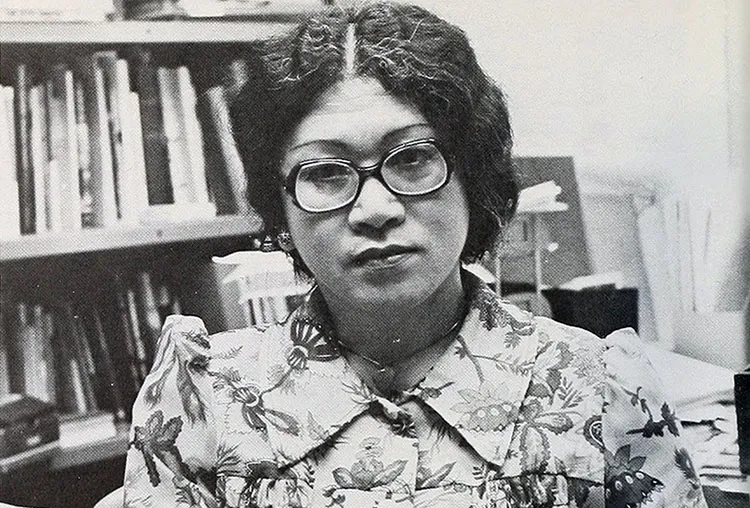
“I loved teaching courses that were new to me because I had to do my reading day by day, along with the students,” Kitao said. “The point is to enjoy learning and expanding one’s horizons so you develop that habit. School doesn’t end with college.” Kitao in her office, 1976.
Kitao arrived on campus as a respected Renaissance scholar and had just completed her dissertation, later adapted into Circle and Oval in the Square of Saint Peter’s: Bernini’s Art of Planning (1974), the definitive work on Rome’s famous landmark. At Swarthmore, she found a “rigorously verbal” curriculum — serious study meant discussion and interpretation, and serious scholarship meant academic papers. Students could not major in studio art, dance, or theater, which were viewed as extracurricular activities.
“It was regarded as amateurish, even though the efforts were not,” Kitao said. “Academics saw art as nonintellectual, as a pursuit that engaged the hands and eyes. Artists of course knew that it wasn’t just hands and eyes but the coordination of the hands, the eyes, and the mind.”
“Architectural studies gave Kaori the opportunity to master and integrate many disciplines, from mathematics and technology to aesthetics and sociology,” says recently retired List Gallery director Andrea Packard ’85, who knew Kitao as a student and as a colleague. “It created the foundation for her hybrid, multicultural, and integrative approach to teaching.”
Kitao pioneered courses in architecture, semiotics, film, and industrial and commercial design, such as City, Cinema: Form and Signification, Philadelphia: City and Architecture, Hollywood 1939, Japanese Architecture and Culture, and Streets. She also taught more traditional courses in Renaissance and Baroque art such as Michelangelo, Rembrandt, Florence, and Roman Heritage.
“Kaori was known across campus for her passion for pedagogical creativity,” Cothren says. “For example, she initiated the first serious study of cinema as a visual art. She was also known for a curriculum about Philadelphia that included field trips into the city to experience on site the changing styles, character, and use of its architecture.”
Studio Art remained a program with no major until 1977, two years after Kitao became department chair. In that role, she strengthened Art History with notable hires such as Cothren and Connie Hungerford, who later served as Swarthmore’s provost and interim president.
Kitao’s classes were legendary. One, Everyday Things, explored the interrelationships between design, technology, and material culture. Perhaps because she had been one herself, Kitao also had a special affinity for international students and once began the first day of class with: “If English is not your native language, you can write in any language you want, because I know nine.”
“Kaori was a true intellectual with a powerfully curious mind,” says Sara Lawrence Lightfoot Professor of Art Randall Exon, another Kitao hire. “Her interests and knowledge went well beyond her training and scholarship. Her expertise expanded over her career to include the entire history of architecture, landscape design, furniture design, product design, poetry, philosophy, and the history of mathematics.”
“If I had the power,” Kitao once said, “I would require all college students to have one studio art and one art history [course]. It helps us learn better, because it teaches us to see clearly, intensely, and systematically.”
Kitao’s interests and advocacy also extended to the performing arts. When Professor Emerita of Dance Sharon Friedler came to Swarthmore in 1985 as Dance’s second director, Kitao reached out and provided invaluable guidance.
“Kaori was clear about what she saw as the challenges we faced in our efforts to build a more robust dance program,” Friedler says. “As we approached the full faculty vote to establish a dance major in course and Honors, Kaori’s advocacy and wisdom helped guide me and the rest of the dance faculty in having conversations and crafting a curriculum that led to nearly unanimous support among the full faculty.”
Professor Emeritus of Theater Allen Kuharski says Kitao supported the expansion of theater in the curriculum that his hiring in the early 1990s reflected. He initially worked most closely with her in the context of the Sager Fund Committee, which provided programming to help overcome homophobia and related discrimination.
“Kaori was a stalwart member of the committee in those years, bringing both her gravitas as a distinguished senior faculty member and her wit to the meetings,” Kuharski says. “This was when the committee was in its most activist phase in some of the difficult years of the HIV/AIDS epidemic. Kaori was always present for the annual symposia and impressed our visiting speakers in the sessions, and alums always looked forward to seeing her there.”
Kitao had a similar effect on Film & Media Studies. “When I came to teach film in the English Literature Department in 1994, I was told I’d need to earn her respect and trust as the originator of the College’s curriculum in the field,” White says. “Her take on the discipline included the most up-to-date theory, in multiple languages. In fact, her perspective was prescient of how we teach the subject today.”
Although these and other initiatives ultimately succeeded, they were often tiring, uphill efforts that involved pointed critiques of how long change took. Kitao cautioned against complacency. “Some [faculty] are alarmingly indifferent or unlearned in the matters of art,” she said. “We have to be constantly alert to potential opposition.”
In February 2001, nearly 100 of Kitao’s students and colleagues from five decades gathered on campus to celebrate her impending retirement. The range of speakers and topics hinted at the breadth of her own wide-ranging interests, spanning colonial architecture to Steven Spielberg, the Stonewall riots to Ellis Island, the design of Kohlberg Hall to the importance of coffee in undergraduate education, and the Zenlike lesson of Kitao’s famous lecture in introductory art history that began simply “Rock. Garden. Rock. Garden.”
That May, the Student Art Association dedicated a small, little-used building on campus to Kitao in recognition of her advocacy. The Kitao Student Art Gallery continues as the College’s only student-run art exhibition space.
Reflecting on retirement, Kitao said she thought of it as “going freelance” and that she looked forward “to further diversification. I am eager to spread out, perhaps rather irresponsibly — definitely chaotically.”
Indeed, for most of her retired years and especially after she moved to New York City, Kitao was out virtually every day and night enjoying art museums and galleries as well as opera, chamber music, ballet, modern dance, and theater performances.
“Her friends would call her for what was termed ‘The Kaori Review’ when considering whether to attend an exhibition or performance because invariably she had already seen it,” says Buffington Professor of Mathematics Janet Talvacchia, a longtime friend. “Kaori would give a detailed discussion of the work and say whether she thought it was worth seeing or not. If we ended up seeing it, Kaori would engage us about our take on what we saw. Poorly formed opinions were not tolerated!”
“I hold fond memories of Kaori gesturing gracefully as she described dances and dancers whose work moved and sustained her as her own physical capacities waned,” Friedler says. “Kaori’s light burned bright and wide; I am forever grateful.”
Even in retirement, Kitao’s influence continued to grow, in part due to her 1999 essay on the liberal arts, “The Usefulness of Uselessness,” a topic she expanded upon in her 2001 Baccalaureate address.
“We turned it into a little red booklet and placed it in the middle of one of the brochures that we sent to students and guidance counselors,” says Vice President and Dean of Admissions Jim Bock ’90. “They would often write to me asking for additional copies, as would English teachers who wanted to use it in class assignments. We retired it after about a decade, but I still believe it was one of our most effective pieces, and with no pictures or glossy print.”
In addition, and in honor of her 80th birthday, Kitao ensured she would continue to educate students by making several generous gifts to the College. She was prompted, she said, because of what she felt the College had given her:
“Swarthmore allowed me to shape and develop my career the way I wanted, and I am deeply indebted to the institution for this reason. … I owe Swarthmore more than a successful career and far-reaching education through teaching. So much of my happy life was nursed and nurtured by the College and its students.”
Kitao’s gifts totaled a staggering $275,000 — “hard-earned money that I had saved by exercising frugal living through my career,” she said — and reflected not only her teaching interests but also the areas she believed the College had neglected and needed to strengthen.
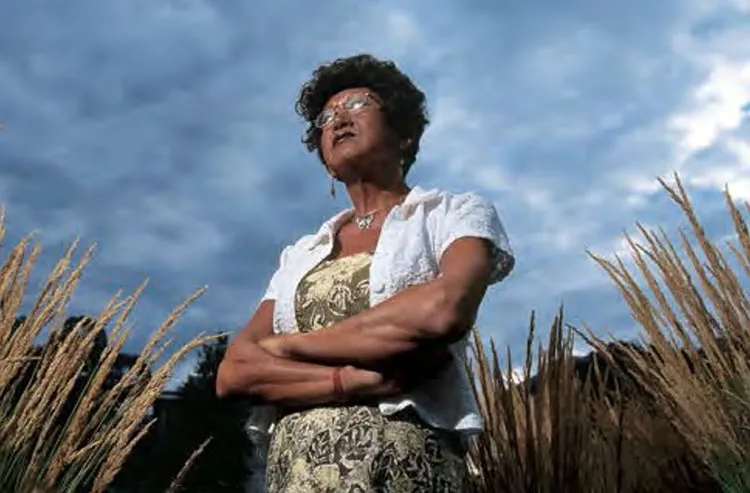
"It is the students that endow a college with distinction, and I had the fortune of having had remarkable young people in my classes," Kitao said, shown here on campus in 1999.
The Kitao Endowment in Mathematics supports an annual lecture — the next will take place on Tuesday, Oct. 6 — which she was motivated to establish, she said, by her desire to fulfill her unrealized “alternative ambition” for a career in the field. The Kitao Endowment for Cinema History supports curricular, scholarly, and public events that explore the topic, especially silent cinema. The Kitao Endowment for the List Gallery supports a variety of educational initiatives such as a student fellowship in curatorial studies, the publication of exhibition catalogs, and on-site sculpture and installation projects. And the Kitao Humanities Research Fellowship Endowment supports historical research, original scholarship, and professional development, with a preference for Italian studies, Japanese studies, and the performing arts.
Kitao noted she was “ecstatically happy to have accomplished the giving” and to “leav[e] behind tracks of my teaching career for decades to come. … For this reason I consider my endowment program the most extravagant gift to myself.”
Of course, the College benefited as well. Packard notes that the word genius often refers to an individual who displays exceptional talent and achievement.
“But one of the early meanings of the word refers to the notion of a guardian spirit or a tutelary deity who cares for another person or for a place, such as a college or museum, that cultivates exceptional qualities in others. Kaori had that rare ability to kindle the genius and bring out the best in her students, colleagues, and friends.”