Roman Shemakov ’20 Named Knight-Hennessy Scholar at Stanford
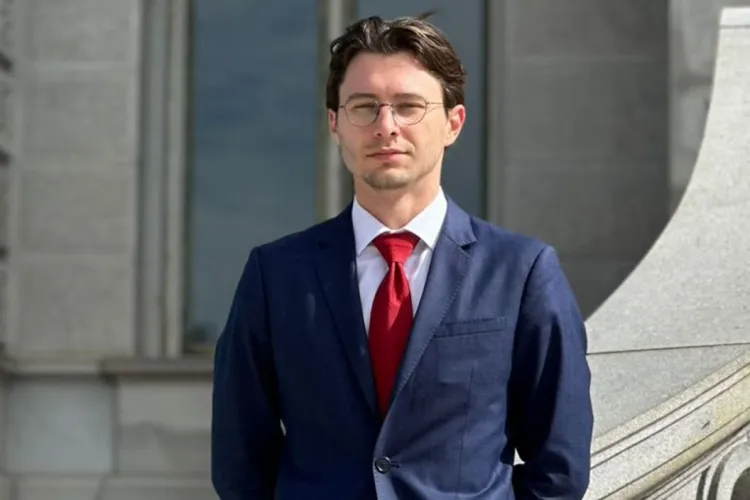
Roman Shemakov ’20 has been named a Knight-Hennessy Scholar, a prestigious global leadership program at Stanford University in which he will pursue a master of business administration degree.
Knight-Hennessy Scholars is the largest fully endowed graduate fellowship in the world, supporting graduate students across Stanford’s seven schools. The 2026 cohort includes 87 scholars representing 31 countries who will pursue degrees in 45 graduate programs while participating in the program’s multidisciplinary leadership development curriculum.
An American and Ukrainian dual citizen, Shemakov is the first Swarthmore graduate to be named a Knight-Hennessy Scholar since Amy DiPierro ’15, who received the award in 2018.
“The call came while I was on a train back to Kyiv, and it was a big surprise,” says Shemakov, who majored in history and economics at Swarthmore and earned a master of laws degree at Peking University in Beijing, China.
“What it means to me is mostly gratitude, particularly for the people who took a chance on me along the way, starting with professors at Swarthmore — and a sense of responsibility about what to do with it next.”
The scholarship represents the next step in a journey sparked by a question that arose from two Swarthmore seminars: Associate Professor of History Megan Brown's Supranational Institutions and Professor of Economics Stephen O'Connell's Emerging Market Economies.
“Both of them, from very different perspectives, were asking the same question,” he says. “How do societies get built, governed, destroyed, and rebuilt?”
That question led him to infrastructure — the systems that underpin economic development, national security, and recovery after conflict. After Swarthmore, Shemakov spent a year in Taiwan as a Luce Scholar, working at an urban planning firm. Later, at Peking, he worked at the Asian Development Bank and the Asian Infrastructure Investment Bank in Beijing, focusing on infrastructure and emerging technology projects.
In 2024, he moved to Kyiv to serve as an advisor to Ukraine’s minister of economy. Over the last two years, he helped negotiate a bilateral economic agreement between Ukraine and the U.S., and worked with the U.S. Development Finance Corporation to operationalize it through the Reconstruction Investment Fund, a sovereign-backed investment vehicle supporting Ukraine’s dual-use technologies, infrastructure, and critical minerals.
His work also included helping implement two $300 million bilateral reconstruction facilities with France and Switzerland. The projects rebuilt hospitals, supplied modular homes to internally displaced families, replaced destroyed electrical substations, and supported the construction of a factory producing demining equipment in frontline territories. More recently, Shemakov has worked with the European Commission, the World Bank, and the U.S. Treasury on the financial architecture for Ukraine’s postwar reconstruction.
Today, Shemakov aspires to strengthen the critical infrastructure systems that underpin national security and economic resilience.
The Knight-Hennessy Scholarship will support his M.B.A. studies while connecting him with a global community of scholars and leaders from a wide range of disciplines. Shemakov says the experience grants him the opportunity to build on lessons learned in development finance and government service.
“Concrete methods and new perspectives,” he says. “I've spent the past couple of years at a multinational development bank and the Ukrainian government, learning how critical infrastructure gets built. I hope to sharpen that into something more entrepreneurial.”
He is equally excited by the community he will join at Stanford.
“Stanford is one of the few places where the distance between an idea and a working venture is very short,” he says. “and you're surrounded by people who actually build things. I'm looking forward to being in that environment.”
While the scholarship marks an important milestone, Shemakov remains focused on the larger question that first took shape during his undergraduate years.
“As for next steps, I try to hold them loosely,” he says. “I’m still trying to answer the question that first came up at Swarthmore: where exactly I sit in service of it is something I'm comfortable leaving open.”