In Honor of Retired Mathematics Professor Gene Klotz
President Valerie Smith shared the following message with the campus community on May 27, 2026:
Dear Friends,
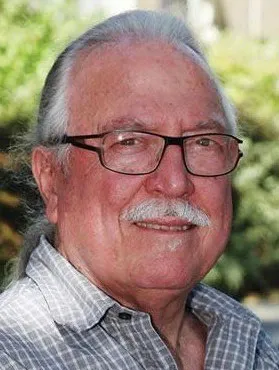
With deep sadness, I write to share the news that Eugene “Gene” Arthur Klotz, the Albert L. and Edna Pownall Buffington Professor Emeritus of Mathematics, died peacefully at his home in Swarthmore, Pa., on Wednesday, May 13. He was 90.
Gene, who served on the faculty for a remarkable 47 years, is remembered as an innovative and inspiring mentor and colleague, and as among the first in his field to realize the potential of technology to support mathematics learning.
Gene is survived by his wife, Carole Netter, a retired longtime lecturer in French at the College; children Gretchen and Jeremy; and two grandchildren.
A memorial service will take place on campus in the fall. In lieu of flowers, the family welcomes contributions in Gene’s memory to the Mathematics Education Trust.
I invite you to read more below about Gene and his many contributions to our community.
Sincerely,
Val Smith
President
Roy J. and Linda G. Shanker Presidential Chair
In Honor of Retired Mathematics Professor Gene Klotz
Eugene “Gene” Arthur Klotz, the Albert L. and Edna Pownall Buffington Professor Emeritus of Mathematics, died Wednesday, May 13, at age 90. With his passing, Swarthmore has lost a passionate and influential educator who developed essential, award-winning resources such as the Math Forum that continue to have a nationwide and international following.
“The Math Forum started with a small group of people working in an office in the old du Pont Science Building and grew to become the leading online resource for math learning, teaching, and communication,” says Professor and Chair of Mathematics and Statistics Lynne Steuerle Schofield ’99, who worked for the organization as a recent alum. “Students could use it to learn about puzzles and have fun, and educators could go to share pedagogical ideas and acquire new teaching skills. It is impossible to calculate the impact it had on helping an innumerable number of people fall in love with math.”
In addition to his professional pursuits, Klotz sought to connect with colleagues through his many and varied interests.
“Gene went out of his way to welcome me when I arrived at the College,” says Professor Emeritus of Mathematics Don Shimamoto. “I think sustaining a communal spirit within the department meant a lot to him and was one of his enthusiasms. The daily departmental lunches he organized introduced me to the hoagie. Gene usually tried to connect to people through humor, but he could also give good, serious advice in private.”
“What I remember most about Gene is his curiosity,” says Professor of Statistics Steve Wang. “He was interested in so many topics, such as paleontology and astronomy. I always enjoyed receiving emails from Gene on our shared interests.”
Klotz was born in Fredericksburg, Iowa, to Lloyd Klotz, a farmer, and Elizabeth Rausch, a nurse who raised him as a single mother near Los Angeles. After graduating from Chaffey High School, he earned a B.S. in mathematics from Antioch College in 1958. Klotz then held a National Science Foundation (NSF) graduate fellowship from 1959–1962 and taught at Yale University, where he received a Ph.D. in mathematics.
In 1963, Klotz joined Swarthmore’s Mathematics faculty, where he taught calculus and data structures, among other topics. That first year, five eager students approached him about teaching his algebra seminar as a graduate-level course. He offered to teach them a second-year, graduate-level math seminar if they would do some work over the summer. In Klotz’s estimation, “It worked out pretty well — three of them pursued careers in mathematics,” including one, Robert MacPherson ’66, who became a noted mathematician, and another, Steve Maurer ’67, who later joined him on the College’s Mathematics faculty.
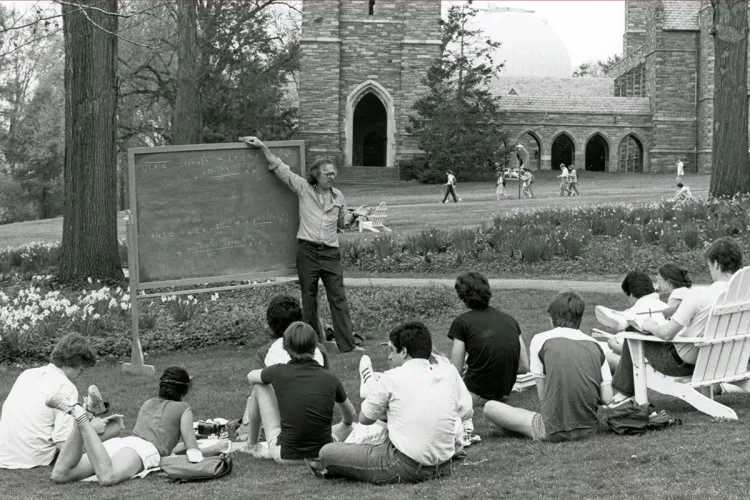
Gene Klotz teaches class on Parrish Beach.
Klotz had a well-known and longstanding willingness to try new things. He taught the College’s first biomathematics course in the 1970s, foreshadowing its popularity on campus. And he nudged — if not actually dragged — Mathematics into the computer age.
In the early 1980s, Klotz used computer graphics from Atari’s Space Invaders and Asteroids to develop game-like video programs for teaching trigonometry. He also used computer graphics to teach calculus. In 1986, he launched the multimedia Visual Geometry Project with Moravian College mathematician Doris Schattschneider to develop new technology-based education materials. Over the years, he achieved admirable success in consistently securing research funding for his work, notably roughly $2 million from the NSF to explore the internet’s potential to support mathematics education and collaboration.
“This was a point of particular pride to him,” Shimamoto says. “The Visual Geometry Project led to an easy-to-use, interactive app called The Geometer’s Sketchpad [developed by a student, Nick Jackiw ’88, under the auspices of the Geometry Project]. I certainly used it when I taught geometry, and in nearly all my courses.”
With the advent of the internet, Klotz expanded his project to the Math Forum, an online place for math educators to discuss and share ideas for implementing problem- and project-centered teaching instead of traditional memorization and “drill-and-kill” practices. Its popular advice section, Ask Dr. Math, featured interactions ranging from simple questions from students doing nightly homework to complex questions asking what math was and how it worked.
“The ‘math doctors’ started as fellow students and faculty at Swarthmore and grew to become an international collection of students, teachers, users, and lovers of math,” Schofield says.
“Gene told me he was done doing ‘new math,’” says Professor of Statistics Phil Everson, “and I tried to make the analogy to a band that doesn't write their own songs but does new, creative things with other people's music. Gene interrupted to say, ‘That's right, I'm a math cover band.’"
In the process, the Math Forum became a widely recognized, significant, and ongoing contribution to math education. It is the origin of the Notice and Wonder practice that is now a central component of the mathematics curriculum and teacher education, and its resources are integrated in the programs and publications of the National Council of Teachers of Mathematics (NCTM).
“Gene was a character who had many interests, one of which was mathematics. He thought that visualizing mathematics could revolutionize education, and he surrounded himself with people who could make significant strides toward figuring this out,” says Dorwin P. Cartwright Professor of Social Theory and Social Action and Professor and Chair of Educational Studies K. Ann Renninger, who served as the director of research and evaluation on Klotz’s NSF grants.
As noted in Klotz’s NCTM Lifetime Achievement Award: “His method seems to be to collect a combustible leaf pile of talent; to ignite it with a combination of provocative ideas, problems, and fascinating playthings; to fan it with daily stimulation, expert advice only when needed, constant humor … ; and then, somehow, rather than let it consume itself or burn out, to connect it to a renewable or even expanding energy source, while he himself steps back, brushes off his hands, and begins casting his eye out for new tinder.”
For his part, Klotz saw great potential in technology’s advances. In 1997, when the World Wide Web had only been in the public domain for a few years, he optimistically noted the new opportunities it presented:
“The web is being used for much delightful individual expression. In the past, the public was for the most part unaccustomed to interacting with mathematicians, and was inclined to see us as colorless, inarticulate, and out of touch. We now run the risk of being perceived as colorful and mildly amusing — and out of touch. One of the most important things the web will do for us is to provide a splendid arena for self-expression; we'll come to know amazing facets of our colleagues, deepening our interactions and also humanizing us to the rest of the world.”
Klotz also noted presciently that the web was “destined to make broad changes in our professional (and maybe our personal) lives. It's exhilarating to be involved in this revolution and to try to get it right.”
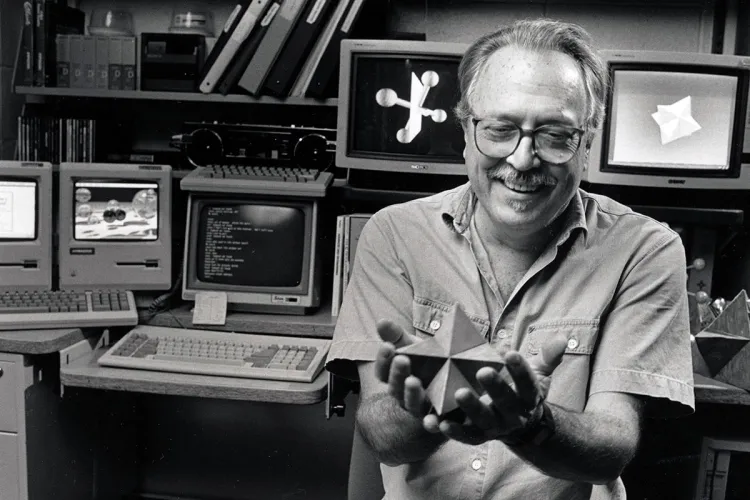
Klotz holds a stella octangula featured in the Visual Geometry Project.
On campus, Klotz’s projects were large enough to warrant permanent support staff and dedicated research space. “Within our department, this remains unique to this day,” Shimamoto says. “The staff consisted largely of recent Swarthmore graduates and, with additional support from the College, current students over the summer. This allowed our students to become involved in ongoing research at a time when the rest of us in the department were trying to figure out how to make that work.”
“Gene’s projects involved many Swarthmore students,” says Aimee Johnson, the John Watts Roberts ’39 and Jane Martin Roberts ’39 Professor of Mathematics, “and were a wonderful way to bring lots of them, including some who might not have thought of themselves as a natural fit with mathematics, to a deeper appreciation and grounding in the subject.”
While some may avoid or be intimidated by new technology, Klotz’s persistent engagement reflected what he felt was an obligation:
“We all know about dynamical systems, and that butterflies can effect momentous changes, but this has always been more likely in some times and places than in others. Ours appears to be one of these times and places, when we as individuals can cause significant changes in the communications revolution swirling around us. It's possible that great good — as well as great disaster — can come out of this. I think the former is likely only if a lot of us get involved and keep trying.”
After he retired in 2010, Klotz continued to live on Yale Avenue in Swarthmore and maintained an office on the second floor of the train station for many years. He also remained active in the community and pursued his many non-math-related interests, including reading, bird watching, gardening — he had a plot in the ’Ville community garden — and travel. He also indulged his passion for what he called “far-out music” — flamenco, contemporary classical, and music from the late 14th-century.
“Gene was a true Renaissance man, knowledgeable in many disciplines across the sciences and the arts,” says Professor of German Hansjakob Werlen, a longtime friend. “As a member of the punningly named Guido’s Foot early music ensemble, Gene loved playing medieval and early Baroque music on the lute. His knowledge of avant-garde jazz was encyclopedic, and he loved music with a deep passion.”
“In addition to his mathematical interests, Gene was a connoisseur of food and music,” says Albert L. and Edna Pownall Buffington Professor of Mathematics Jaye Talvecchia. “I recall fondly hearing wonderful jazz concerts with him and Carole, and all of us cooking wonderful meals at their home.”
“But first and foremost, Gene was a loyal and generous friend and a very modest man,” Werlen adds. “His irreverent and funny presence enlivened any gathering, and his absence leaves a great void.”
Klotz’s longevity meant that he inevitably taught children of former students and some of his colleagues. But for someone known as a consistent innovator, staying in one place for so long didn’t seem a contradiction.
“I’m liberal artsy,” Klotz said in 2010, “and Swarthmore struck me as an interesting place to be. Over the years, the College has given me the building materials with which to construct a career and the flexibility to try some radical ideas.”