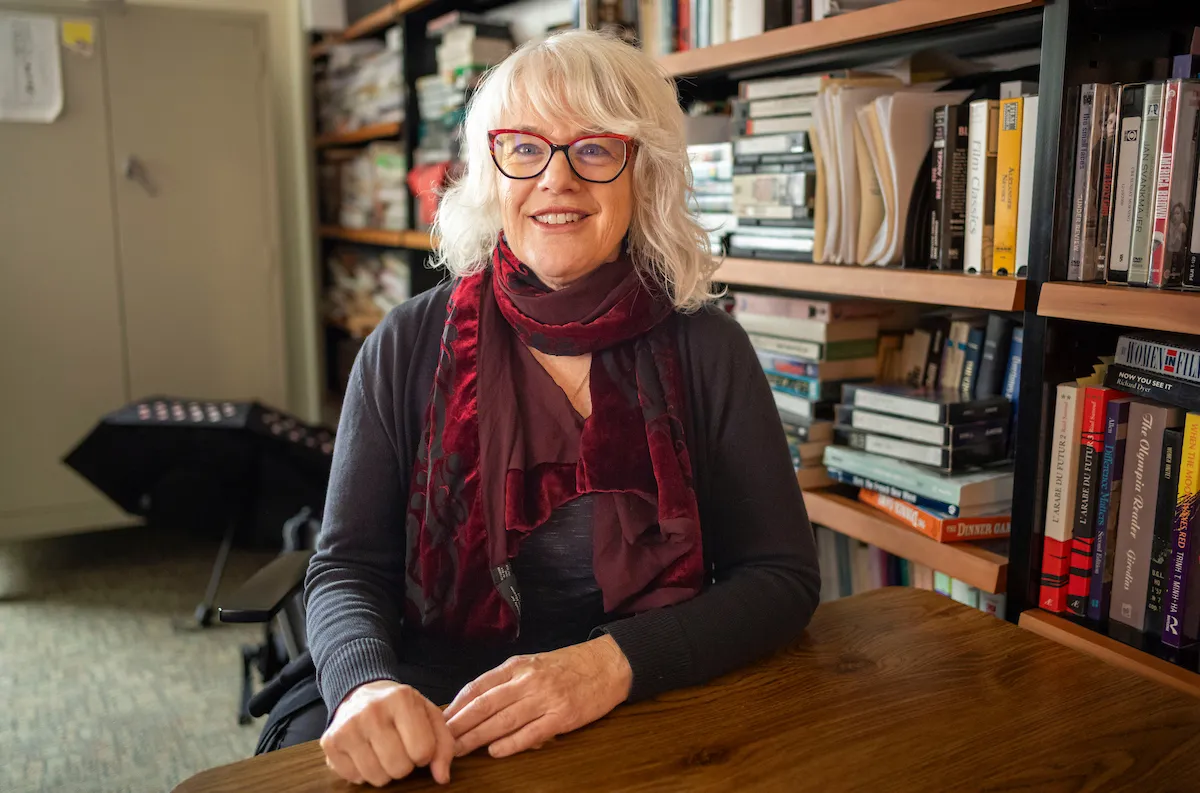
Carina Yervasi
"Film is not reality. It takes pieces of what we think of as reality and sews them together into a narrative. And I saw that social movements could use film to tell really powerful stories.”
Graduate school deepened her immersion in Francophone cinema. Alongside Akerman, she discovered Raoul Peck’s Lumumba: Death of a Prophet, a 1990 experimental documentary about the assassination of the first prime minister of the Democratic Republic of the Congo (then known as the Republic of the Congo and later Zaire). With a fragmented structure weaving together personal memories with archival footage, the film delivered a richly textured reflection on Lumumba’s legacy. It pushed Yervasi towards post-colonial studies.
“There’ll always be plenty of people to work on French film,” she remembers thinking. “But there aren’t a lot of people working in this field right now.”
Shortly after joining Swarthmore in 2001, Yervasi’s pivot brought her to West Africa, and to the Panafrican Film and Television Festival of Ouagadougou (FESPACO) in Burkina Faso. She would return year after year to the film festival, the continent’s largest, where she discovered films difficult to find in the U.S. Returning to the college with a suitcase filled with VHS tapes picked up in the market — an archive she is still gradually digitizing — she introduced her students to films, resourcefully made and often wildly entertaining, that were a clear window into the complexities of West African society.
Though filmed in West Africa, these films were also global. Post-production often occurred in France, and audiences were stretched across diasporas in Europe and the U.S. This tension, between the local and the global, has also shaped her teaching. In 2019, Yervasi co-founded Swarthmore’s Global Studies Program with Professor of Political Science Ayse Kaya, intending to break down disciplinary boundaries while helping students understand processes that cross national borders.
Yervasi’s time in Nice was formative. A longtime believer in the power of travel to broaden minds, as executive director of Swarthmore’s Global Engagement Office she now helps students study abroad, fostering partnerships with universities around the world. From time to time, she leads a trip herself. Earlier this year, she took nine global studies students on a trip to Senegal. In Dakar, they toured the new Museum of Black Civilizations, connected with local host students, and listened as a fisherman described the devastating toll offshore drilling has taken on fishing traditions.
But when it comes to the world of film and video, Yervasi is an optimist. While many of us fret about smartphones, screen time, and shrinking attention spans, Yervasi sees a golden age of cinema ahead — particularly in the Global South. The future of film, she believes, is likely going to be more participatory than ever before.
“Anyone now with a phone is making a film, and that’s a beautiful thing,” she says. “The democratization of filmmaking is amazing. And with billions of people with a screen in their pocket — well, that’s your audience.”