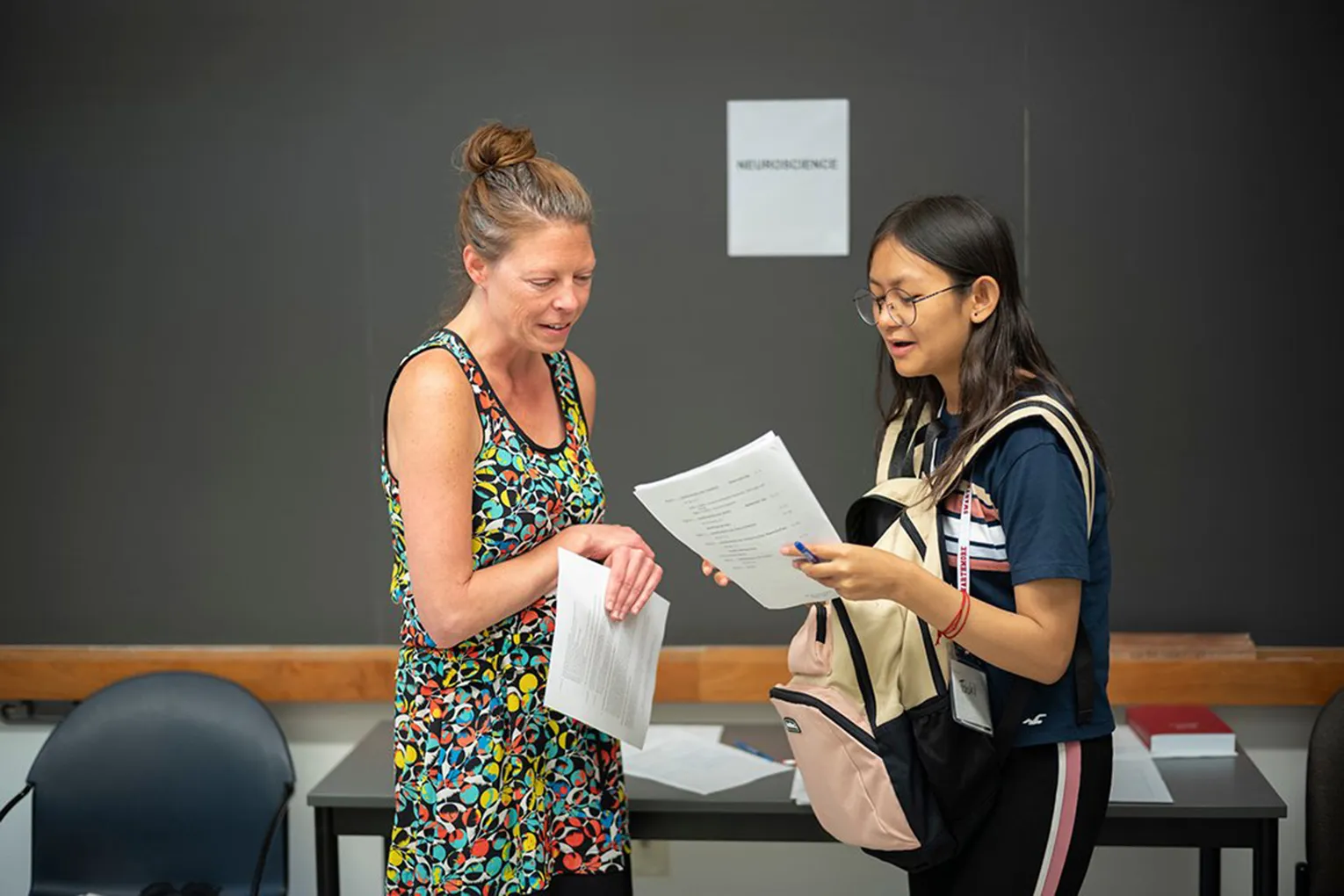
October 12th, 2026Associate Professor of Art History Brian Goldstein studies what architecture reveals about society at large.
Written by Tomas Weber
Photography Laurence Kesterson
Architectural historian Brian Goldstein likes to surprise his students by taking them to stand outside Parrish Hall.
There, he invites them to knock on the classical columns that stand sentinel at the front of the building. The students, expecting to hear the thud of knuckle against stone, are surprised by the metallic clang. The white columns, Goldstein goes on to explain, are not marble. Nor are they made of granite. They aren’t even concrete. They are cast iron, produced in a factory in the late 19th century.
“It’s an amazing way to show students how rampant the classical tradition then was, that the columns were being mass-produced,” says Goldstein, associate professor of art history and department chair. “At a certain moment, Swarthmore felt like it had to have them too.”
A historian of the built environment, Goldstein studies what buildings reveal about society. Architecture isn’t just about style or engineering. It’s also about what kind of society, and what kind of world, we want to build.
“The questions that most animate me are why people build things,” he says, “and what style can tell us about the kind of society that creates it.”
These questions are ever relevant. Buildings, after all, are always getting built. But the connections between architectural styles and competing visions of society feel especially taut these days. Architecture, as Goldstein points out, has become conscripted into the national political fight.
Last August, President Trump signed an executive order encouraging new federal buildings to be constructed in a classical style, referencing Ancient Greece and Rome. “It’s an old debate,” says Goldstein. “It goes right back to the founding of the United States, and the question of what an architecture that represents the ideals and people of this country looks like.”
For some, classical architecture situates the U.S. in a proud lineage of world-shaping civilizations. Other people, in particular many Black Americans, struggle to see themselves reflected in that architectural tradition, which is tied to a history of slavery.
These arguments are shaped by history, but architecture is about the future. That’s the reason, Goldstein says, the discipline is so political.
“Architects project the future and hope somebody builds it,” he says. “That’s why there’s often a utopianism among architects — a wish to make the world a better place.”
But deep contradictions remain. Despite architecture’s stated progressive values, “the profession remains an elitist and exclusive one,” says Goldstein. Black architects have historically represented just ½ to 2% of the profession, “less than medicine and law,” he says.
“Bond really brings all these threads together, because in many ways, it’s his life,” he says. “He is a person who comes out of the civil rights tradition, and he is also a person educated in the most elite spaces.”
Brian Goldstein
“Architects project the future and hope somebody builds it. That’s why there’s often a utopianism among architects — a wish to make the world a better place.”
Trained at Harvard in the 1950s, Bond moved to newly independent Ghana in 1964, where President Kwame Nkrumah was using modernist architecture as a language of liberation. On his return to the U.S., Bond developed a practice that placed communities at the heart of the architectural process. His buildings – which include the Birmingham Civil Rights Institute in Alabama, the 9/11 Memorial in New York City, and Atlanta’s Martin Luther King Jr. Center for Nonviolent Social Change – often celebrated urban Black spaces typically disparaged by planners, while looking beyond Western traditions for influence.
“Bond was practicing a kind of architecture that promised social change,” Goldstein says. “But he was never allowed to be in a dominant position in the field. And so, architects ask, ‘How do we make a better world?’ — well, the answer is actually there, if you look at the right people.”
A “civic architect,” Bond believed that buildings were more than showcases of an individual architect’s vision. They were, he thought, the reflection of a community’s life.
It’s an insight Goldstein brings into his classes this semester. In the course Building Architecture from Dirt to Dust, Goldstein introduces students to the world beyond “the name on the door of the architect’s office” — a world that includes construction workers and maintenance staff. Students meet with Swarthmore’s Environmental Services workers, learning how daily cleaning and repair reshape buildings on campus.
“Every building has something to tell you about the people who built it, the people who’ve occupied it, the people who’ve adapted it and changed it, and those who take care of it,” he says.
As one student in the class told him: “I don’t see the world the same after.”
Submissions Welcome
The Communications Office invites all members of the Swarthmore community to share videos, photos, and story ideas for the College's website. Have you seen an alum in the news? Please let us know by writing news@swarthmore.edu.