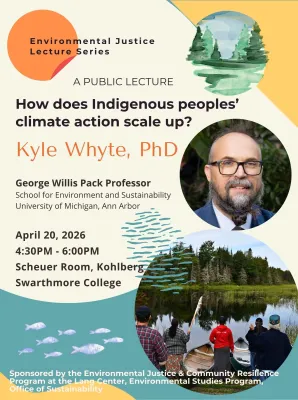
How Does Indigenous Peoples' Climate Action Scale Up?: Kyle Powys Whyte
April 20, 2026 | Kyle Whyte, George Willis Pack Professor in the School for Environment and Sustainability at the University of Michigan and an enrolled member of the Citizen Potawatomi Nation, challenged the widespread assumption that Indigenous peoples can only make change slowly and at local scales. Whyte's research on environmental justice centers the moral and political issues Indigenous peoples are addressing in the areas of climate change, conservation, and cooperative relationships with science institutions. Drawing on Indigenous movements across the United Nations, multinational industries, regional governance, and national laws and policies, he argued that responsible relationships, kinship bonds, care for land, and self-determination are effective and ethical methods for scaling up climate action. Compared to dominant methods of scaling up, which tend to worsen climate risk, carbon footprints, and human suffering. Whyte argued that Indigenous methods are not only just, but can be organized to achieve speed.
Learn more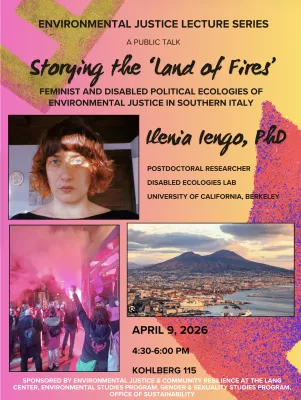
Feminist and Disabled Political Ecologies of Environmental Justice: Ilenia Iengo
April 9, 2026 | Dr. Ilenia Iengo, postdoctoral researcher at the Disabled Ecologies Lab at UC Berkeley and member of the Undisciplined Environments collective, explored her scholar-activist approach to feminist and disabled political ecological praxis. Her research examines toxicity, embodiment, storytelling, and prefigurative urban politics in Naples, drawing on her PhD in Feminist Political Ecology from the Autonomous University of Barcelona. Focusing on the 'Land of Fires' (Terra dei Fuochi) in Campania, Italy — a region marked by decades of illegal toxic dumping and burning, resulting in disproportionately high rates of cancer, reproductive disorders, and environmental illness — Iengo argued that storytelling is a powerful tool for political organizing and consciousness-raising. Her talk invited audiences to critically examine the ableist, heteronormative, and neoliberal frameworks that shape dominant understandings of health, nature, and justice, while opening space for the transformative possibilities of collective care, mutual aid, and interdependence among bodies and territories.
Learn more- Communicating Care through Digital Storytelling: Phaedra C. Pezzullo
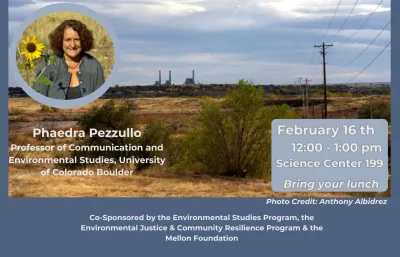
February 16, 2026 | Phaedra C. Pezzullo, Kleiman Faculty Scholar in the Department of Communication at the University of Colorado Boulder and Faculty Associate of Environmental Studies, reflected on how multi-modal digital storytelling — including audio clips, photographs, and narratives — can counter deficit models of communication and underscore the value of the public humanities for communicating care. Drawing on the Colorado Environmental Justice Digital Storytelling Project, a collaboration between the Colorado Department of Public Health and Environment, people living in the most impacted zip codes, and members of a university class on the Foundations of Environmental Justice, Pezzullo explored how tools like Colorado EnviroScreen can be paired with humanistic storytelling to hold accountable patterns of environmental injustice. An internationally recognized scholar with expertise in environmental and climate justice studies, rhetorics of social movements, and environmental communication, Pezzullo is also the founding Director of the Sustainability and Storytelling Lab and Director of the CU Boulder Graduate Certificate in Environmental Justice.
- Climate Resilience at Work: Alumni Career Paths for Just Sustainability
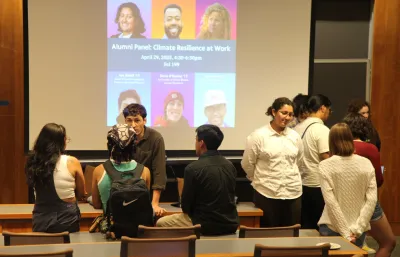
April 29, 2025 | Organized by PSRF Mahika Shergill '26 in collaboration with Professor Giovanna Di Chiro and the EJCR, this alumni panel brought six Swarthmore graduates back to campus to speak with current students about building careers in environmental and climate justice. Intentionally cross-disciplinary, the panelists included engineers, policy advocates, community organizers, and legal professionals, demonstrating that meaningful climate justice work can emerge from nearly any field of study. The event featured a moderated panel discussion, an open Q&A, and an informal networking reception, drawing over 40 attendees from across departments and class years. Many students stayed well past the scheduled end time to connect one-on-one with alumni, ask for career advice, and explore potential opportunities. The event was funded through the President's Climate Commitment Fund Amplify Grant and co-sponsored by the Lang Center and the Office of Sustainability.
- Chester Justice Collections Launch
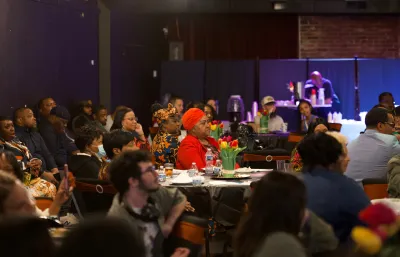
March 29, 2025 | The launch of the Chester Justice Collections (CJC) marked a powerful step forward in community archiving and environmental justice storytelling. Introduced during the 2024 Women Change Makers banquet in Chester, the event unveiled CJC to the public for the first time—spotlighting a growing, searchable digital repository of oral histories, photographs, documents, and media created by and for Chester residents.
- Bringing the Ciénaga Back: Dr. Diana Ojeda on Land Recuperation and Mangrove Restoration
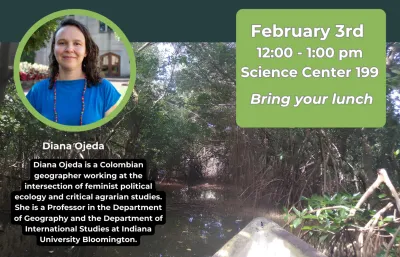
February 03, 2025 | In this research talk, Dr. Diana Ojeda—Professor of Geography and International Studies at Indiana University Bloomington and Director of the Commons Program at the Ostrom Workshop—shared her work at the intersection of political ecology, agrarian studies, and territorial justice. Drawing on her extensive research in the Colombian Caribbean, Dr. Ojeda examined the struggle to protect and restore mangrove ecosystems in Cartagena, one of the region’s cities most impacted by the climate crisis.
Her talk focused on grassroots environmental defense, particularly among Black communities in Cartagena. These communities are not only resisting environmental degradation but are actively reclaiming land and revitalizing ecosystems critical to regional biodiversity and climate resilience. Dr. Ojeda highlighted how these efforts push back against intersecting forces of racialized dispossession, ecological violence, and urban development—what she calls “multiple regimes of death.”
As a leading scholar in political geography and editor of Antipode: A Radical Journal of Geography, Dr. Ojeda brought a powerful analysis of how local struggles for land and ecological restoration are deeply embedded in global structures of inequality. This event offered students and faculty a chance to engage with critical questions about environmental justice, racial capitalism, and the politics of restoration in Latin America and the Caribbean.
The event was co-sponsored by Environmental Studies, the Mellon Foundation and the Environmental Justice & Community Resilience Program.
- The Power of Emotions in Climate Justice Activism: A Talk by Sarah Jaquette Ray ’98
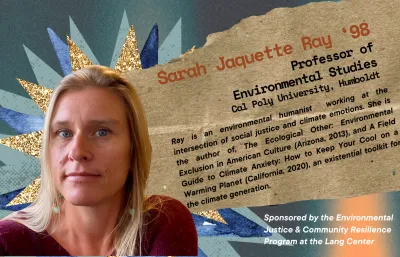
November 20, 2025 | In this talk, Sarah Jaquette Ray ’98, Professor and Chair of Environmental Studies at California Polytechnic University, Humboldt, examined the role of emotion in shaping climate justice movements. Titled The Power of Emotions in Climate Justice Activism, her lecture explored how climate emotions—especially anxiety—reflect and reinforce broader political, racial, and cultural dynamics in the U.S. today.
Ray asked: Who feels climate anxiety, and whose grief gets recognized? How can we build emotionally sustainable activism that bridges climate and racial justice? Drawing from her books The Ecological Other, A Field Guide to Climate Anxiety, and The Existential Toolkit for Climate Justice Educators, Ray offered practical tools for engaging in long-term, justice-centered climate work.
Blending insights from psychology, social movements, and mindfulness practices—along with her training as a certified mindfulness facilitator—Ray invited the audience to consider how tending to emotions can support more inclusive, resilient climate action. A Swarthmore alum and environmental humanist, she offered a compelling framework for activism that sustains both people and the planet.
- A Symposium on Resisting Extraction and Building Resilience on the Navajo Nation: Stories from Diné Leaders, Artists, and Activists
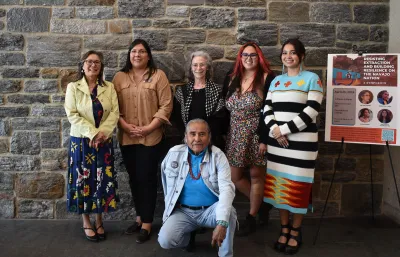
April 25-26, 2024 | This two-day symposium convened a panel of Navajo (Diné) scholars, activists, and artists to discuss the colonial legacies of extractive industries on Navajo lands and the ongoing fight for environmental and social justice. Panelists offered cross-generational perspectives on the impacts of uranium and coal mining, the erosion of land and water rights, and the broader struggle for Indigenous sovereignty. They shared their efforts to resist these injustices through research, advocacy, artistic expression, and cultural revitalization, demonstrating how reclaiming traditional knowledge and practices is central to decolonial futures. Learn More here.
- Environmental Humanities in Action: Joni Adamson on Climate Fiction and Global Policy
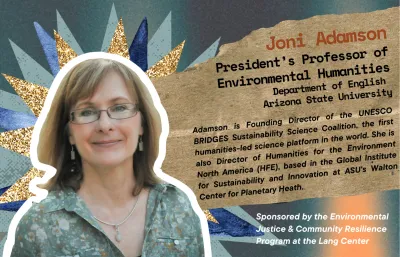
September 24, 2024 | In this timely and thought-provoking lecture, Joni Adamson, President’s Professor of Environmental Humanities at Arizona State University, explored the growing influence of climate fiction on international climate policy. Focusing on Kim Stanley Robinson’s novel Ministry for the Future (2020), Adamson discussed how the book is shaping conversations at the United Nations’ Summit of the Future, where Robinson himself is serving as an official delegate.
The novel’s blend of terrifying realism and surprising optimism has captured the attention of global leaders and policymakers, prompting dialogue around imaginative responses to the climate crisis. Drawing from her leadership in the UNESCO BRIDGES Sustainability Science Coalition and her extensive scholarship in environmental humanities, Adamson reflected on how storytelling, literary analysis, and humanistic thinking can influence high-level decision-making.
Adamson is a leading voice in the integration of environmental humanities with sustainability science. She directs the Flagship Hub of UNESCO BRIDGES, the Humanities for the Environment North America Observatory, and is a Distinguished Global Futures Scholar at ASU’s Global Futures Laboratory. Her talk illustrated the transformational power of narrative and the critical role of the humanities in reimagining planetary futures and informing global climate policy.
- Plant Medicine and Black Women’s Healing Traditions: A Roundtable
April 26, 2023 | This roundtable conversation centered Black women healers who cultivate deep, embodied relationships with plant and fungal medicine in their community healing work. Grounded in the wisdom of African Diasporic sacred ecology and herbalist traditions, the discussion explored how plant medicine has long been a cornerstone of Black wellness, resistance, and healing. As legalized cannabis and psychedelic-assisted therapies expand, panelists emphasized the importance of making these radical healing modalities accessible to frontline communities most in need of compassionate care.
Bridging public health, critical race theory, environmental justice, and ancestral spirituality, the event featured distinguished healers and practitioners:
- Iya Dr. Funlayo Wood, a scholar-priestess in the Ifa-Orisa tradition, spoke on the spiritual and ecological significance of plant medicine, drawing on her decades of work with plant teachers like La Madre Ayahuasca.
- Angela Harris, M.Div., LCPC, a psychedelic session guide at the Johns Hopkins Center for Psychedelic & Consciousness Research, explored the potential of psychedelics in treating trauma, particularly among BIPOC communities.
- Tsehaitu Abye, MBA, founder of Black Dragon Breakfast Club, discussed the intersection of cannabis policy, racial equity, and business ownership in reclaiming Black agency in the cannabis and hemp industries.
- Oluwatobi Aderotoye, a chemistry researcher and Students for Sensible Drug Policy (SSDP) HBCU Campus Ambassador, examined cannabis policy reform efforts and the role of scientific research in advocating for equitable legalization.
Drawing inspiration from bell hooks’ words on healing and reconnecting with the natural world, this conversation reinforced the understanding that plant medicine is not just a commodity but a birthright—one that sustains health, community, and cultural continuity. The event was free and open to the public, inviting dialogue on the role of healing justice in reimagining public health and policy.
Watch here: Plant Medicine and Black Women’s Healing Talk
- Lessons from the Deep: Dr. Alexis Pauline Gumbs’ Visit
April 20, 2023 | Poet, scholar, and activist Dr. Alexis Pauline Gumbs—self-described as a “Queer Black Feminist Love Evangelist and an aspirational cousin to all life on earth”—shared insights from Undrowned: Black Feminist Lessons from Marine Mammals (Chico, CA: AK Press, 2020), her award-winning exploration of kinship, survival, and resistance. Blending Black feminist theory, marine biology, and Afro-diasporic traditions, Gumbs examines how marine mammals model radical care, adaptation, and protection in ways that challenge extractive and militarized human systems.
Gumbs’ work redefines sustainability through the lens of interspecies kinship, arguing that marine mammals—our air-breathing, ocean-dwelling relatives—offer transformative lessons in social and ecological change. She highlights how whales and dolphins, shaped by conflict and struggling to survive environmental degradation, embody a resistance that resonates deeply with Black feminist and decolonial movements. Her discussion touched on the endangered North Atlantic Right Whale, connecting its survival to histories of Indigenous Shinnecock and enslaved African ancestors. She also explored echolocation as a metaphor for visionary action, offering new ways to perceive justice, community, and interconnected survival.
Through a poetic and interdisciplinary approach, Gumbs invited participants to reconsider the possibilities of solidarity, care, and activism—both within human communities and across species. Her talk illuminated how the wisdom of marine life can inspire new modes of resistance and survival in the face of ecological crisis.
Watch here: Dr. Alexis Pauline Gumbs' Talk
- “Queer Mycology Forest Walk and Dinner” with Dr. Patricia Kaishian
Dr. Patricia Kaishian, Assistant Professor of Biology at Bard College, led a Queer Mycology Forest Walk exploring fungi as indicators of ecosystem health and as a lens for understanding the intersectionality of science, environmental justice, and queer ecology. A mycologist with a Ph.D. in Forest Pathology & Mycology from SUNY College of Environmental Science & Forestry, Kaishian challenges traditional scientific narratives, arguing that fields like mycology are deeply shaped by cultural and political systems. Her work spans taxonomy, species discovery, and interdisciplinary studies connecting fungal diversity to ecofeminism, queer theory, and decolonial science.
During the walk, participants engaged with her article The Science Underground: Mycology as a Queer Discipline, discussing how fungal networks mirror broader structures of marginalization and resistance. Kaishian emphasized the role of fungi in ecological resilience and how their decentralized, symbiotic existence offers alternative ways to think about knowledge, power, and sustainability. She also shared insights from her essay A Tangled Web: Redwoods, Colonialism, Eugenics, and Climate Change, which examines the entanglement of environmental destruction with histories of oppression.
The event fostered critical discussions on the ways science is shaped by dominant ideologies and how fungi, often overlooked, serve as both ecological healers and radical metaphors for resistance. Student co-organizers Yeh Seo Jung ‘23 and Ray Craig ‘24 further explored these themes in their zine, Queer Ecologies, which examines the intersections of queer ecology, environmental justice, and social change through art, scholarship, and activism. The walk and zine together reinforced a key takeaway: science is not neutral, and reimagining it through queer and decolonial frameworks can open new pathways for justice and ecological care.
Queer Ecologies: A Final Syllabus/Zine Product of Our Independent Study, Crossings: Swarthmore Undergraduate Feminist Research Journal: 1 (1), 53-80.
- Looking Back, Moving Forward: Law, Policy & Environmental Justice Conference
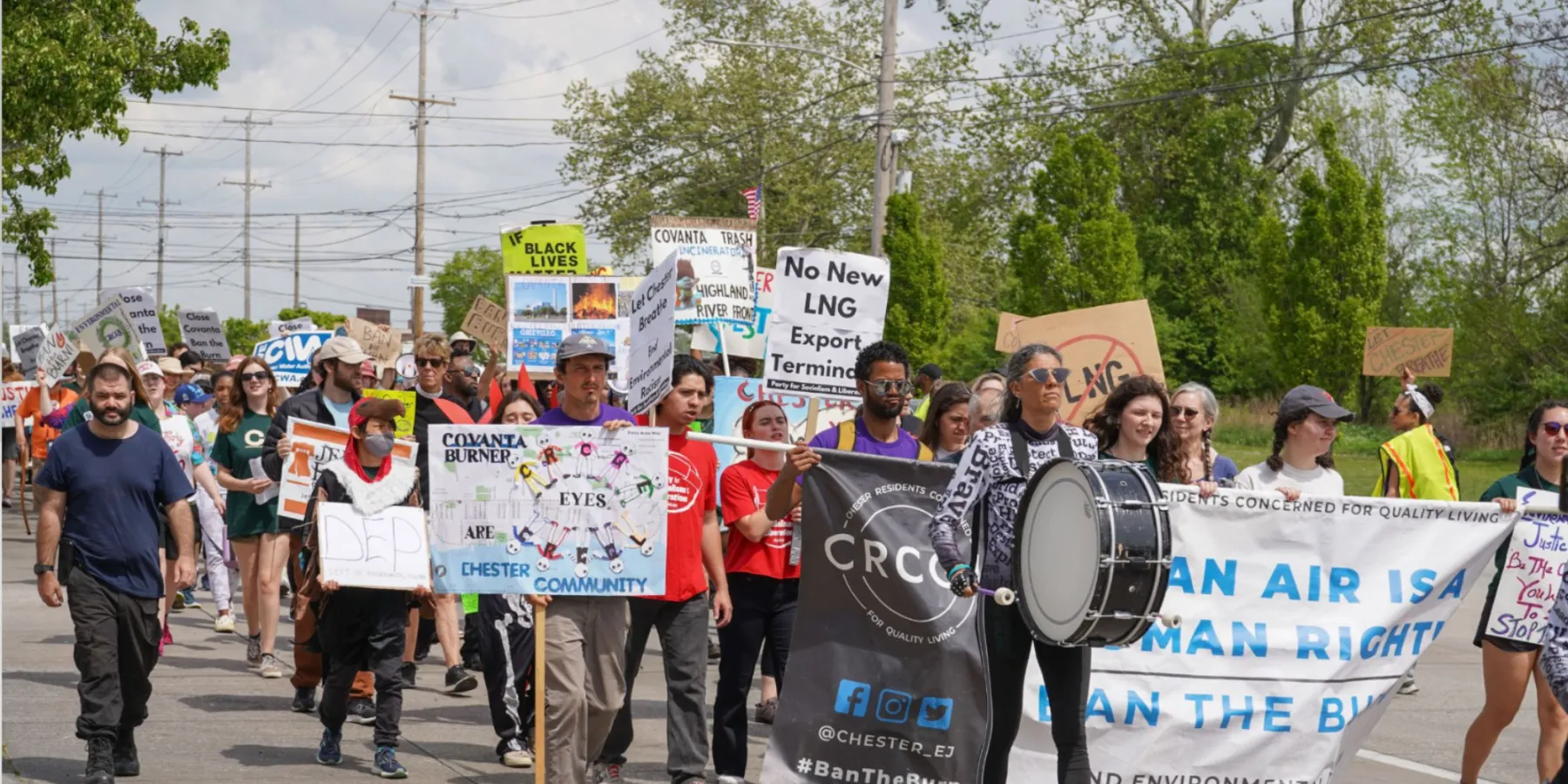
April 22-23, 2022 | This two-day virtual conference critically examined the role of law and legal strategies in advancing environmental justice (EJ) policy and action. Centering on the 30-year struggle of Chester Residents Concerned for Quality Living (CRCQL) to shut down the nation’s largest waste incinerator in Chester, PA, the event explored how grassroots activism has shaped legal and policy frameworks to combat environmental racism.
Bringing together EJ activists, attorneys, and scholars, the conference featured three dynamic panels that examined innovative legal approaches for strengthening EJ movements. Discussions covered multi-racial and cross-class coalition-building, community and solidarity lawyering, and just transition policies. Panelists also analyzed emerging federal initiatives, such as the White House Environmental Justice Advisory Council and the Justice40 initiative, which seek to amplify the voices of EJ communities in national policy-making.
Co-organized by Swarthmore’s Giovanna Di Chiro, CRCQL’s Zulene Mayfield, and Christopher Mele of the University at Buffalo, the conference was co-sponsored by the Environmental Justice & Community Resilience Program (EJCR), the Environmental Studies Program, and Swarthmore’s Office of Sustainability, alongside the Baldy Center for Law & Policy and the Digital Scholarship Studio & Network at the University at Buffalo. By reflecting on past struggles and embracing new legal strategies, Looking Back, Moving Forward provided a vital forum for shaping the future of environmental justice law and activism.