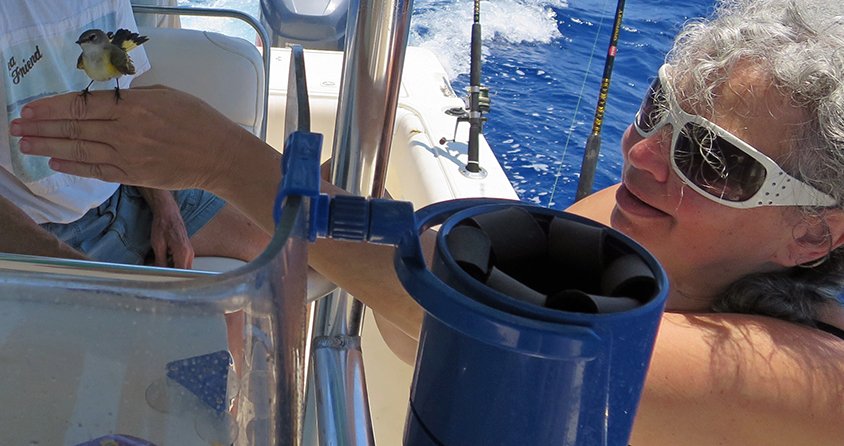
[The photo above is from May 2016. I was in a boat 25 miles offshore from the Florida keys, and an American Redstart landed on my hand. If you know my book ALBERT, you can imagine how thrilled I was.]
- Publications [pdf]
- Downloadable Publications
- Curriculum Vitae complete [pdf]
- Writer Website
- TedX presentation "What children (and everyone else) need to read"
Courses I am scheduled to teach:
This course is an examination of the nature of music, approached from a disability perspective. We include music with regard to the ear, the eye, bodily movement, the somatosensory system, and neurodiversity. The issues are to a great extent biological/cognitive, but interpretable via culture. We explore what notions such a rhythm, pitch, timbre, melody, dynamics, and the like mean in a variety of contexts, asking what similarities and difference there are between, for example: (1) ordinary expression and artistic expression (2) musical arts and language arts (3) music and poetry (4) music and dance. We consider these questions in a context of whether there exists a differentiating line and according to which people: autism, blindness, deafness.. how do these ways of being affect musicking? The music vs. poetry differentiation is of particular relevance to the deaf community and the music vs. dance differentiation is of particular relevance in indigenous contexts. No prerequisites. Counts toward Global Studies and Interpretation Theory.
Linguistics 63/Theater 33 (Tuesday from 1:15 to 4): Supporting Literacy Among Deaf Children. Our students will work with children and staff at the Pennsylvania School for the Deaf to make video-books for families to share with their young deaf children. These video-books are designed to develop and promote preliteracy skills. We study issues of literacy among the deaf, how to be good collaborators and allies as deaf and hearing together, and the role of shared reading activities in establishing a firm language foundation, growing vocabulary, and strengthening family bonds. Our products are offered free here. Students will need to acquire skills in using Final Cut Pro or some other film editing program. Prerequisites: a rudimentary knowledge of a sign language (any natural sign language), such as one semester of ASL (which can be taken concurrently). Also helpful is a background in linguistics, education, theater, film, or early childhood development -- but if you don't have that and this course grabs you by the heart, I'll be happy to welcome you. Counts toward Interpretation Theory and Global Studies.
Linguistics 91/Dance 23A (Monday from 1:15 to 4) (co-taught with Ellen Gerdes): Defying categorization: Contemporary dance and sign language performance. This course interrogates issues surrounding late 20th and early 21st century movement-based performance, focussing on dance, storytelling, and sign poetry, including cultural hybridity and the relationship between movement and text. We will address materials in Euro/American contexts and Asian contexts. Jumping off from the history of aesthetics and methodologies developed by performance studies and dance studies, as well as sociological distinctions of in-group/out-group, we will ask what gets performed, where, by whom, and why. No prerequisites. Counts toward Interpretation Theory.
No prerequisites. W course. Counts toward Comparative Literature.
Linguistics 54/ Education 54: (Wednesday from 1:15 to 4): How children talk to each other: Oral and written language. We examine children's dialogue and its rendering in children literature. Each student will pick an age group to study. There will be regular fiction-writing assignments as well a primary-research assignments. This course is for linguists, educators, writers of children's literature, and anyone else who is strongly interested in child development or literacy. It is a course in which we learn through doing.
Prerequisite: any introductory level linguistics course of permission of the instructor. This prereq can be met concurrently. W course. NOTE: This course is pass/fail. And it does not count against the maximum number of courses you can take P/F.
Who I am/ what I do:
I am a linguist down to my toes, and I am honored and grateful to be a Fellow of the Linguistic Society of America (inducted in 2015) and the recipient of the LSA's Victoria A. Fromkin Lifetime Service Award (in 2024), the LSA's Mentoring Award (in 2020), and the LSA's Linguistics, Language, and the Public Award (in 2014). I haven't met an area of linguistics yet that doesn't fascinate me.
For years I analyzed the syntax of Italian, with happy detours into other components of the grammar and sometimes other spoken languages (one of the most delightful on Chinese tonal poetry). But when I came to Swarthmore to set up a curriculum in linguistics (a curriculum that became tri-college, with our first graduate in 1993), I needed to teach across the board. That wide responsibility plus student interest led me down new paths. Now I work on whatever languages present an intriguing phenomenon I think I have the tools to grapple with. I have published on all components of grammar, in synchronic and diachronic perspectives.
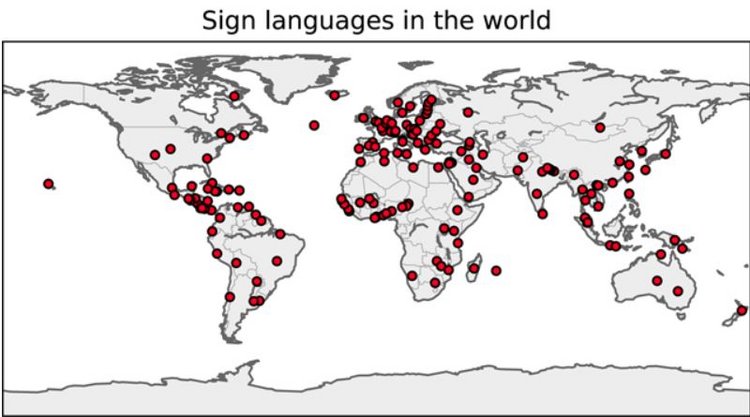
Much of my recent work is on sign languages and more broadly cognitive issues that arise from their analysis. There are hundreds of sign languages, some indicated on this map:
These days most often I work with collaborators (some are alums of Swarthmore). My focus is largely on modality effects, such as how iconicity is pertinent to the syntax/semantics interface and how biomechanics affects the lexicon and enlightens us about diachronic change. I'm presently studying how considerations of visual perception affect movement choices within the frozen and productive lexicon across seven sign languages and how signers choose a starting point when they draw a shape in the air, looking at data collected on six sign languages. I hope to do a study of the timing of breaths and its relationship to syntactic boundaries in ASL as compared to Swiss German Sign Language (three collaborators and I are discussing this). In other words, it's all beautiful to me.
I'm on a team that works to protect deaf children's right to language. We publish mostly in medical journals. You can access our articles here. This work has taught me about first language acquisition and honed my advocacy skills.
And I am engaged in developing materials to encourage shared reading between deaf children and their parents (see below). This is part of a larger effort to promote literacy skills via convincing parents to give their deaf children a rich and firm first language foundation and convincing teachers (through journal articles aimed at them) of the efficacy of fun and humor in the inclusive classroom. Prof. Gene Mirus of Gallaudet University and I presented our project (RISE) at the World Literacy Summit in Oxford, UK, in spring 2023. We have just initiated a study of what features might make a bimodal-bilingual videobook more effective in promoting preliteracy skills among deaf children.
With respect to literacy skills, I am also engaged with a research team at Università degli Studi Roma Tre. We are looking at whether the use of gestures during shared reading activities promotes acquisition of a second L1 for immigrant children in Italy and speeds up their developing literacy skills. This is new work for me (I became involved only in late 2022), but it is a natural extension of my commitment to language acquisition and literacy rights in general. I was in Rome in Nov. and Dec. 2023, helping to analyze the results of our first study, and giving presentations in linguistics. We are now working on a second study.
Beyond mainstream linguistics, I'm interested in how linguistic theories and methodologies can be applied to analyze body articulations in yoga and dance. This work is part of SUPERLINGUISTICS: I gave the first presentation in a series on SUPERLINGUISTICS at the University of Oslo in January 2019. In spring 2017, I co-taught a course on corporality in storytelling in which we examined silent narrative in films, stage plays, mime, stand-up comedy, sign language visual vernacular, and dance. My partner was Elizabeth Stevens of the Department of Theater. In spring 2021, I co-taught a course on innovations in dance in the past century with comparisons to innovations in sign literature in the same period. With regard to signing, attention was on the semantics of phonetics (Ha! If you're a linguist reading this, I bet that surprised you). My partner on this was Olivia Sabee of the Dance Program. In spring 2022, I co-taught a course on creating narratives in clay and in language (both spoken and sign). My partner was Syd Carpenter of the Art Department. These co-taught courses were capstone seminars for the program in Interpretation Theory. Ellen Gerdes and I are co-teaching a revised dance-sign course in spring 2024.
This work has circled back to straight linguistic research: Rachel Sutton-Spence and are I investigating torso articulations in sign languages in order to understand what the grammar of sign languages must include (see forthcoming article); torso articulations in sign languages as compared to different dance genres in order to see what sign/language art versus performance art is (see article in 2023); and torso articulations in various sign language genres in order to understand how one makes a determination whether a given articulation is "language" or not (this one delves into philosophical and political issues in linguistics today; it might be a while in coming).
I also analyze linguistic innovations in poetry, story-telling, jokes, and taboo language. I organized a conference on Disrespected Literatures at the college in spring 2017; you can see a short (3 minute) video about it here. I co-edited an issue of the Italian online journal Altre Modernità (published by the Università di Milano) devoted to disrespected literatures (December 2019, here). I've published work on what sign language literature can tell us about sign language structure; I integrate analysis of sign language literature into Linguistics 63/Theater 33; and I teach Linguistics 29/Comparative Literature 29, on sign language literature from a linguistics perspective (first taught in fall 2021, next offered in fall 2024) . Gene Mirus and Jami Fisher and I published a manuscript with Cambridge U. Press on taboo in sign in late fall 2023.
The Linguistic Society of America did a spotlight interview with me in April 2017.
The American Association for the Advancement of Science did a spotlight interview with me in February 2022.
I also write books (fiction and nonfiction) for children, where recently I've been concentrating on STEM books as well as fiction. Starting in September 2020, I led multiple writer workshops and gave critiques for the "Telling Feminist Stories Initiative" of the United Nations Entity for Gender Equality and the Empowerment of Women. The launch of the first volume of stories -- titled Awake Not Sleeping: Reimagining Fairy Tales for a New Generation --was 18 November 2021 in Istanbul, Turkey. I gave the keynote address; the link in English is here. My keynote starts around -1:45 and ends around -1:31. I return later near the end of the video, as I moderate a session on why fairy tales matter. I was involved in the initial stages of helping prepare writers for the second volume of stories.
In fall 2021, Shepherd "best books" asked me to recommend five books on a topic of my choice in exchange for promoting one of my fiction books. Deaf culture was my choice of topics; In a Flash was my fiction book. In fall 2023, they asked me to talk about my three favorite books that I had read during the 2023 year in exchange for promoting one of my fiction books. Two of my choices were about the plight of children in wartime (What is the What and Mischling); As Night Falls was my fiction book.
Very odd detail: In 2019, then-SWAT-student Alex Kingsley asked me to play a part in Episode One of their film series Restless Writers' Retreat. I never acted before -- know nothing about acting. But the part made me laugh, so I did it. The series came out in September 2020. Alex is a wickedly good writer -- keep your eye on them. Here's the first episode. And here's a podcast of their new sci-fi comedy podcast called The Stench of Adventure. Their first novel is due out in October 2024 with the publisher Space Wizard Science Fantasy. The working title is The Ivies and the Empress.
As of fall, 2018, I changed from being Professor of Linguistics to Professor of Linguistics and Social Justice. I am also delighted and humbled to have been appointed the Maurice Eldridge Faculty Fellow starting in fall 2021, an appointment I am trying my best to merit.
Bimodal-bilingual videobooks
Since 2013, my students and I have been collaborating with Prof. Gene Mirus and his students at Gallaudet University on producing bimodal-bilingual videobooks in 33 sign languages with the print of the ambient spoken language. We've produced over 130 video-books.
https://riseebooks.wixsite.com/access
For a discussion of how and why we do what we do, go here. For a college article about our project, go here.
In spring and summer 2020 our students (past and present) worked with many countries to make bimodal-bilingual videobooks about COVID-19, with the director of technology being Melissa Curran (our past and beloved student, class of '19). That work led to associations with deaf groups in many countries, groups we continue to work with.
In summer and fall 2021 our students worked on translating texts from English into Spanish and making new productions of some of our ASL videobooks so that they now have Spanish text with English subtitles, to meet the needs of deaf children in North America whose family home language is Spanish. This work is in response to a request from a deaf school in North Carolina.
As of 2021, our students also work on making videobooks with special inserts for autistic children, in response to a request from a publisher in Italy. These books have Lingua dei segni italiana with Italian text. (Research has shown that some autistic children have better communication results in the visual/manual modality than in the aural/oral modality.)
For an overview of our work from 2013 through spring 2024, with a peek at what we accomplished in 2024 through funding from the Engaged Humanities Studio of the Lang Center for Civic and Social Responsibility, go here.