back

General Biology


Course Structure
Students
Course Content
My Work


Course Structure

Students take general biology in tenth or eleventh grade at Friends Select. The course meets four times a week for three 40-minute periods and one 80-minute period. The 40-minute periods are usually used for lecture, demonstration or assessments, such as quizzes and tests. The 80-minute period is usually used for labs, although there was some flexibility in this schedule.

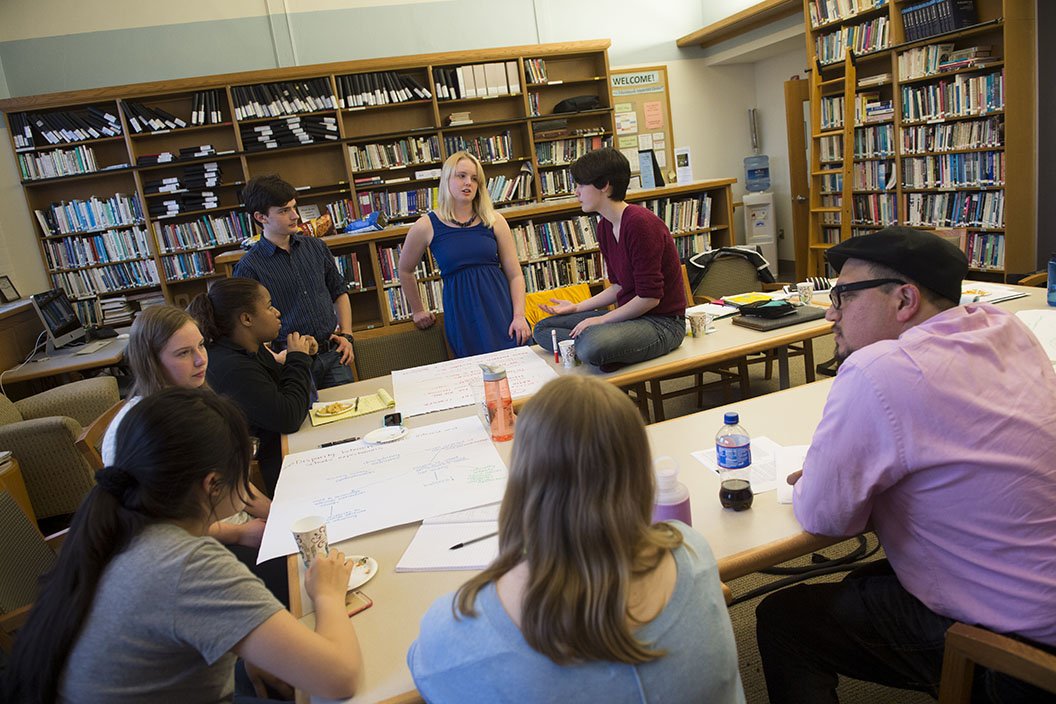
Each of the three classes I worked with had 14-16 students. The desks were arranged in rows in front of a board at the front of the room, and there were lab benches and additional work space at the back of the room. For lab, there was a wide variety of equipment, resources and materials available.

Students were assesssed in a number of different ways throughout the course:

  • homework
  • tests and quizzes (multiple choice and short answer)
  • group and independent projects (i.e. making a 3-D DNA molecule structure)
  • weekly lab reports

Top


Students

There was a wide range of student ability and interest in the general biology classes that I worked with at Friends Select. Most students were accustomed to a traditional lecture format, and I often found it difficult to engage them in more interactive activities. Some students were able to think critically and abstractly with relative ease, whereas others often struggled with memorizing and understanding basic concepts and terminology. Some students came in regularly for help outside of classes, but most did not.


The dynamics in the three classes were very different. One class was very quiet, almost never asking questions, but worked well when doing independent and small group work. Another class was very dynamic during lecture, asking a lot of questions. However, many students had difficultly focusing and staying on task during lab.

Top


Course Content

The following are the major topics and concepts that were taught during the three months I was student teaching at Friends Select Upper School:

  • DNA
    • Molecular Strucure
    • Replication
    • Function and Protein Synthesis
  • Genetics
    • Mendelian Inheritance
      • Indpendent Assortment
      • Monohybrid and Dihybrid Crosses (Punnett Squares)
    • Codominance
    • Incomplete Dominance
    • Genetic Engineering
  • Plants
    • Basic Anatomy and Physiology (Roots, Stems and Leaves)
    • Evolution
    • Reproduction (Flowers, Seeds and Fruits)

Top


My Work

Lab Work

After two weeks of observing the classes, I assumed the responsibility of designing and teaching the labs for all three general biology classes for the remaining eight weeks that I was student teaching in the upper school. I spent 15-20 minutes introducing the lab and left the rest of the 80-minute period for students to work independently. Most of the labs were designed to be self-contained within the 80-minutes period, however, I developed one long-term lab that continued over a three-month period.


The following are the topics and labs that I used:
  • DNA and Chromosomes: Observing barr bodies and Creating karyotypes
  • Mendelian Genetics:
    • Comparing the predicted and actual occurances of human monohybrid traits
    • Investigating the origin of dihybrid corn
  • Genetics, Evolution and Plants - Long-term lab: Testing for differences in success between different phenotypes of Arabidopsis under environmental stress
  • Plant Anatomy and Physiology: Observing plant root, steam and leaf tissue
  • Plant Evolution and Reproduction: Observing plant flowers, fruits and seeds

Top


Sample Lesson: Mendelian Genetics

Farmer Funk's Funky Dihybrid Corn:
Investigating the Origins of Dihyrid Corn


Goals

  • I wanted to design a lab that reinforced the concepts and procedures (especially the Punnett Square) that the students had learned in class while requiring them to apply these concepts and procedures to a new scenario.

Top


Objectives

  • All students will successfully use Punnett Squares to outline the dihybrid P and F1 generation crosses that occurred to produce a phenotypically mixed F2 generation corn cob sample.
  • All students will successfully use Punnett Squares to demonstrate the selective process that must occur to breed pure corn cobs from a pheontypically mixed corn cob sample.

Top


Lesson Plan

Day 1 (80 minute. Lab)

1. Group Introduction (20 min.)

  • Tell the students that we are going to talk about corn sex!
  • Ask students to summarize how a corn plant reproduces – illustrate reproductive cycle on the board.
  • Make sure that all students understand that each corn kernel on a cob has its own genotype. A whole cob includes all the individuals in a generation produced by one cross.

The Problem

Lab Instructions and Guidelines click here

  • Tell the students that they are going to be asked to solve a problem involving plant sex and genetics.
  • Hand out the lab instruction sheet and ask the students to read the background information about Farmer Funk and his dihybrid corn on the first page. While they are reading, show the students samples of the pure purple/starchy, yellow/starchy, purple/sweet and yellow/sweet corn cobs.
  • Ask the students to brainstorm what they think the mystery will be (cross-bed corn).
  • Ask what the cross-bred dihybrid corn will look like. Show them four samples (1:1:1:1, 9:3:3:1. 3:1 and 1:1 ratios) of the phenotypically mixed corn cobs.

Strategies

  • Ask the students to read the second page of the handout that describes the problem and what information they need to discover.
  • Afterwards, ask the students to share strategies for how they could solve the problem.
  • There are a couple possibilities here, but students will probably decide that the best method will be to first calculate a ratio for the kernel phenotypes that are on the cob. Using this ratio, they can then think of the types crosses they have learned in class that produce the same ratios. This same method will allow them to trace back one further generation to identify the possible parent genotypes from the original crosses between pure strains.
  • Do a sample backward-cross diagram on the board and show students the format in the handout that you would like them to use to organize their results.

2. Lab Part I: Identifying the F1 and Parent Crosses (60 min.)

  • Divide the students into four groups and give each group a mixed corn cob sample. (Give students who already have a firm grasp on the concepts and procedures corn with a 1:1:1:1 or 9:3:3:1 ratio instead of a 1:1 or 3:1).
  • Explain that they will work together to identify the F1 and parent crosses that occurred to produce their mixed corn cob sample.
  • Ask the students to make a backward-cross diagram using large paper and crayons, which they will use to present their findings to the rest of the class.
  • Allow the students to work in their groups, helping them as needed.
  • After 30 minutes of work, ask each group to make a 5-minute presentation to the rest of the class, using their diagram to explain what they did to identify the crosses that occurred (Ask that everyone in the group explain some aspect of the process).
  • For homework, ask students to read Part II: How to return to the purebred lines and the Lab Report guidelines in the handout.


Day 2 (40 minute class)

1. Group Introduction (10 min.)

  • In order to give students plenty of time to work together in their groups, ask someone to briefly summarize what they need to do to complete Part II of the lab.
  • If necessary, demonstrate a sample set of crosses on the board that will select for the purebred corn cobs.
  • Before breaking into groups, briefly go over the Lab Report guidelines on the last page of the handout to make sure that students are clear as to what is expected of them. Make it clear that each student must hand in his/her own, unique lab report which includes his/her own version of the results and conclusions.

2. Lab Part II: How to Return to the Purebred Lines? (30 min.)

  • Have students break up back into their groups from the last class. Give them their same mixed corn cob sample and ask them to create a diagram that visually demonstrates the selective process that they would use to return the corn stock to its purebred status using the kernels from their mixed sample. They should include the number of generations it will take to get purebred corn from different phenotypes and show what percentage of the crop will need to be selected out or continue to be self-bred.
  • As long as students follow the general guidelines in the handout and are clear about showing their work and thought process here, there is no one right answer. I purposefully left this part of the lab open to the students’ subjective interpretation by asking them to make economic- and time-conscience decisions. This part of the lab also stresses that genetics concepts have practical, predictive purposes when making decisions and are not isolated to being used for demonstration.

Assessment

All students will be required to write a formal lab report that explains:

  • Objective/Purpose
  • Procedure
  • Results/Data
    • Penotypic ratio of corn kernels on the cob
    • Diagram of the crosses that occurred to produce the mixed dihybrid corn (generations P,F1 and F2)
  • Observations
  • Conclusions
    • Written explanation of how to return the corn crop to purebred.
    • Diagram of the crosses need to return the corn crop to purebred.
    • Drawn plan of how to avoid crossing between different pure strains of corn in the future.

Top