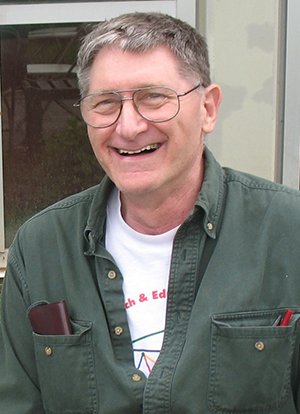
At the more advanced level I have particularly enjoyed teaching introductory analysis, as well as courses in my specialty. In particular, I am the person here who knows the most about linear programming, mathematical game theory, and mathematical biology.
According to course questionnaires, most students really like the online contact. It works especially well for students who are shy about coming to my office, or for whom getting to my office is inconvenient. On the other hand, I am delighted to interact with you however you like -- in person, by phone, in class, email, etc. There are lots of learning styles, and I try to provide information in many different ways in hopes that at least some of it comes in a form most congenial for you.
Another thing students notice are my inventions -- problems I make up in addition to problems from the text. Problems -- both solving them and posing them -- is perhaps the thing that first got me interested in mathematics as a kid, and I think I am now a pretty good problem poser. I used to specialize in hard problems, but now my goal is to make up problems that clearly get at some point. Many of these problems are still to be done with paper and pencil, but I also make up various computer problems and labs. Most mathematicians, including me, feel that
I probably spend at least half my course time preparing problems and solutions, and you should spend at least half you time on the problems too.
I like to teach both classes and seminars. I like giving lectures. I think I have a knack for getting to the point and being clear, while showing my enthusiasm for the subject -- at least this is what students tell me in evaluations. I seem to be good at knowing what is hard for people. I also enjoy making up examples that get at key points; this is closely related to problem writing.
Interestingly, I do better lecturing to large classes (30 or 40) than to small classes (10-20). Somehow I draw more energy from, and thus deliver more energy back to, a larger group -- maybe because I get more questions and comments (natural if there is a fairly constant comment rate per Swattie).
However, there is a lot of evidence now that lectures just don't work for most students (perhaps even Swarthmore students) no matter how clear and engaging the professor is. A great explanation isn't enough; you've got to try it yourselves. Therefore, even in lecture classes I try to do less lecturing these days and spend some time having you work at your seats, or in groups at the board, or have you write little summaries of what class was about, etc.
In seminars the satisfaction has always been seeing what you do, since I am more a coach, getting you to present things, even if your work is incomplete or you are not sure you are right, and getting you to cooperate with each other.
I both classes and seminars, I like the Socratic method -- asking a lot of questions and making you develop your understanding through answering. The Socratic method used to be a norm -- students used to understand that it was meant for their benefit. Or at least I thought they understood it, for they didn't complain about it. But now we get feedback indicating that many students feel questions are meant to intimidate them. So I try very hard these days not to be intimidating -- I ask more gently, wait longer for answers, applaud partial answers, show my delight when someone's false start eventually led the class to reach a good conclusion, and in general, explain why I am asking questions. But this does take a lot more time. I wonder: has an old understanding (about the purpose of questioning) broken down, or were we teachers wrong to think there ever was an understanding?
I am also very eager for you to ask your own questions. I think I am good at understanding what you are trying to ask (because I seem to have a good sense of what students misunderstand). However, if I am not sure I understand your question, I will ask you to try again until I do understand it. Try me and see. Don't be afraid to ask.
A secondary purpose of tests is to make you see the material is a new way. In addition to standard problems, I like to write some questions which provide a slightly different context than you have seen; will you see the connection and solve the problem?
This part of this essay used to be titled "Teachng Style". However, these days there is considerable opinion that disussing teaching style is barking up the wrong tree; we should be discussing your Learning Style. In this regard, consult my complementary statement How I learn. How do You?. My teaching style is based on my learning style; I'll change it if your learning styles are quite different.
Steve Maurer