Good news! In a March 14th ruling (below), the judge presiding over AC2T v. Purrington dismissed the case with prejudice. The decision came after Jeremy Hirsch, the company’s chairman-of-the-board, emailed the court to say he no longer wanted to pursue the defamation suit against me, citing lack of money. I suspect the real reason is that he and co-founder Chris Bonner didn’t want to comply with several of the judge’s recent orders, such as coming to Pennsylvania to be deposed (for 6 hours, with me in the room) and handing over documents (emails, texts, experimental data) that they really didn’t want anyone to see. And they likely wanted to avoid the trial, too, which would have been a complete disaster. The 2-page ruling is below:
Although this is great news, the judge did not order the company to reimburse me for my legal costs (approximately $90,000), so I’ll need to sue Spartan Mosquito for malicious litigation. And the judge did not order the company to retract any of its allegations against me (for example, that I am a secret employee of a big pharmaceutical company). And I never got my day in court, which after four years I was looking forward to.
But the biggest bummer is that this company is still selling its tubes to the public.
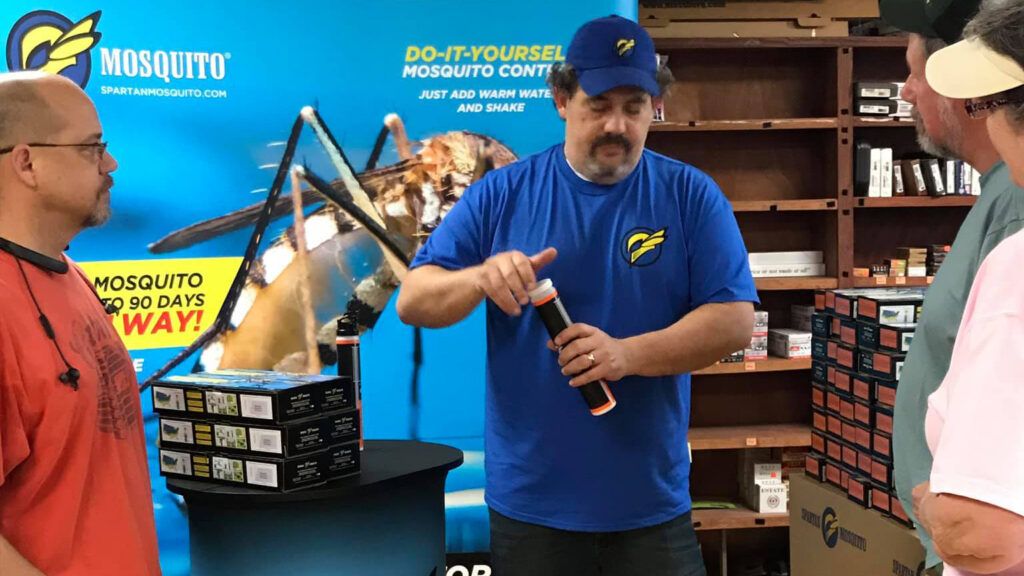
As a reminder, these are the two guys behind the scam: Chris Bonner and Jeremy Hirsch. They both live in Hattiesburg, Mississippi, in large houses with pools.
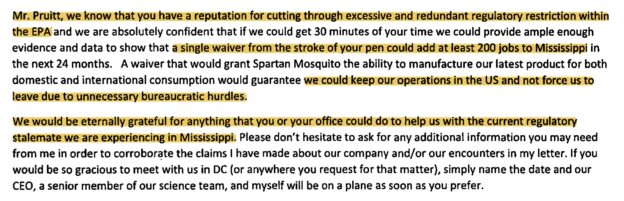
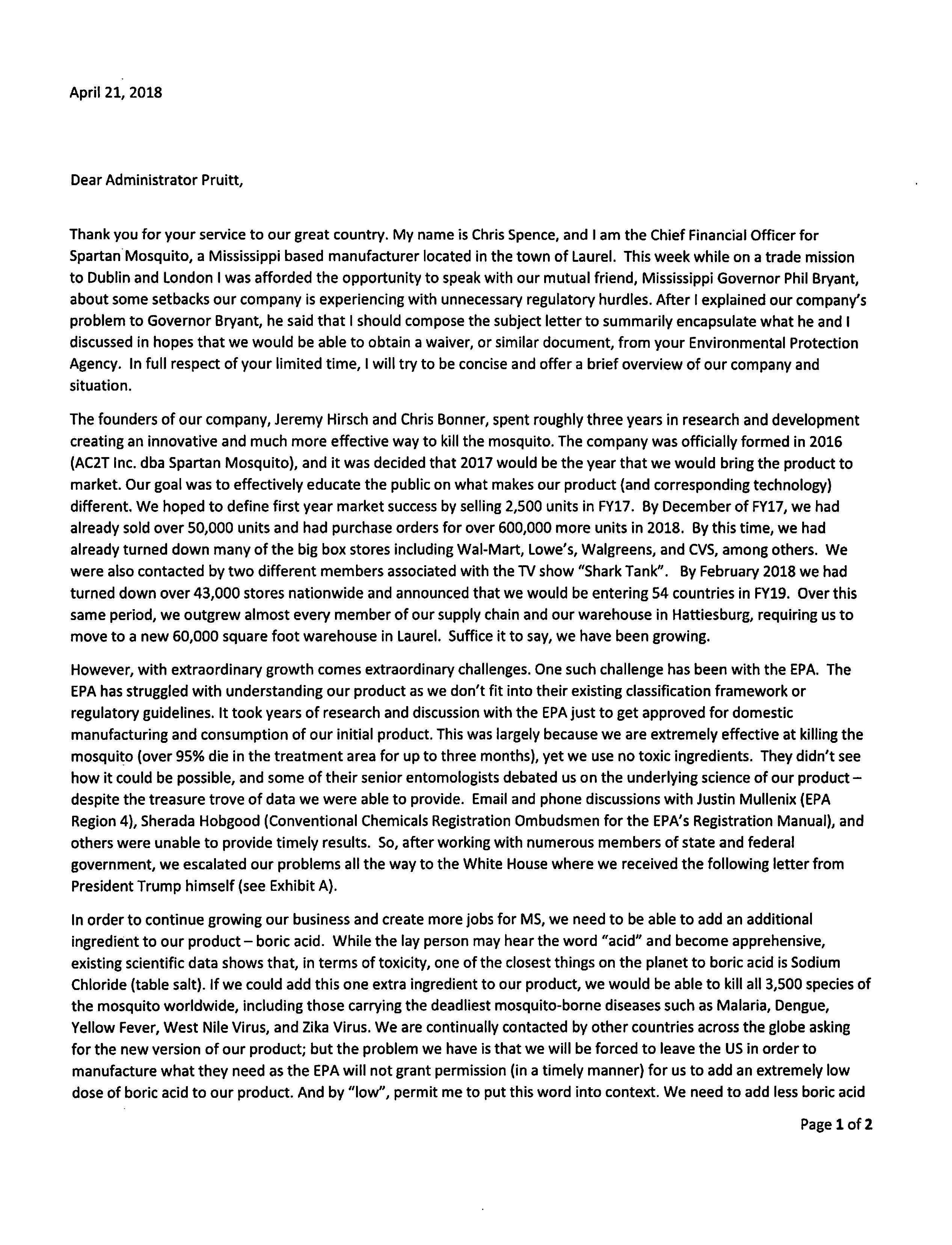
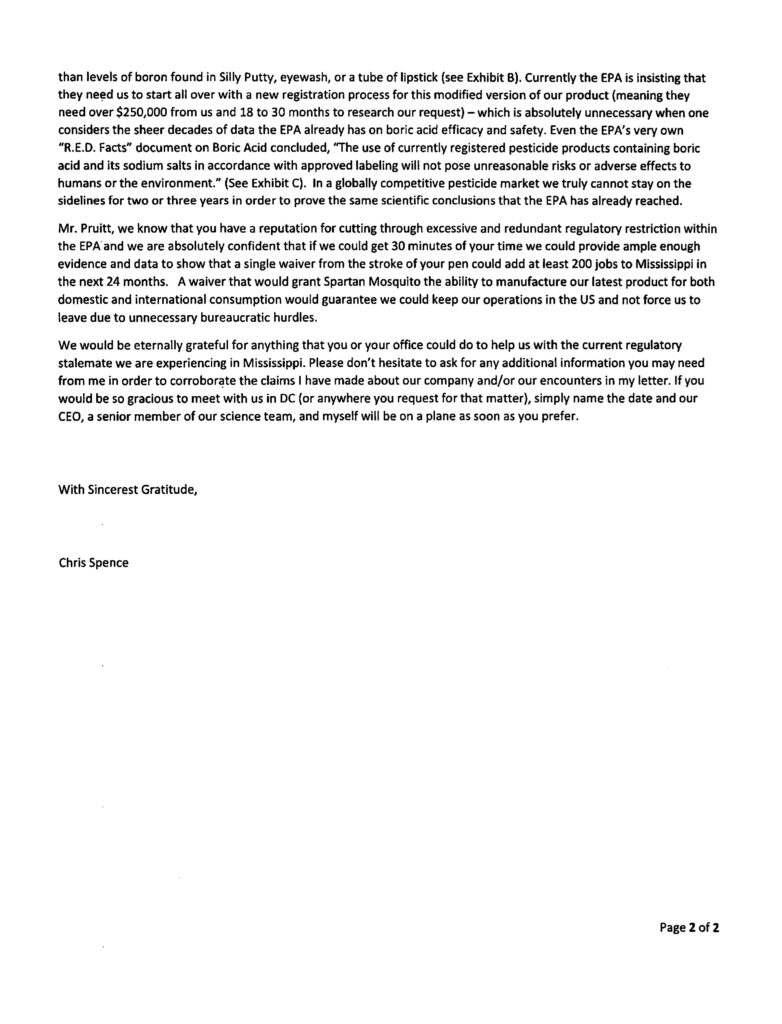
In a prior post I detailed Spartan Mosquito’s secret efforts to secure an EPA registration for the Spartan Mosquito Pro Tech, a plastic tube filled with sugar, yeast, boric acid, and water that the company claims, “kills mosquitoes.” Below is an early part of that successful campaign, a letter sent by Spartan Mosquito’s Chris Spence (CFO/CEO) to EPA’s then-administrator, Scott Pruitt, in April of 2018. In it, the company asks to bypass the normal pesticide-approval process. In particular, it didn’t want to have to prove that the pesticide killed mosquitoes. I obtained the letter through a FOIA request.
Notes and additional files
Given the style of writing and word choice, I’m 99% sure the letter was written by Spartan Mosquito’s Jeremy Hirsch, one of the company’s cofounders and current chairman of the board.
I have asked the EPA for Mr. Trump’s letter (“Exhibit A”) but they have refused to give it to me.
Here is “Exhibit B” referenced in the letter. It’s a graphic that shows the boric acid concentration of the Spartan Mosquito Pro Tech relative to other objects such as Silly Putty.
Here is “Exhibit C” referenced in the letter. It’s a collection of facts pulled from papers on toxicity of boric acid to mosquitoes. NB: the toxicity of boric acid to insects is well known, but Spartan Mosquito likes to focus on the ingredient to distract from the real issue of whether mosquitoes would go inside the tubes and drink the fluid that has the boric acid. Research (by me) shows that mosquitoes do not.
Mr. Spence sent a similar letter to Senator Cindy Hyde-Smith, who sits on several important committees that regularly touch on the EPA. The ask in that letter, dated April 24, 2018, was for Hyde-Smith to get Pruitt to agree to a meeting. Spartan Mosquito employees gave at least $8,100 to her 24 hours later, on April 25, 2018.
Mr. Spence left Spartan Mosquito in November of 2023 and deleted all references to his affiliation with the company from his LinkedIn profile after three years as CEO. I don’t think people normally erase their CEO positions. Journalists should definitely give him a ring.
If you’d like to see the data that Spartan Mosquito eventually submitted to the EPA on July 29, 2019, see this page. In particular, look at the file named “Spartan Mosquito Eradicator Pro Tech EPA Reg. No. 93813-R Field Efficacy Evaluation Against Mosquitoes” (PDF). In this document, Spartan Mosquito summarizes four “experiments” conducted at various locations in Mississippi by Jeremy Hirsch, Chris Bonner, or Michael Bonner.
To the best of my knowledge, California is the only state to request the efficacy data for the Spartan Mosquito Pro Tech from the company. After reviewing the files the state banned all sales of the pesticide product.
Spartan Mosquito says it is has had meetings with multiple countries interested in hosting production facilities for the tubes. It is testing the tubes in Togo and plans to sell in areas with high rates of malaria.
Further evidence of the special consideration the EPA granted Spartan Mosquito is the letter below, sent by Jeremy Hirsch (Spartan Mosquito’s founder and chairman) to Andrew Wheeler (EPA Administrator) on 11 November 2020, almost eight months after the Spartan Mosquito Pro Tech obtained a registration:
The letter references a meeting Mr. Hirsch had with with EPA staff, likely including Susan Bodine (then Assistant Administrator of EPA’s Office of Enforcement and Compliance Assurance) and Alexandra Dunn (then Assistant Administrator for EPA’s Office of Chemical Safety and Pollution Prevention). The obsequious tone of the letter suggests that Spartan Mosquito had been in trouble for some reason. Because the EPA still allows sales of the Spartan Mosquito Pro Tech I assume the meeting diffused whatever concerns the EPA had uncovered. I obtained the letter via a FOIA request. The EPA will not give me any information on what the problem was.
That said, I do know that the pesticide-approval staff at the EPA met in September of 2020 to discuss the Spartan Mosquito Pro Tech after I shared my concerns about the quality and trustworthiness of the data. Erik Kraft (Branch Chief, Regulatory Management and Science Branch) sent an email to me after the meeting: “I’ve discussed your email about the performance of the product with my senior staff and we’ve determined to not take any further action…” It could be the case that the letter from Mr. Hirsch, above, is related somehow to the concerns that I shared. All of my concerns are listed in my review and in my analysis of the Spartan Mosquito’s efficacy tests. In summary, I am sure that Spartan Mosquito misled the EPA. And I’m pretty sure that the EPA now knows it was misled.
The other explanation for the meeting might have been that the EPA became concerned about the claims the company was making about efficacy on its website and Facebook page. Although “kills mosquitoes” was permitted, the EPA eventually asked, in February of 2021, for the addition of qualifying language to the label: “Product has not demonstrated complete kill of mosquito populations.” I don’t know what prompted that letter, but the meeting in November of the previous year could have been related. Spartan Mosquito has not made the requested change.
Why is the Spartan Mosquito Pro Tech still on the market?
The EPA can issue a “stop sale” order on a registered pesticide if it learns that the pesticide violates any provision of FIFRA (i.e., is “misbranded”). Here’s EPA’s language: “As defined in FIFRA Section 2(q)(1)(A) a pesticide is misbranded if its labeling bears any statement, design or graphic representation which is false or misleading.” Accordingly, the EPA could simply say, “the label falsely claims that mosquitoes gather around the tubes.” Similarly, the company’s patent highlights the role of CO2 in attracting mosquitoes, so listing the yeast and sugar as “inactive” ingredients is deceptive. Finally, the EPA could object to the “kills mosquitoes” claim because the tubes clearly do not kill mosquitoes (because they don’t attract them in the first place). In regard to the latter, the EPA might act on the misleading data the company submitted. I’m assuming somebody powerful is holding the EPA back from issuing a stop-sale order, or that the EPA is embarrassed to admit it erred in granting a registration (probably more likely). Only media exposure will change this strategy.