home

Guidelines for Music 48 (Performance: Individual Instruction)

(Revised 08 October 2007)

INTRODUCTION

The Department of Music and Dance offers subsidized individual music lessons to Swarthmore College student instrumentalists and vocalists who are members of Departmentally sponsored ensembles. Under this program, known as Music 48, students may receive one half credit per semester for ten hours of private lessons with a teacher of their choice. They also receive assistance toward the cost of the lessons. The purpose of this program is to help musically talented Swarthmore students continue their growth as musicians while they are in college. There is no limit on the number of semesters a student may enroll in this program.

MERIT-BASED SCHOLARSHIPS

Students who wish to participate in Music 48 are ranked by audition. The levels of subsidy awarded are one-third, two-thirds, or 100% of the cost of 10 private lessons per semester. In addition to private lessons, all Music 48 students are also eligible to receive one-on-one sessions with a vocal coach or accompanist. For students at the 1/3 subsidy level, the Department will fully subsidize one hour of coaching time (or two half-hour sessions) per semester. For students at the 2/3 level, the department will fully subsidize four hours of coaching time per semester. The highest level of subsidy is a Garrigues Scholarship, which pays for transportation costs to and from lessons in full. Garrigues scholarship students may include as many coaching sessions as may be afforded, along with the required ten lessons, within the maximum per-student allotment. Garrigues Scholars who are seniors can also receive Departmental sponsorship for a Senior Recital.

NEED-BASED SCHOLARSHIPS

Music 48 funds students on a need-blind basis. Students with financial need are encouraged to audition for the program. If they are ranked at the one-third or two-thirds level, they may submit an application to the Department Coordinator to supplement their award. One-third subsidies are limited to an additional $250 in increased support; two-third subsidy requests will not exceed $750 toward the cost of 10 lessons over the course of the semester. This supplemental funding is available for private lesson fees only; it is not available to supplement additional sessions with a vocal coach or accompanist, or for transportation expenses.

LESSONS FOR BEGINNERS

Although Music 48 is limited to students who are members of Departmental Ensembles, the Department is also able to support a few students who, as beginners, are not eligible to participate in the full program. Click here for more information.

MUSIC 48 CHECKLIST

Here is a brief checklist of all Music 48 Requirements. Further information about each item follows below, under the heading "Specific Requirements." In order to receive credit and a lesson subsidy, you must:

  1. fulfill the DEPARTMENT ENSEMBLE REQUIREMENT;
  2. AUDITION for Music 48;
  3. secure a PRIVATE TEACHER;
  4. submit a MUSIC 48 APPLICATION to the Department by the deadline;
  5. take TEN LESSONS during the semester;
  6. submit a MUSIC 48 PAPER by the deadline;
  7. have a CONFERENCE with your Music 48 Advisor to discuss your paper; and
  8. perform for a JURY at the end of the semester.

SPECIFIC REQUIREMENTS

1. ENSEMBLE REQUIREMENT. To qualify for Music 48, you must concurrently be a member in good standing of one of the performing ensembles sponsored by the Music Department. (You may also choose to register to receive 0.5 academic credit for participating in your ensemble, but this is not required.) For information about auditioning for Department Ensembles, please click here.

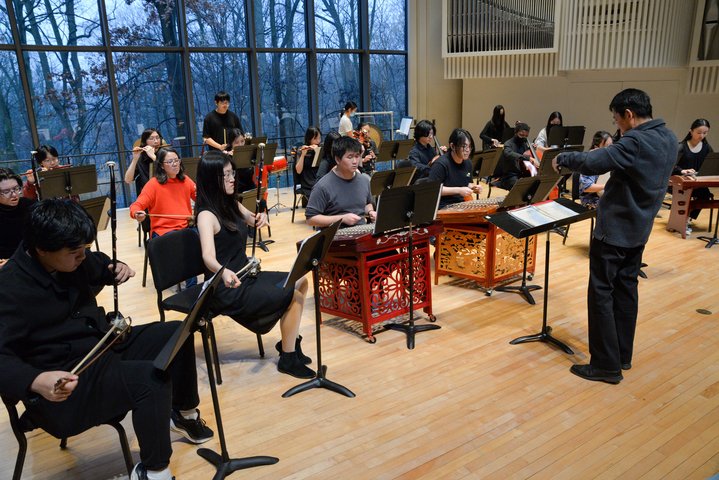
Voice students normally satisfy this requirement by joining the Chorus. Most instrumentalists satisfy it by joining the Orchestra, Wind Ensemble, or Jazz Ensemble. Instrumentalists who are not eligible to join any of these groups must speak to Michael Johns to find an alternative way to satisfy this requirement. Intermediate-level pianists and guitarists, for example, sometimes satisfy the ensemble requirement by singing in the Chorus or playing in the Gamelan.

Music 47 Chamber ensembles do not satisfy this requirement.

Advanced pianists --- i.e., those who are Garrigues Scholars --- may satisfy this requirement by participating in the Department's Program for Accompanists. In this program, pianists collaborate on a weekly basis throughout the semester with several vocalists and/or instrumentalists, working with them at rehearsals, lessons, and concert performances. Another option may be to accompany Dance classes (see Sharon Friedler, Chair of the Dance Program) or the Chorus (see John Alston, director of the Chorus). It is expected that pianists will devote at least three hours per week to this, a time commitment that roughly corresponds to membership in one of the Department's ensembles; it is the pianist's responsibility to arrange a weekly accompanying schedule with vocal and/or instrumental students and their teachers.

2. AUDITION: If you are new to Music 48, you must play an audition for Swarthmore's music faculty at the beginning of the fall semester. (Students who have previously enrolled in Music 48 need not reaudition at this time.) Students who wish to begin Music 48 in the spring semester may audition at juries in December; it is not possible to audition in January.

Auditions and juries are held in Lang Concert Hall; the dates are posted on the Department website. Students must sign up in advance on the Department bulletin board, across from Lang 401. You should prepare a four or five minute excerpt of music --- but not a technical exercise! --- that demonstrates your current level of musicianship. If the composition you are performing calls for piano accompaniment, the Department provides a pianist. It is important that you rehearse with the accompanist before the auditions; please bring a score for him or her. A sign-up sheet for these rehearsals is also posted on the Department bulletin board.

On the basis of this audition, the faculty awards scholarship subsidies (see the section entitled "Merit-Based Scholarships", above).


3. PRIVATE TEACHER. Before you can enroll in Music 48, you must secure a private teacher. Singers who need guidance in finding a teacher should see John Alston; instrumentalists who need guidance in finding a teacher should see Michael Johns. It is your responsibility to contact the teacher with whom you wish to study and to arrange to audition for him or her if needed; several excellent teachers post audition sign-up sheets on the Department bulletin board. You must also work out a lesson schedule and fee arrangement that is mutually acceptable. At the end of the semester, the Department will ask your private teacher for a written evaluation of your progress.

4. MUSIC 48 APPLICATION: Once you have reached an agreement with a teacher, you must submit a Music 48 Application to the Department of Music and Dance. Applications are available in the Music and Dance Office, 401 Lang. The deadline to register is posted on the Department website. You may not register for Music 48 through the Registrar's Office: the Department will take care of your registration once your application has been accepted. After you are registered, you will be assigned an advisor from the Music faculty.

In order to receive a lesson subsidy, you must be registered to take Music 48 for credit. There are no exceptions. Please note, however, that Music 48 lies outside the five-credit limit imposed by the College; that is, the Registrar will permit you to register for 5.5 credits without extra tuition charge if and only if the extra 0.5 credit is Music 48.

5. TEN LESSON REQUIREMENT. You must take ten one-hour lessons (or the equivalent) during the semester. It is assumed that you will be prompt and well-prepared for each of your lessons. Students who do not meet teacher expectations in these areas will not be permitted to re-enroll in the program. In addition, a student with one unexcused missed lesson will be given a grade of No Credit and will lose his or her subsidy.

Students with one-third and two-thirds scholarships should pay their teachers directly for all lessons during the earlier portion of the semester. After they have paid their share in full, the Department will pay its share of the remaining lessons. Students who fail to honor their financial obligations will receive a grade of No Credit.

As part of your course of study, it is vital that you and your teacher think carefully about your choice of repertoire. At the end of the semester, you will perform a four minute composition (or excerpt) at juries, so it is important that you and your teacher select a composition at the appropriate level of difficulty and devote adequate practice time to it.

6. MUSIC 48 PAPER: The Music Faculty affirms that, in order to perform well, a fine musician must engage many aspects of music well beyond the technical demands of a given composition. Thoughtful inquiry into the historical/cultural context and the musical content of a composition are no less important than learning to play or sing the notes. We ask, therefore, that all Music 48 students do a research project and write a short paper on the composition they intend to play at juries. The Music 48 Paper may be brief (one or two pages) but should include a detailed bibliography. Your paper should be submitted directly to Bernadette Dunning, Administrative Coordinator (hard copy only, please!); the deadline may be found on the Department website, along with the list of Music 48 Advisors.

The music faculty has created a set of questions to guide you in your research. Please consult them; they are available on the Department website.

Failure to turn in the Music 48 Paper on time will result in a grade of No Credit and loss of subsidy.

7. CONFERENCE. After submitting the Music 48 Paper, each student must meet with his/her Music 48 Advisor to discuss the content of the paper. These conferences normally happen during the week before juries. Failure to confer with your Music 48 Advisor will result in a grade of No Credit and loss of subsidy.

8. JURY. Juries take place during the exam period in December and in May. The sign-up procedure is the same as for auditions in September. At juries, each Music 48 student is expected to give a well-prepared performance of a short work, movement, or excerpt (ca. 4 minutes) before a jury composed of the Music faculty. All singers must have jury pieces memorized. The purpose of juries is threefold:

  • to award credit for that semester's work;
  • to receive written comments from the music faculty; and
  • to determine eligibility and level of scholarship support for the upcoming semester.

Juries are normally required of all Music 48 Students. A student who has performed a Senior recital or a prominent solo with a Department ensemble may apply in writing to have this requirement waived.

Failure to appear at juries will result in a grade of No Credit and loss of subsidy.

Academic Credit

Music 48 is graded exclusively on a Credit/No Credit basis. It does not count towards the limit of four elective pass/fail courses taken elsewhere in one's course of study. Students may receive one half credit per semester without limit if they wish.

Further Information about 100% Scholarships:

100% Scholarships are awarded to students in two different categories:

1) Garrigues Scholarships are awarded to the outstanding students on the basis of preeminent performance at auditions [in September ] or juries [December or May]. Garrigues Scholarships are awarded for one semester only; Garrigues Scholars must compete to renew their scholarships during juries at the end of that semester with no guarantee of success. Garrigues Scholarships include full funding for ten lessons; for transportation to and from lessons; for up to six (6) sessions with a vocal coach or professional accompanist; and to hire a professional accompanist for a Senior Recital.

2) Students below the Garrigues level who are section leaders in Department Ensembles or who are Music Majors and Music Minors in good standing are automatically eligible to have their scholarship support raised to the 100% level. The additional support is available for lesson fees only; it is not available for additional sessions with a coach or accompanist, or for transportation costs. Students with special needs, however, are encouraged to discuss this with the Department.

Funding Limits: 100% scholarships are normally funded to a cap of $1,500 per student per semester. Students needing to exceed this dollar limit or the number of lessons should submit a written proposal to the Department Chair for additional funds.

Click here for this semester's Music 48 Deadlines.

Click here for Music 48 Paper Research Questions.

Click here for the list of Music 48 Advisors

home | overview | concerts | facilities | faculty | students | courses | lessons | ensembles | audio clips | other resources | forms | prospective students