|
|
|
Education: PhD, City University of New York Graduate School and University Center, French and Certificate in Film Studies MPhil, City University of New York Graduate School and University Center, French BA, Hofstra University, French |
|
|
Q. When did you come to work at Swarthmore? I arrived at Swarthmore College Fall 2001.
Before coming to Swarthmore, I taught French literature and film and Francophone film at another school. Before that, I taught French and introduction to Film Studies in several colleges in New York City.
I am commited to teaching literature and film and I am able to do both here at Swarthmore. I felt very drawn to teaching in a department where languages are conceived of as tools of communication and products of culture. In this way, language learning is developed within the context of a culture's diverse political, social, literary, and artistic histories.
My knowledge of French has given me access to many places including, obviously, France and, less obviously, Belgium. I've been to museums, archives and libraries in many areas of the Francophone world that I would have never been able to visit without the ability to speak cogently about my interests and convince curators to allow me to enter. When I first began studying French, I never dreamt I'd end up doing research in an archive in Brussels. Yet as I was working on my dissertation and manuscript, I spent many valuable hours at the Cinémathèque royale de Belgique going through files with film-related documents.
Any city.
I love to teach about the concept of space in film: Configurations of Space in Postcolonial Cinema . It's a course in which I can talk about how spatial relations have impacted history and how filmmakers use space and its politics to tell stories and define people.
I recently wrote an article on one of my favorite films from 1975. The film, "Jeanne Dielman, 23 quai du Commerce, 1080 Bruxelles," directed by Belgian filmmaker Chantal Akerman, relies on a narrative of the passage of time rather than on any other structuring device. As I am also interested in the role of women involved in social movements of the same era, I wanted to include research about a documentary film in which a group of women go on strike and then take over their sewing factory. In the end I had to edit out several sections regarding the group of workers, because it proved too difficult to develop my argument about the role of time in film in relation to the workers' documentary. I will have to write another article where I can go into detail about the important roles these women had in the development of radical work places. In addition, I want to find out more about the filmmakers themselves, the women of the factory and film students who were part of an experimental film production company.
A black and white film still of a city street.
The question about my favorite writer in French is as difficult for me to answer as when asked who is my favorite filmmaker. I keep a running top 10-ish list of both writers and filmmakers. The list changes frequently and unreliably reflects my tastes at any given moment. When I get particularly obsessed with a writer or a filmmaker I go on a reading or screening binge and I try to read or see everything that person has created.
The best home-cooked French meal I ever had was made by François's Mom, Janine. It began with an apéritif: vin de noix\; for an appetizer we had raw artichokes with olive oil and salt\; the main course was gigot that we roasted on a spit over the fireplace in the dining room\; and we finished the meal with a supremely rich, unfrosted chocolate cake. I could just cry thinking about it.
I feel taller when I speak French, especially when I wear sunglasses while speaking French. I have never been able to figure out why.
I have studied film and literature since I began taking classes in college as an undergraduate. These two disciplines have contributed enormously to my research and teaching on the specific context of postwar France and Belgium and Francophone cinema. My interests in the culture of social movements and change in the 1960s and 1970s have pushed me towards a better understanding of the fields of history and politics. These two fields contribute to my research and teaching as they create the contextual situation from which I often analyze literature and film.
Talking.
I feel I can offer students specialized knowledge about postwar and contemporary Francophone literature, culture and film and, in particular, about social movements in French-speaking areas of the world.
Watch old movies on TV and go to the movies.
I team-taught a course called "Situation and City" with a colleague from architecture at another school. We had students compare their own urban situation to the development and growth of cities from the late 19th-century through to the present. Some of the students' projects included mapping 15 minutes\; describing the experience of sitting by a window in a cafe\; discussing the presence of city administration in everyday life\; and navigating streets with a map of another city. I would love to team-teach such a course at Swarthmore.
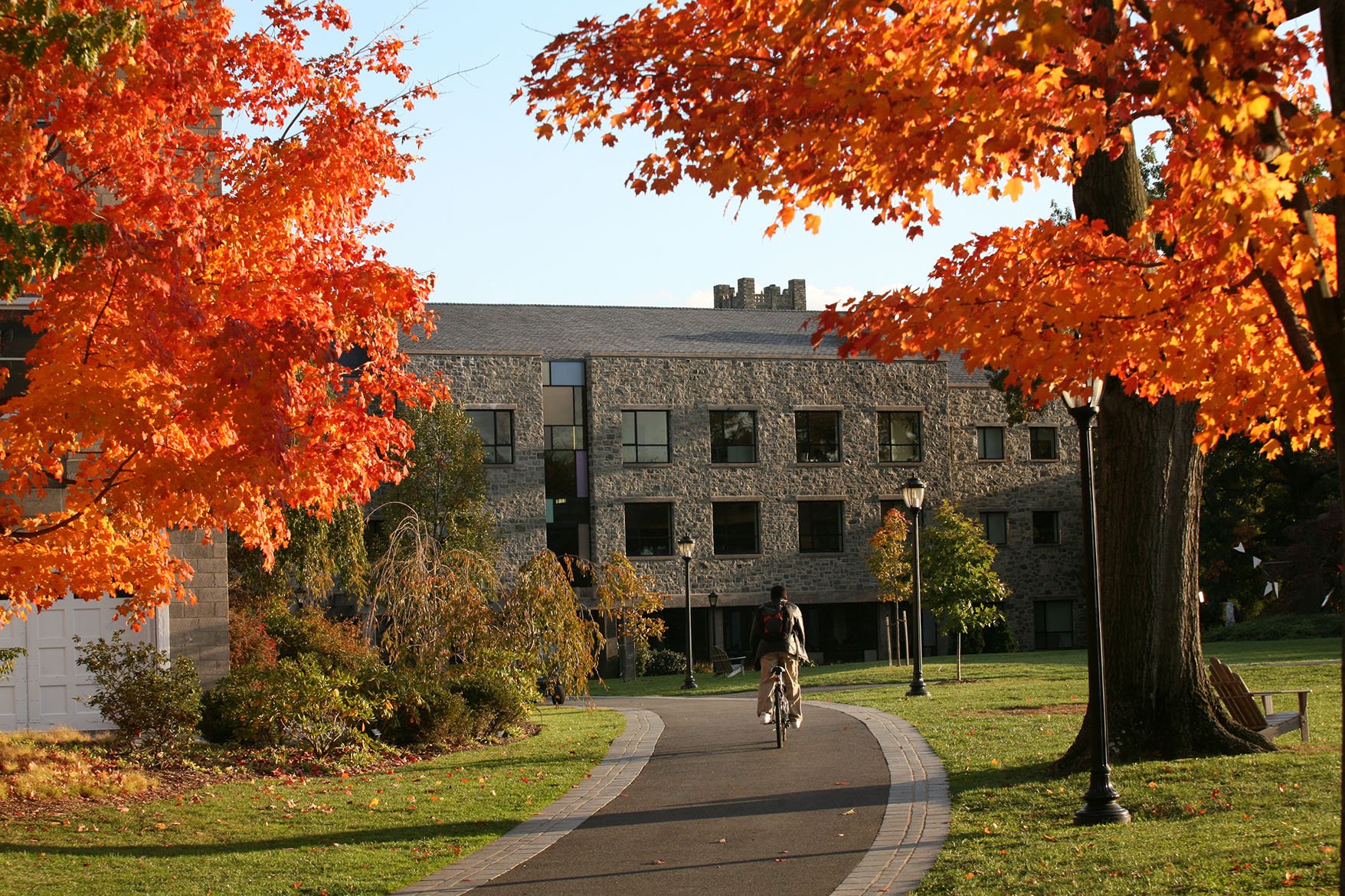
The garden walkway outside Trotter.
My favorite French periodicals are "Libération" (newspaper) and "Cahiers du Cinéma" (film magazine). |
|